The association between white matter hyperintensities and suicide attempts in affective disorders: a systematic review and meta-analysis
Systematic review and meta-analysisMixed results
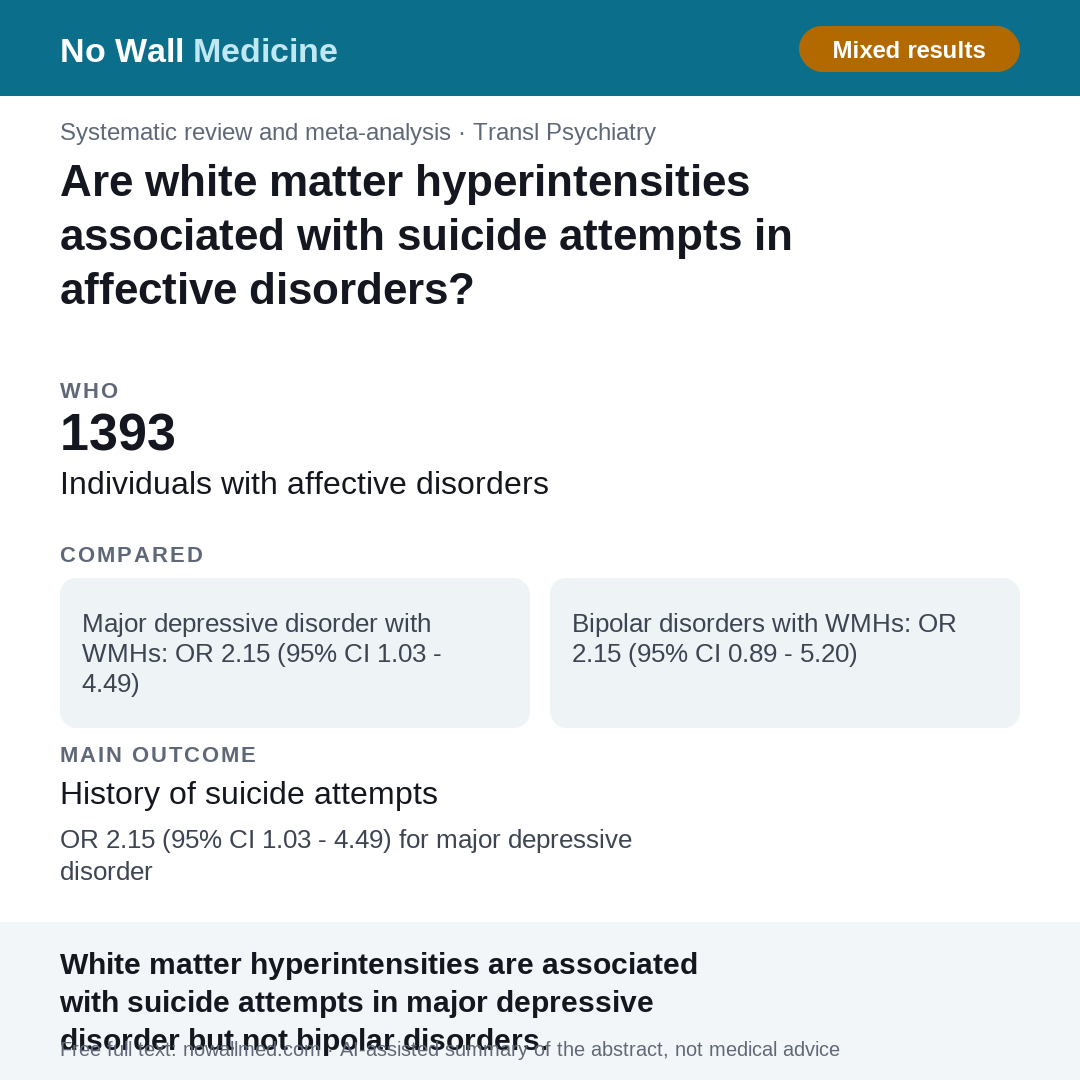
Are white matter hyperintensities associated with suicide attempts in affective disorders?
Who
1393
Individuals with affective disorders
Compared
Major depressive disorder with WMHs: OR 2.15 (95% CI 1.03 - 4.49)
Bipolar disorders with WMHs: OR 2.15 (95% CI 0.89 - 5.20)
Main outcome
History of suicide attempts
Result: OR 2.15 (95% CI 1.03 - 4.49) for major depressive disorder
Bottom line: White matter hyperintensities are associated with suicide attempts in major depressive disorder but not bipolar disorders.
Limitation: Small number of studies, heterogeneity in lesion rating systems, and lack of severity data.
Transl Psychiatry · 2025-10-17Download image
Clinical question: Are white matter hyperintensities associated with suicide attempts in affective disorders?
Abstract
A growing body of literature examines the neurobiological bases of suicidal behaviors, including the potential relationship between white matter hyperintensities (WMHs) and a history of suicide attempts in patients with affective disorders. We aimed to synthesize these studies, evaluate their quality, and provide recommendations for future research. We conducted a comprehensive literature search using three approaches: (i) search across PubMed, PsycINFO, Scopus, and Web of Science until October 2024; (ii) screening of previous reviews and meta-analyses; and (iii) citation mining of the included studies. The PRISMA guidelines were followed, and a random-effects meta-analysis was performed to calculate pooled Odds Ratios (OR). Sixteen studies were included in the systematic review, involving 1393 participants. Of these, 8 were also included in the meta-analysis. The main analyses revealed an association between WMHs (either deep or periventricular hyperintensities), and a history of suicide attempts in individuals with major depressive disorder (OR = 2.15, 95% confidence interval (CI) 1.03 - 4.49) and bipolar disorders (OR = 2.15, 95% CI 0.89 - 5.20). The main limitations concern the small number of studies, the degree of heterogeneity among the lesion rating systems adopted, and the lack of data on the severity of WMHs. Also, only some of the studies controlled for key confounding variables that may influence results. Overall, we found that individuals with affective disorders who had WMHs, particularly periventricular rather than deep white matter hyperintensities, were more likely to have attempted suicide in their lifetime, suggesting a potential role as neurobiological markers for suicide attempts.
Topics
Cite this article
Torino G, Maggioni E, Lengvenyte A, Brambilla P, Delvecchio G. The association between white matter hyperintensities and suicide attempts in affective disorders: a systematic review and meta-analysis. Transl Psychiatry. 2025. doi:10.1038/s41398-025-03626-7
Spotted a mistake? Suggest a correction