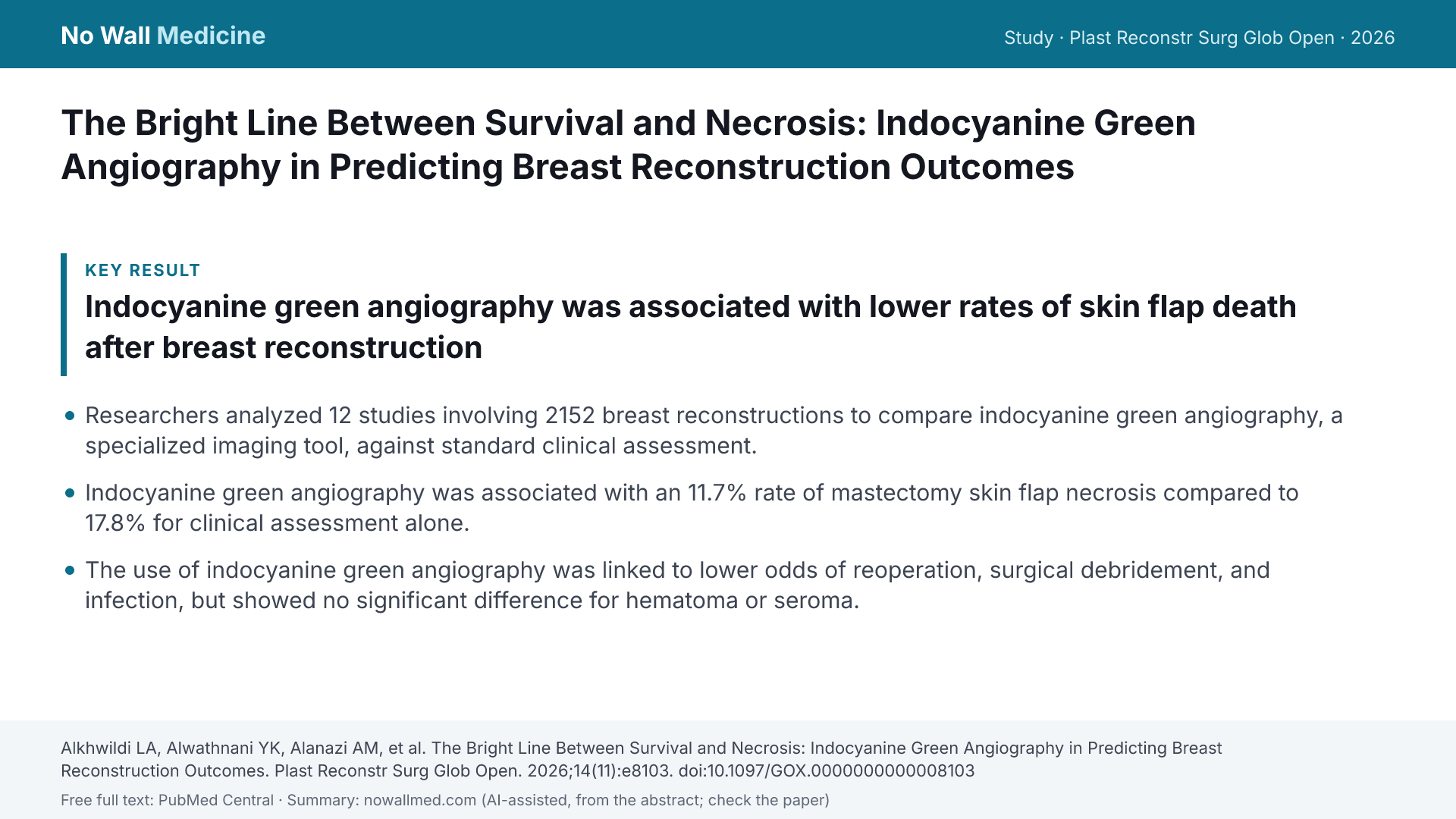
Indocyanine green angiography was associated with lower rates of skin flap death after breast reconstruction
The Bright Line Between Survival and Necrosis: Indocyanine Green Angiography in Predicting Breast Reconstruction Outcomes
Why it matters: Traditional clinical assessments of whether skin tissue will survive after breast reconstruction are often subjective.
Key points
- Researchers analyzed 12 studies involving 2152 breast reconstructions to compare indocyanine green angiography, a specialized imaging tool, against standard clinical assessment.
- Indocyanine green angiography was associated with an 11.7% rate of mastectomy skin flap necrosis compared to 17.8% for clinical assessment alone.
- The use of indocyanine green angiography was linked to lower odds of reoperation, surgical debridement, and infection, but showed no significant difference for hematoma or seroma.
Study type: Observational study: it can show a link, but not prove that one thing causes another.
Headline and key points written with AI from the paper’s abstract, with every number checked against it. Read the paper before relying on them.
Was this summary helpful?
Headline, design, result, key points, caveat and citation as plain text.
Cite this article
Alkhwildi LA, Alwathnani YK, Alanazi AM, et al. The Bright Line Between Survival and Necrosis: Indocyanine Green Angiography in Predicting Breast Reconstruction Outcomes. Plast Reconstr Surg Glob Open. 2026;14(11):e8103. doi:10.1097/GOX.0000000000008103
Spotted a mistake? Suggest a correction