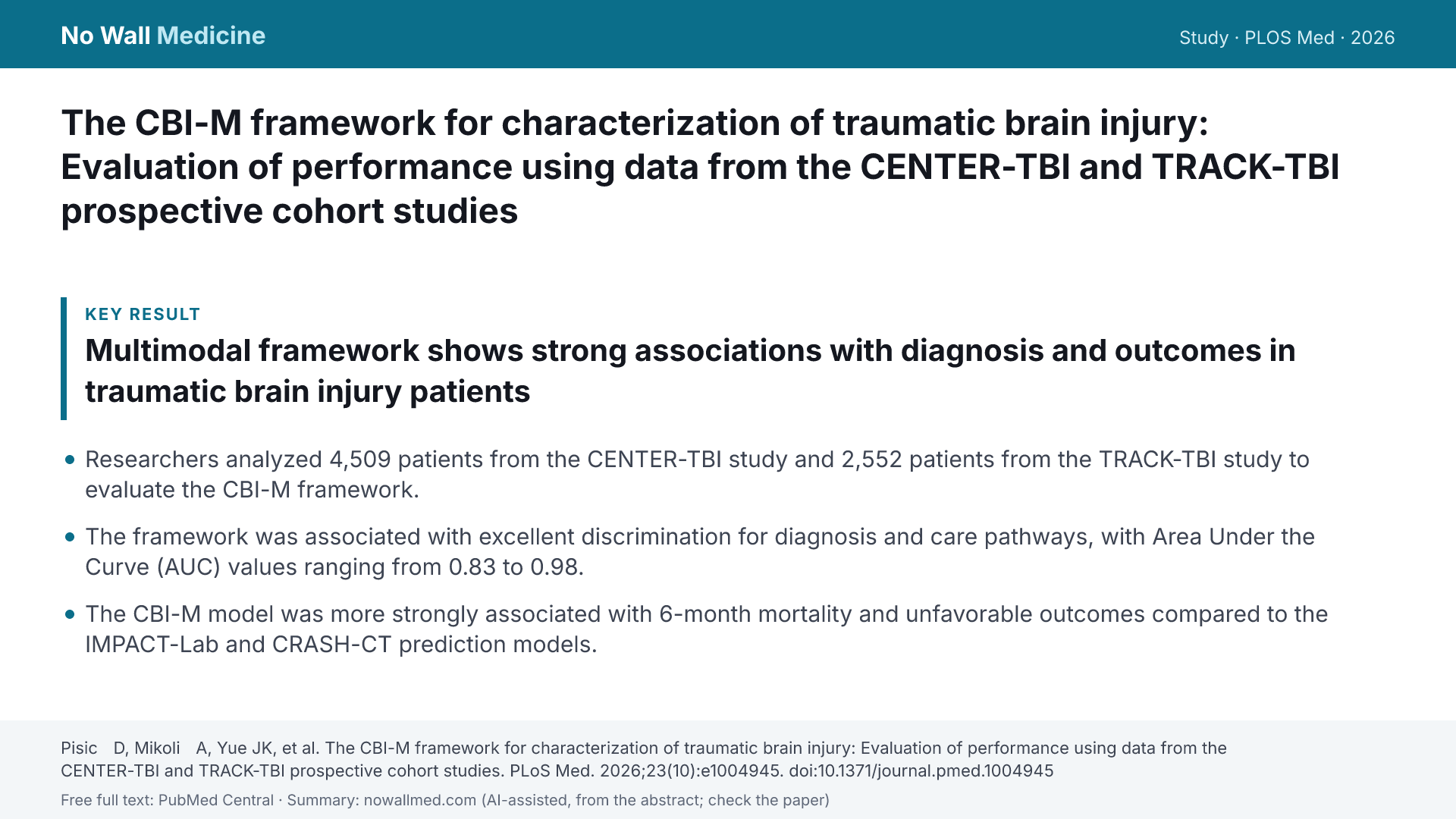
The CBI-M framework for characterization of traumatic brain injury: Evaluation of performance using data from the CENTER-TBI and TRACK-TBI prospective cohort studies
Key result: Multimodal framework shows strong associations with diagnosis and outcomes in traumatic brain injury patients
Key points
- Researchers analyzed 4,509 patients from the CENTER-TBI study and 2,552 patients from the TRACK-TBI study to evaluate the CBI-M framework.
- The framework was associated with excellent discrimination for diagnosis and care pathways, with Area Under the Curve (AUC) values ranging from 0.83 to 0.98.
- The CBI-M model was more strongly associated with 6-month mortality and unfavorable outcomes compared to the IMPACT-Lab and CRASH-CT prediction models.
Limitation the authors note: The authors state the study was restricted to high-income settings, lacked three elements of the modifier pillar, and carried a risk of possible reverse causality.
Discussion prompts
- Would these patients look like yours? Who was left out?
- Is the main outcome one that matters to patients?
- Is the difference large enough to change what you do?
Cite: Pisică D, Mikolić A, Yue JK, et al. The CBI-M framework for characterization of traumatic brain injury: Evaluation of performance using data from the CENTER-TBI and TRACK-TBI prospective cohort studies. PLoS Med. 2026;23(10):e1004945. doi:10.1371/journal.pmed.1004945
Free full text: PubMed Central · Summary and visual abstract: nowallmed.com/a/the-cbi-m-framework-for-characterization-of-traumatic-brain-injury-1tp37rj/ (AI-assisted from the abstract; check the paper before relying on it).