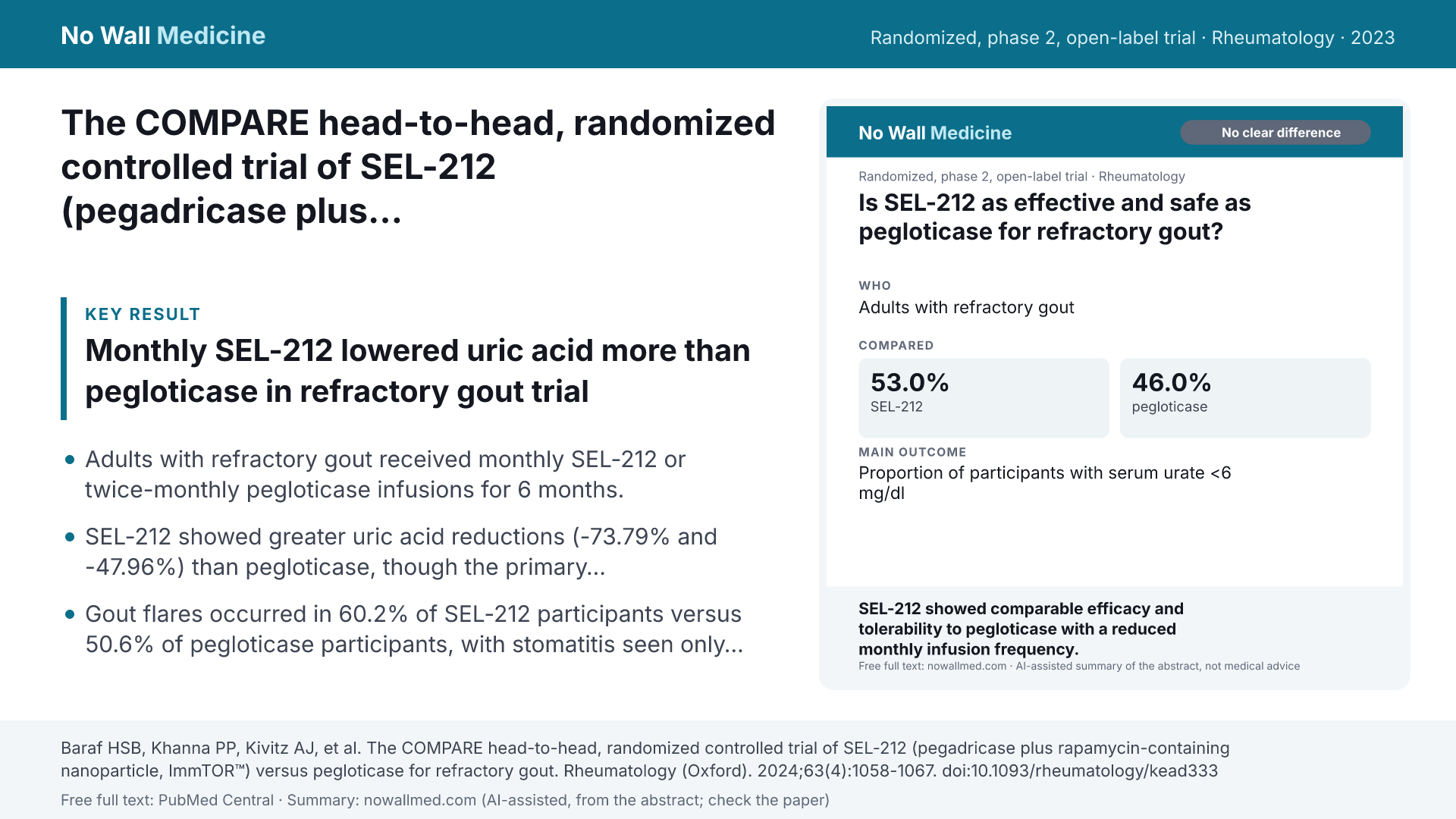
The COMPARE head-to-head, randomized controlled trial of SEL-212 (pegadricase plus rapamycin-containing nanoparticle, ImmTOR™) versus pegloticase for refractory gout
Key result: Monthly SEL-212 lowered uric acid more than pegloticase in refractory gout trial
Key points
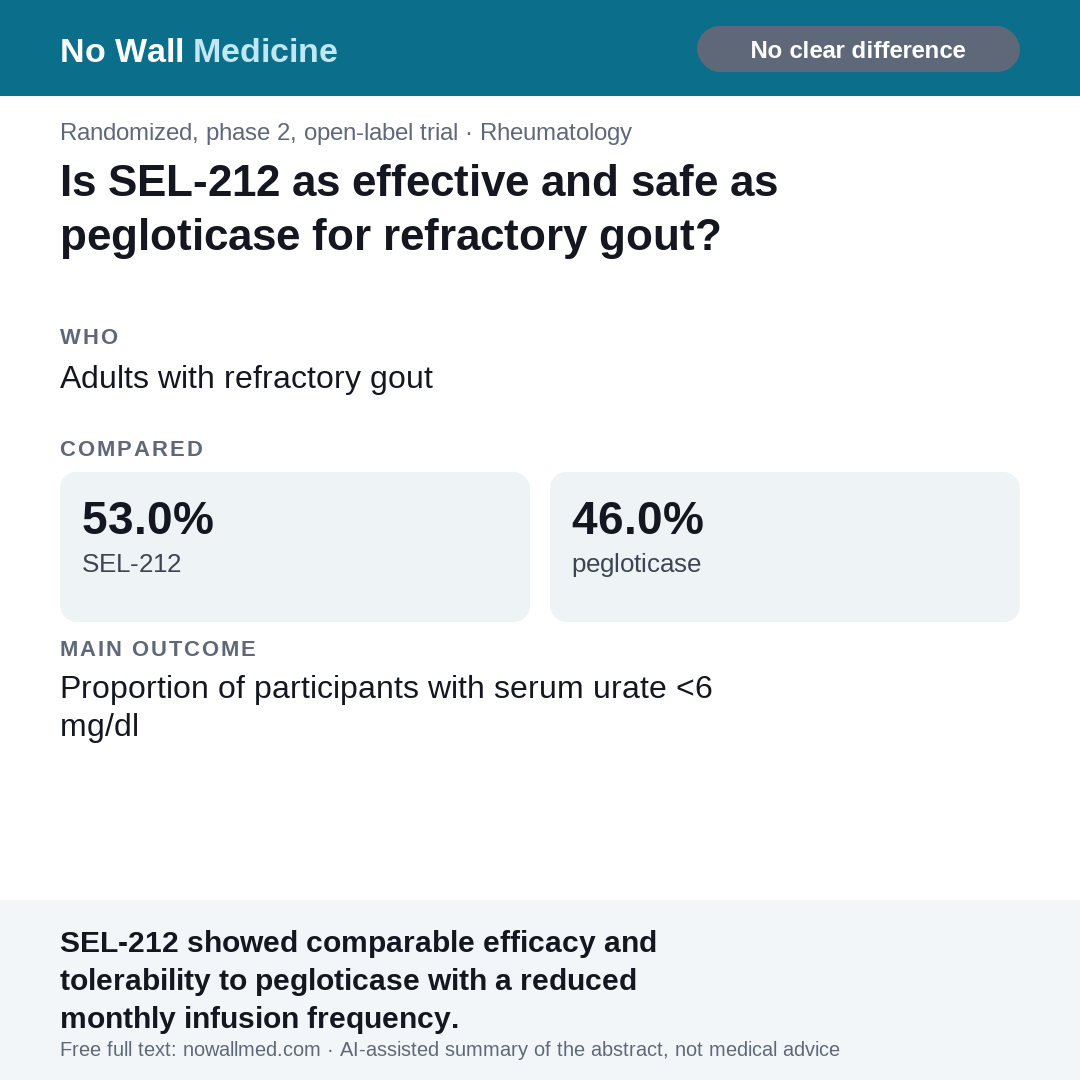
- Adults with refractory gout received monthly SEL-212 or twice-monthly pegloticase infusions for 6 months.
- SEL-212 showed greater uric acid reductions (-73.79% and -47.96%) than pegloticase, though the primary endpoint difference was not significant.
- Gout flares occurred in 60.2% of SEL-212 participants versus 50.6% of pegloticase participants, with stomatitis seen only in the SEL-212 group.
Why it matters: Pegloticase requires frequent infusions and causes antibodies, so researchers tested if a monthly combination therapy could lower uric acid with less burden.
Discussion prompts
- Would these patients look like yours? Who was left out?
- Is the main outcome one that matters to patients?
- Is the difference large enough to change what you do?
Cite: Baraf HSB, Khanna PP, Kivitz AJ, et al. The COMPARE head-to-head, randomized controlled trial of SEL-212 (pegadricase plus rapamycin-containing nanoparticle, ImmTOR™) versus pegloticase for refractory gout. Rheumatology. 2023. doi:10.1093/rheumatology/kead333
Free full text: PubMed Central · Summary and visual abstract: nowallmed.com/a/the-compare-head-to-head-randomized-controlled-trial-of-sel-212-wpm3ex/ (AI-assisted from the abstract; check the paper before relying on it).