Alternative second-line strategies showed higher response rates than increasing antidepressant doses in major depression
The DEPRE'5 study: pragmatic, multicentre, five-arm, parallel-group randomised controlled trial with blinded assessment to compare treatment strategies in major depression after a failed selective serotonin reuptake inhibitor treatment
Five-arm, parallel-group randomised controlled trialBenefit found
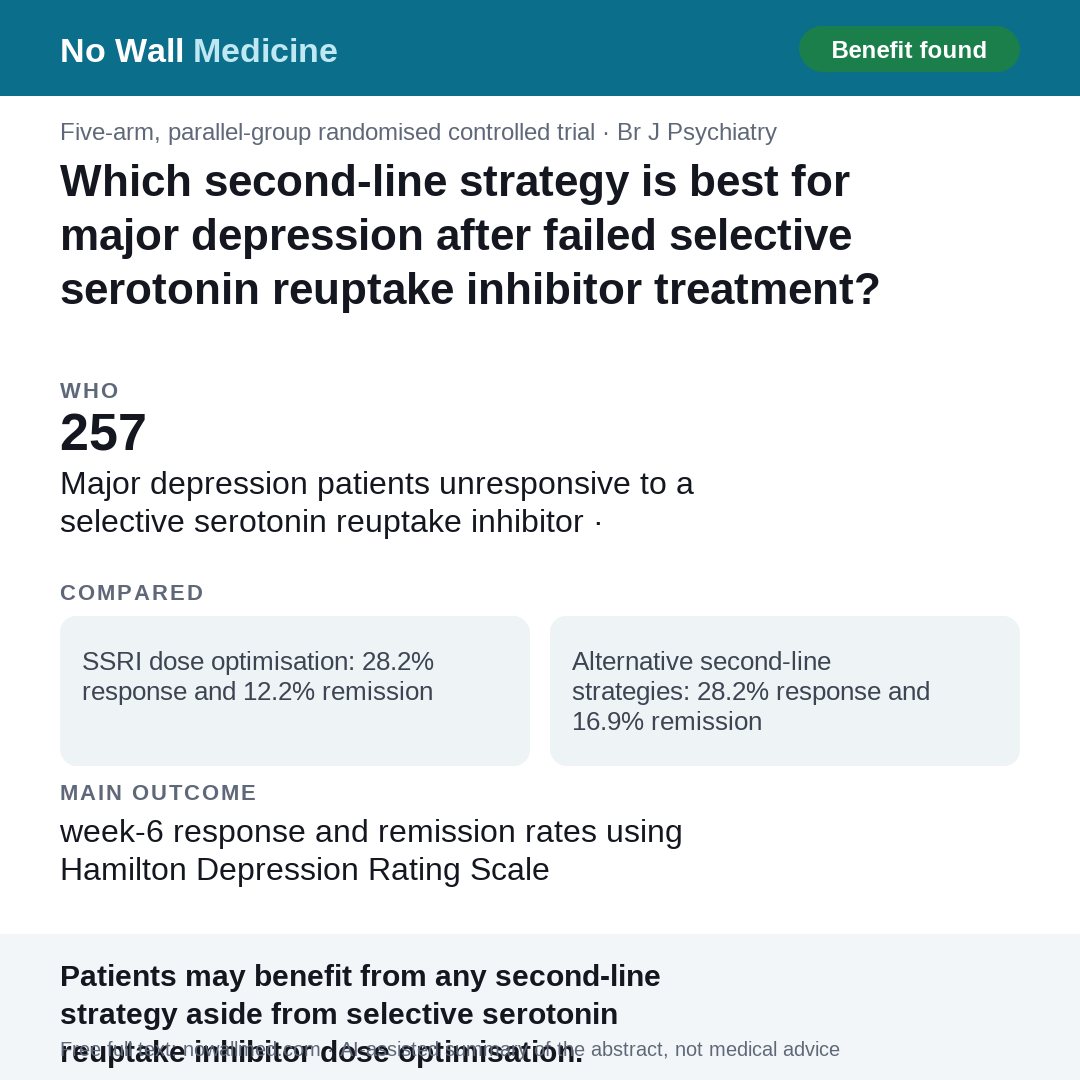
Which second-line strategy is best for major depression after failed selective serotonin reuptake inhibitor treatment?
Who
257
Major depression patients unresponsive to a selective serotonin reuptake inhibitor · multicentre
Compared
SSRI dose optimisation: 28.2% response and 12.2% remission
Alternative second-line strategies: 28.2% response and 16.9% remission
Main outcome
week-6 response and remission rates using Hamilton Depression Rating Scale
Result: odds ratio = 2.36 (95% CI 1.0-5.6)
Bottom line: Patients may benefit from any second-line strategy aside from selective serotonin reuptake inhibitor dose optimisation.
Limitation: limited statistical power
Br J Psychiatry · 2025-06-18Download image
Clinical question: Which second-line strategy is best for major depression after failed selective serotonin reuptake inhibitor treatment?
Why it matters: Clinicians need to know which second-line treatment strategies are most effective for patients who do not respond to initial selective serotonin reuptake inhibitor treatment.
Key points
- Researchers studied 257 participants with major depressive disorder who did not respond to selective serotonin reuptake inhibitors, comparing dose optimization against four other treatment strategies.
- Alternative strategies led to higher response rates of 28.2% compared to 14.3% for dose optimization, though remission rates showed no statistically significant difference.
- The group receiving problem-solving therapy reported the fewest adverse effects, while the group adding nortriptyline experienced the most at 75% compared to 28.1%.
Limitation the authors note: The study had limited statistical power.
Headline and key points written with AI from the paper’s abstract, with every number checked against it. Read the paper before relying on them.
Topics
Cite this article
Pérez V, Puigdemont D, de Diego-Adeliño J, Elices M, Leal I, Cabello M. The DEPRE'5 study: pragmatic, multicentre, five-arm, parallel-group randomised controlled trial with blinded assessment to compare treatment strategies in major depression after a failed selective serotonin reuptake inhibitor treatment. Br J Psychiatry. 2025. doi:10.1192/bjp.2025.13
Spotted a mistake? Suggest a correction