Wearable digital technology shows 0.88 pooled accuracy for detecting the fertility window and ovulation
The diagnostic accuracy of wearable digital technology in detecting fertility window and menstrual cycles: a systematic review and Bayesian network meta-analysis
Systematic review and Bayesian network meta-analysisBenefit found
What is the diagnostic accuracy of wearable digital technology for monitoring fertility windows?
Who
Women monitoring fertility windows and menstrual cycles
Compared
Wearable digital technology: pooled accuracy of 0.88 (95% CI: 0.86-0.90)
Conventional methods
Main outcome
Diagnostic accuracy of wearable digital technology
Result: pooled accuracy 0.88 (95% CI: 0.86-0.90)
Bottom line: Wearable digital technology shows promise for tracking fertility windows and optimizing pregnancy planning.
NPJ Digit Med · 2026-01-24Download image
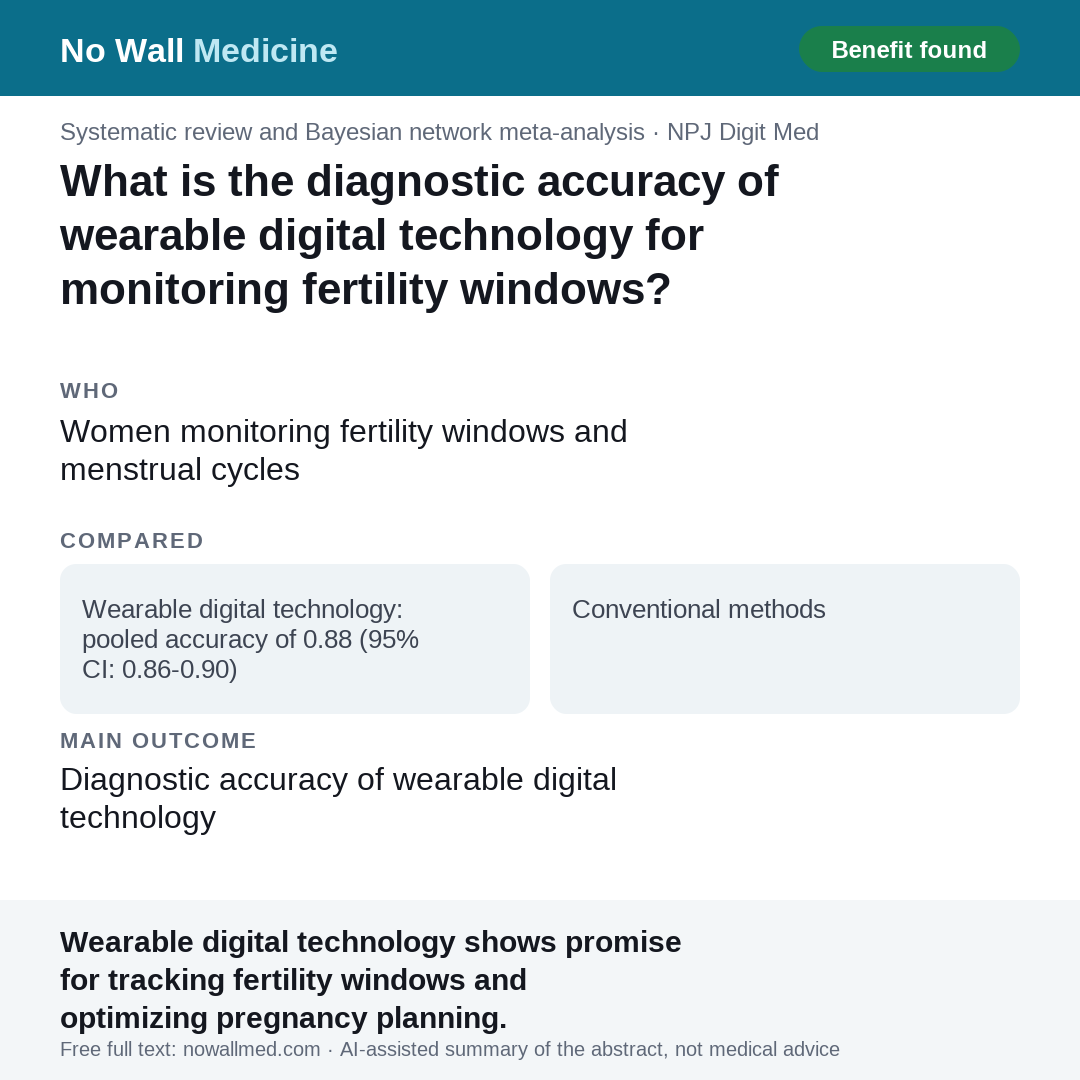
Clinical question: What is the diagnostic accuracy of wearable digital technology for monitoring fertility windows?
Why it matters: There is a need to evaluate how accurately wearable digital technology can monitor women's reproductive health and fertility windows compared to traditional methods.
Key points
- Researchers analyzed 27 studies from 8 databases to evaluate how well wearable digital technology tracks menstrual cycles and ovulation compared to conventional methods.
- The technology showed a pooled accuracy of 0.88, with a sensitivity of 0.79 and a specificity of 0.80.
- Ring-type devices and the use of multiple physiological parameters or random forest algorithms improved the efficiency of detecting the fertility window.
Headline and key points written with AI from the paper’s abstract, with every number checked against it. Read the paper before relying on them.
Was this summary helpful?
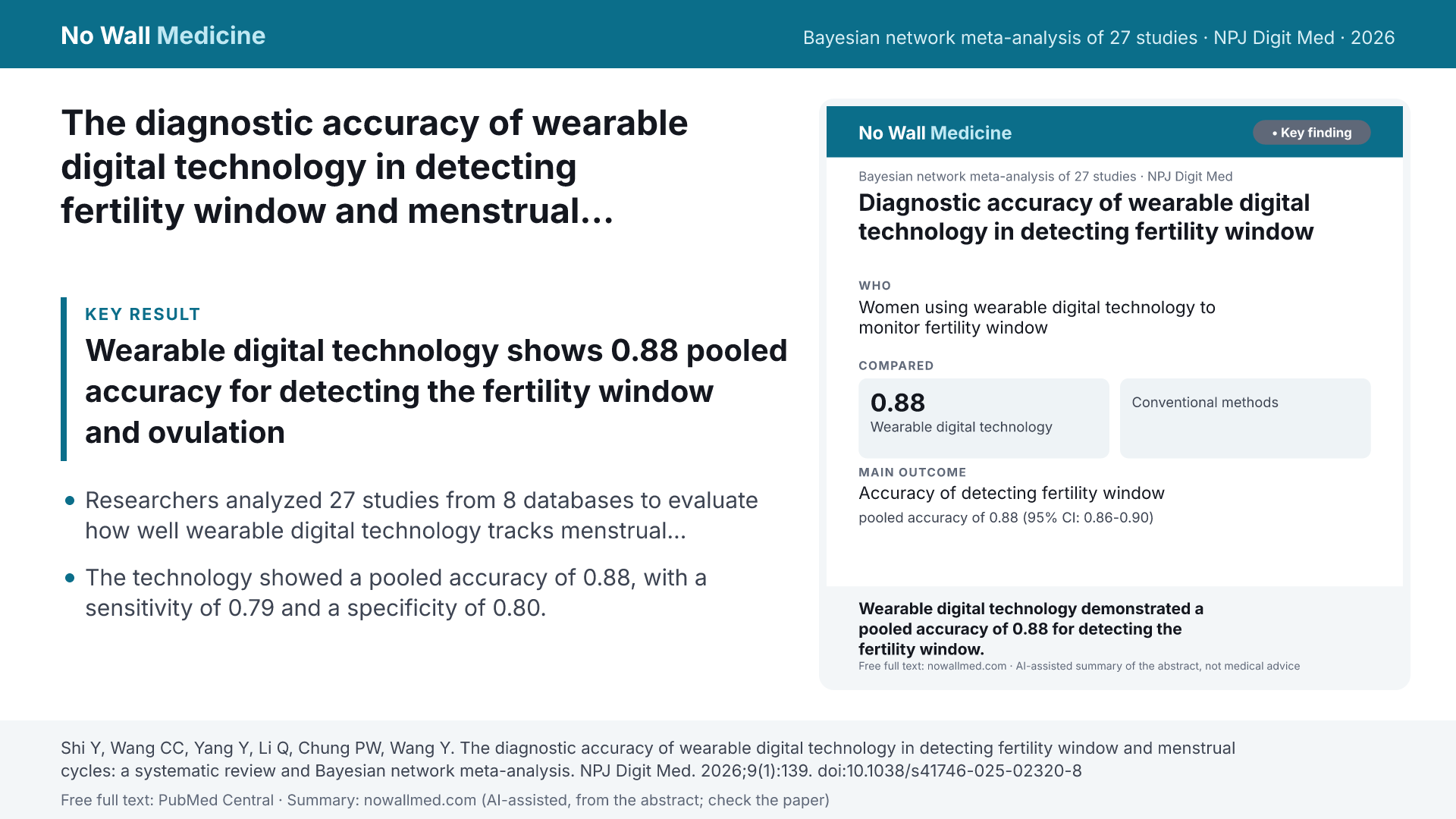
Cite this article
Shi Y, Wang CC, Yang Y, Li Q, Chung PW, Wang Y. The diagnostic accuracy of wearable digital technology in detecting fertility window and menstrual cycles: a systematic review and Bayesian network meta-analysis. NPJ Digit Med. 2026. doi:10.1038/s41746-025-02320-8
Spotted a mistake? Suggest a correction