The diagnostic and prognostic capability of artificial intelligence in spinal cord injury: A systematic review
Systematic reviewMixed results
What is the diagnostic and prognostic capability of artificial intelligence in traumatic spinal cord injury?
Who
280,817
Patients with traumatic spinal cord injury
Compared
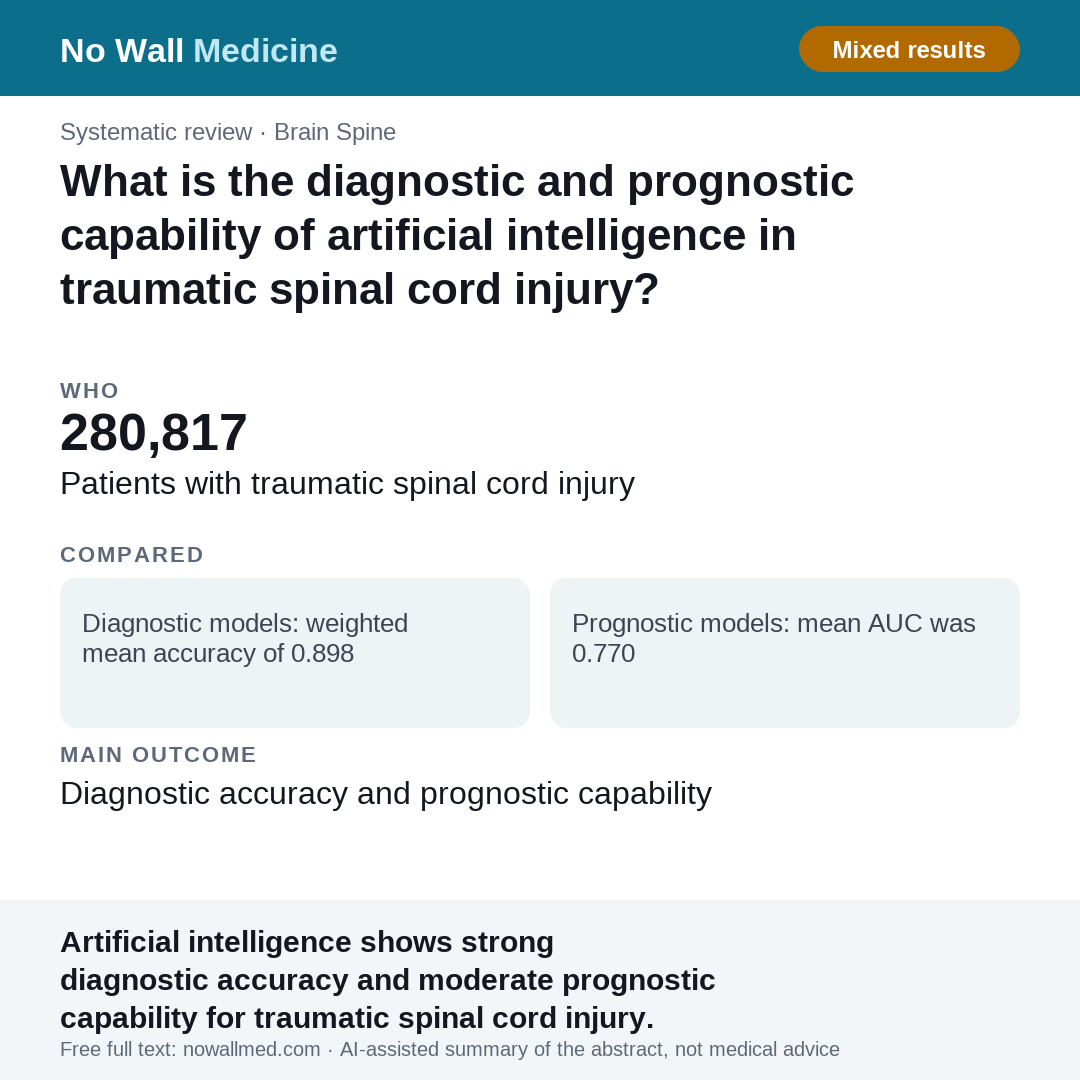
Diagnostic models: weighted mean accuracy of 0.898
Prognostic models: mean AUC was 0.770
Main outcome
Diagnostic accuracy and prognostic capability
Bottom line: Artificial intelligence shows strong diagnostic accuracy and moderate prognostic capability for traumatic spinal cord injury.
Limitation: Lack of standardised frameworks and external validation limits clinical applicability.
Brain Spine · 2025-02-05Download image
Clinical question: What is the diagnostic and prognostic capability of artificial intelligence in traumatic spinal cord injury?
Abstract
Background
Artificial intelligence (AI) models have shown potential for diagnosing and prognosticating traumatic spinal cord injury (tSCI), but their clinical utility remains uncertain. Method
ology: The primary aim was to evaluate the performance of AI algorithms in diagnosing and prognosticating tSCI. Subsequent systematic searching of seven databases identified studies evaluating AI models. PROBAST and TRIPOD tools were used to assess the quality and reporting of included studies (PROSPERO: CRD42023464722). Fourteen studies, comprising 20 models and 280,817 pooled imaging datasets, were included. Analysis was conducted in line with the SWiM guidelines. Results
For prognostication, 11 studies predicted outcomes including AIS improvement (30%), mortality and ambulatory ability (20% each), and discharge or length of stay (10%). The mean AUC was 0.770 (range: 0.682-0.902), indicating moderate predictive performance. Diagnostic models utilising DTI, CT, and T2-weighted MRI with CNN-based segmentation achieved a weighted mean accuracy of 0.898 (range: 0.813-0.938), outperforming prognostic models. Conclusion
AI demonstrates strong diagnostic accuracy (mean accuracy: 0.898) and moderate prognostic capability (mean AUC: 0.770) for tSCI. However, the lack of standardised frameworks and external validation limits clinical applicability. Future models should integrate multimodal data, including imaging, patient characteristics, and clinician judgment, to improve utility and alignment with clinical practice.
Cite this article
Gill SS, Ponniah HS, Giersztein S, Anantharaj RM, Namireddy SR, Killilea J. The diagnostic and prognostic capability of artificial intelligence in spinal cord injury: A systematic review. Brain Spine. 2025. doi:10.1016/j.bas.2025.104208
Spotted a mistake? Suggest a correction
Top studies every Monday
The week’s key trials and guidelines in your specialties, by email. Free.
Get the weekly digest