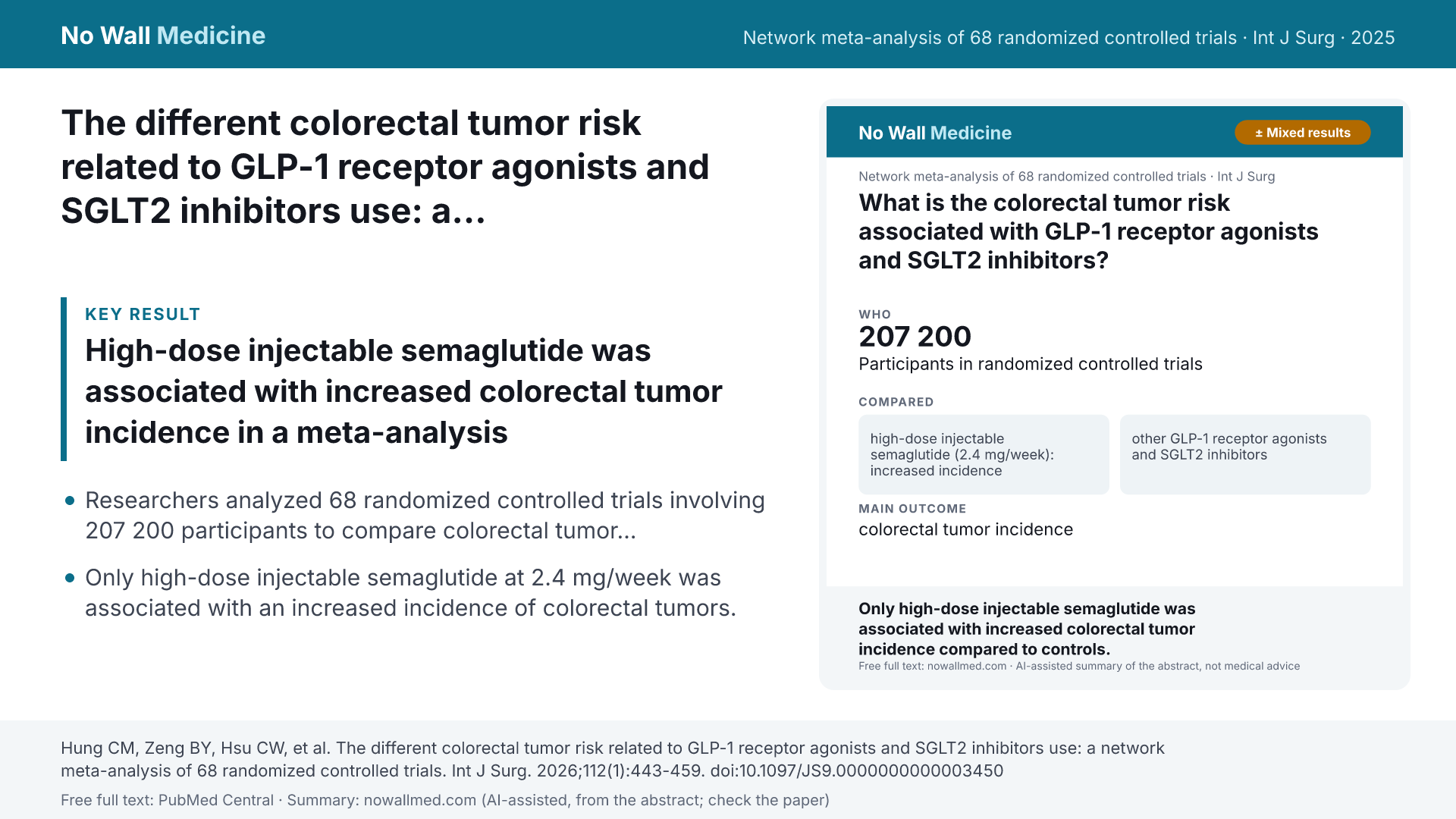
High-dose injectable semaglutide was associated with increased colorectal tumor incidence in a meta-analysis
The different colorectal tumor risk related to GLP-1 receptor agonists and SGLT2 inhibitors use: a network meta-analysis of 68 randomized controlled trials
Network meta-analysis of 68 randomized controlled trialsMixed results
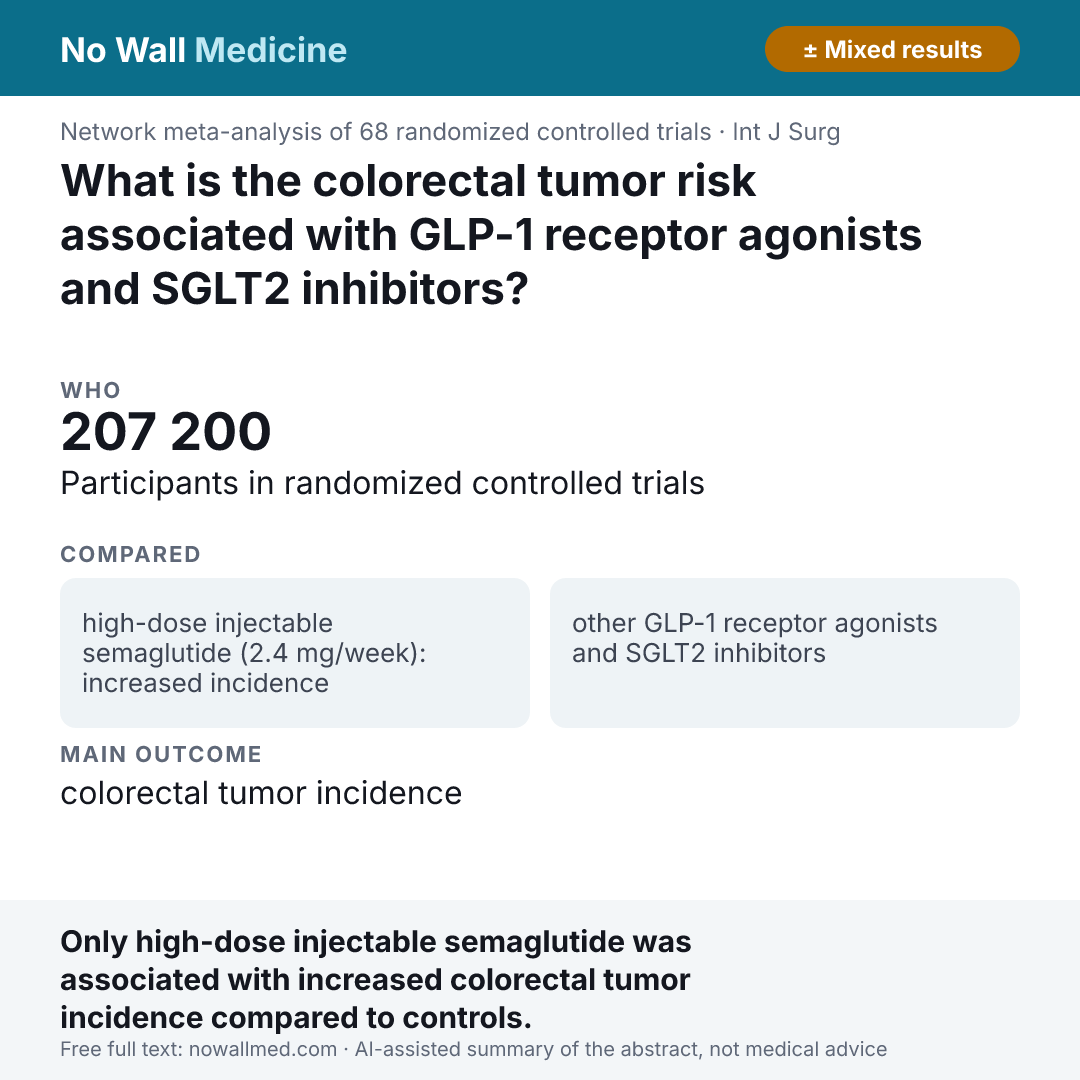
What is the colorectal tumor risk associated with GLP-1 receptor agonists and SGLT2 inhibitors?
Who
207 200
Participants in randomized controlled trials
Compared
high-dose injectable semaglutide (2.4 mg/week): increased incidence
other GLP-1 receptor agonists and SGLT2 inhibitors
Main outcome
colorectal tumor incidence
Bottom line: Only high-dose injectable semaglutide was associated with increased colorectal tumor incidence compared to controls.
Limitation: Findings represent a potential risk signal that requires further validation.
Int J Surg · 2025-09-11 · Save PNG
Clinical question: What is the colorectal tumor risk associated with GLP-1 receptor agonists and SGLT2 inhibitors?
Why it matters: Existing evidence regarding the association between glucagon-like peptide-1 receptor agonists, sodium-glucose cotransporter 2 inhibitors, and gastrointestinal malignancies remains inconsistent.
Key points
- Researchers analyzed 68 randomized controlled trials involving 207 200 participants to compare colorectal tumor incidence between different diabetes medications and controls.
- Only high-dose injectable semaglutide at 2.4 mg/week was associated with an increased incidence of colorectal tumors.
- No other glucagon-like peptide-1 receptor agonists or sodium-glucose cotransporter 2 inhibitors showed significant associations with colorectal tumor development.
Headline and key points written with AI from the paper’s abstract, with every number checked against it. Read the paper before relying on them.
Was this summary helpful?
Subject terms
Headline, design, result, key points, caveat and citation as plain text.
Cite this article
Hung CM, Zeng BY, Hsu CW, et al. The different colorectal tumor risk related to GLP-1 receptor agonists and SGLT2 inhibitors use: a network meta-analysis of 68 randomized controlled trials. Int J Surg. 2026;112(1):443-459. doi:10.1097/JS9.0000000000003450
Spotted a mistake? Suggest a correction