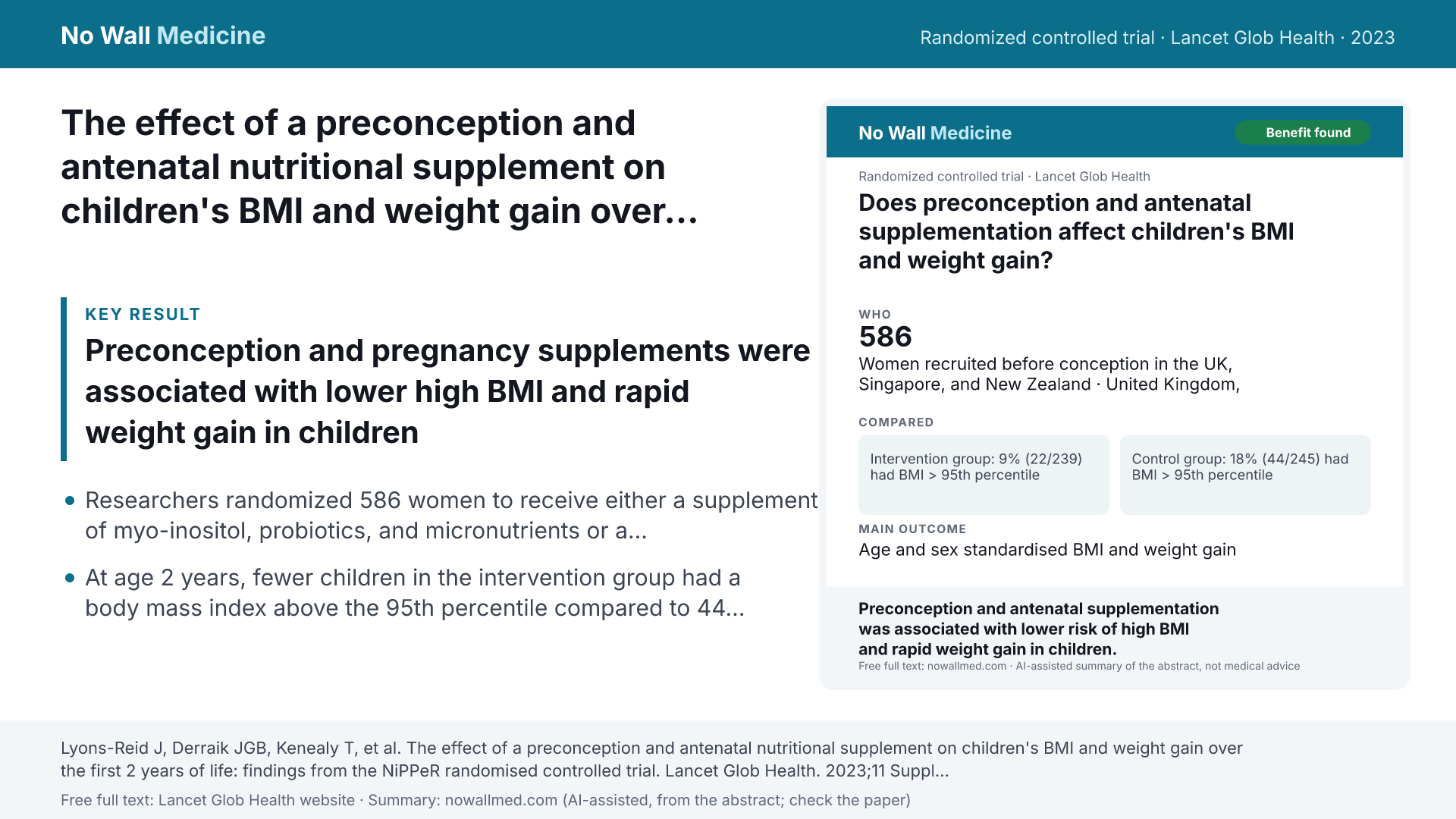
Preconception and pregnancy supplements were associated with lower high BMI and rapid weight gain in children
The effect of a preconception and antenatal nutritional supplement on children's BMI and weight gain over the first 2 years of life: findings from the NiPPeR randomised controlled trial
Randomized controlled trialBenefit found
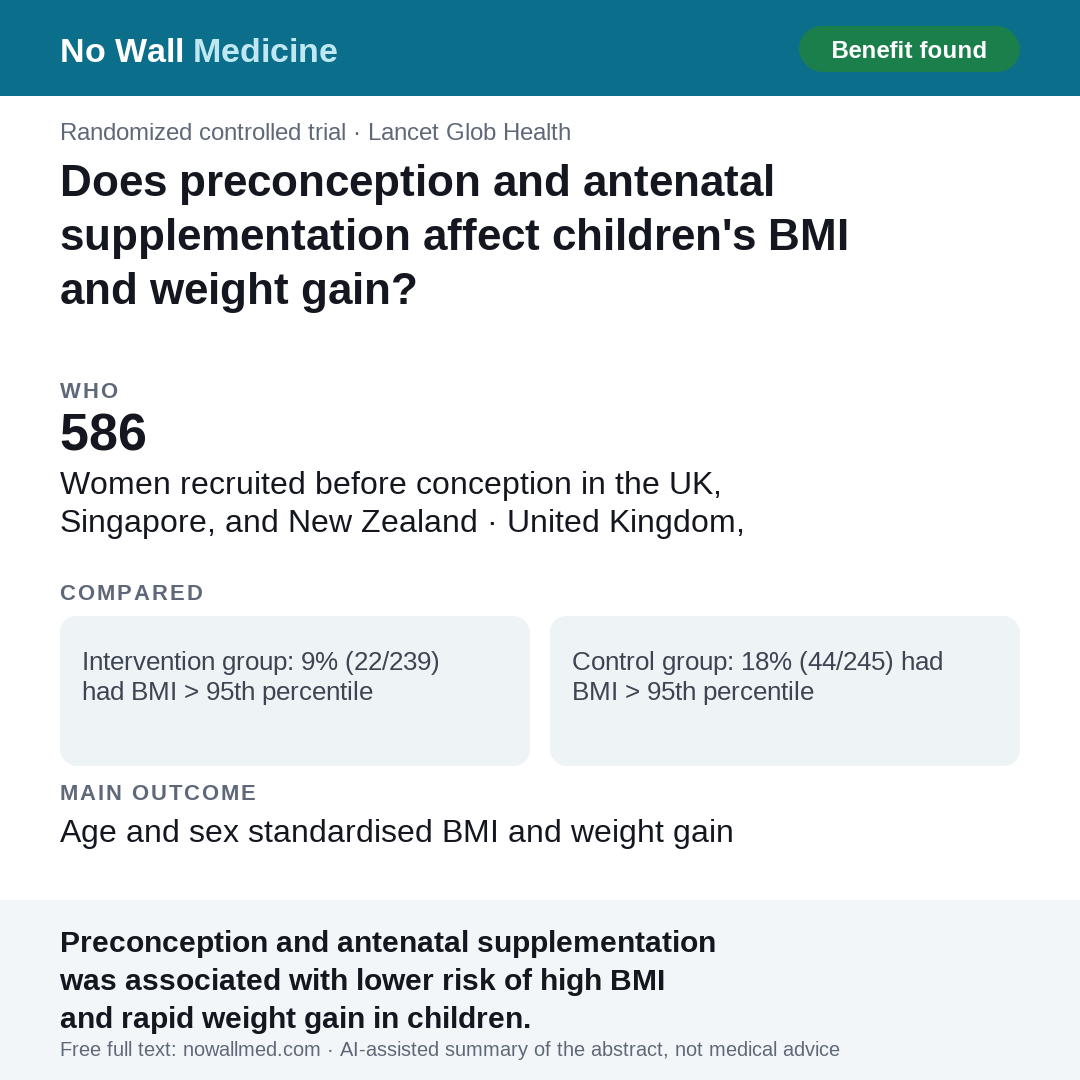
Does preconception and antenatal supplementation affect children's BMI and weight gain?
Who
586
Women recruited before conception in the UK, Singapore, and New Zealand · United Kingdom, Singapore, and New Zealand
Compared
Intervention group: 9% (22/239) had BMI > 95th percentile
Control group: 18% (44/245) had BMI > 95th percentile
Main outcome
Age and sex standardised BMI and weight gain
Result: adjusted risk ratio 0·51, 95% CI 0·31-0·82
Bottom line: Preconception and antenatal supplementation was associated with lower risk of high BMI and rapid weight gain in children.
Limitation: Long-term follow-up is required to assess the longevity of these benefits.
Funded by: National Institute for Health Research and others
Lancet Glob Health · 2023-03-03Download image
Clinical question: Does preconception and antenatal supplementation affect children's BMI and weight gain?
Why it matters: It is unknown whether nutritional interventions taken before and during pregnancy affect the body size and growth of children during their first 2 years of life.
Key points
- Researchers randomized 586 women to receive either a supplement of myo-inositol, probiotics, and micronutrients or a standard micronutrient supplement.
- At age 2 years, fewer children in the intervention group had a body mass index above the 95th percentile compared to 44 [18%] in the control group.
- The intervention was associated with a 24% reduced risk of rapid weight gain of more than 0.67 standard deviations in the first year of life.
Headline and key points written with AI from the paper’s abstract, with every number checked against it. Read the paper before relying on them.
Was this summary helpful?
Abstract
Background
Nutritional intervention before and throughout pregnancy might promote healthy infant weight gain; however, clinical evidence is scarce. Therefore, we examined whether preconception and antenatal supplementation would affect the body size and growth of children in the first 2 years of life. Methods
Women were recruited from the community before conception in the UK, Singapore, and New Zealand, and randomly allocated to either the intervention (myo-inositol, probiotics, and additional micronutrients) or control group (standard micronutrient supplement) with stratification by site and ethnicity. Measurements of weight and length were obtained from 576 children at multiple timepoints in the first 2 years of life. Differences in age and sex standardised BMI at age 2 years (WHO standards) and the change in weight from birth were examined. Written informed consent was obtained from the mothers, and ethics approval was granted by local committees. The NiPPeR trial was registered with ClinicalTrials.gov (NCT02509988) on July 16, 2015 (Universal Trial Number U1111-1171-8056). Findings
1729 women were recruited between Aug 3, 2015, and May 31, 2017. Of the women randomised, 586 had births at 24 weeks or more of gestation between April, 2016, and January, 2019. At age 2 years, adjusting for study site, infant sex, parity, maternal smoking, maternal prepregnancy BMI, and gestational age, fewer children of mothers who received the intervention had a BMI of more than the 95th percentile (22 [9%] of 239 vs 44 [18%] of 245, adjusted risk ratio 0·51, 95% CI 0·31-0·82, p=0·006). Longitudinal data revealed that the children of mothers who received the intervention had a 24% reduced risk of experiencing rapid weight gain of more than 0·67 SD in the first year of life (58 [21·9%] of 265 vs 80 [31·1%] of 257, adjusted risk ratio 0·76, 95% CI 0·58-1·00, p=0·047). Risk was likewise decreased for sustained weight gain of more than 1·34 SD in the first 2 years (19 [7·7%] of 246 vs 43 [17·1%] of 251, adjusted risk ratio 0·55, 95% CI 0·34-0·88, p=0·014). Interpretation
Rapid weight gain in infancy is associated with future adverse metabolic health. The intervention supplement taken before and throughout pregnancy was associated with lower risk of rapid weight gain and high BMI at age 2 years among children. Long-term follow-up is required to assess the longevity of these benefits. Funding
National Institute for Health Research; New Zealand Ministry of Business, Innovation and Employment; Société Des Produits Nestlé; UK Medical Research Council; Singapore National Research Foundation; National University of Singapore and the Agency of Science, Technology and Research; and Gravida.
Abstract reproduced under the article’s CC BY licence.
Subject terms
Cite this article
Lyons-Reid J, Derraik JGB, Kenealy T, et al. The effect of a preconception and antenatal nutritional supplement on children's BMI and weight gain over the first 2 years of life: findings from the NiPPeR randomised controlled trial. Lancet Glob Health. 2023. doi:10.1016/S2214-109X(23)00095-5
Spotted a mistake? Suggest a correction