Pressure support modalities do not improve treatment adherence compared to continuous positive airway pressure
The effect of bilevel ventilation or modified continuous positive airway pressure on treatment adherence in adults with obstructive sleep apnea: a systematic review and meta-analysis
Systematic review and meta-analysisNo clear difference
Does pressure support improve treatment adherence in adults with obstructive sleep apnea?
Who
1462
Adults with obstructive sleep apnea
Compared
Pressure support
Continuous positive airway pressure
Main outcome
Adherence
Result: mean difference 0.21 (95% CI -0.01 to 0.44) h/night
Bottom line: Pressure support yields similar adherence and residual apnoea-hypopnea index to continuous positive airway pressure.
Limitation: Certainty of evidence was very-low-to-moderate.
eClinicalMedicine · 2026-06-15Download image
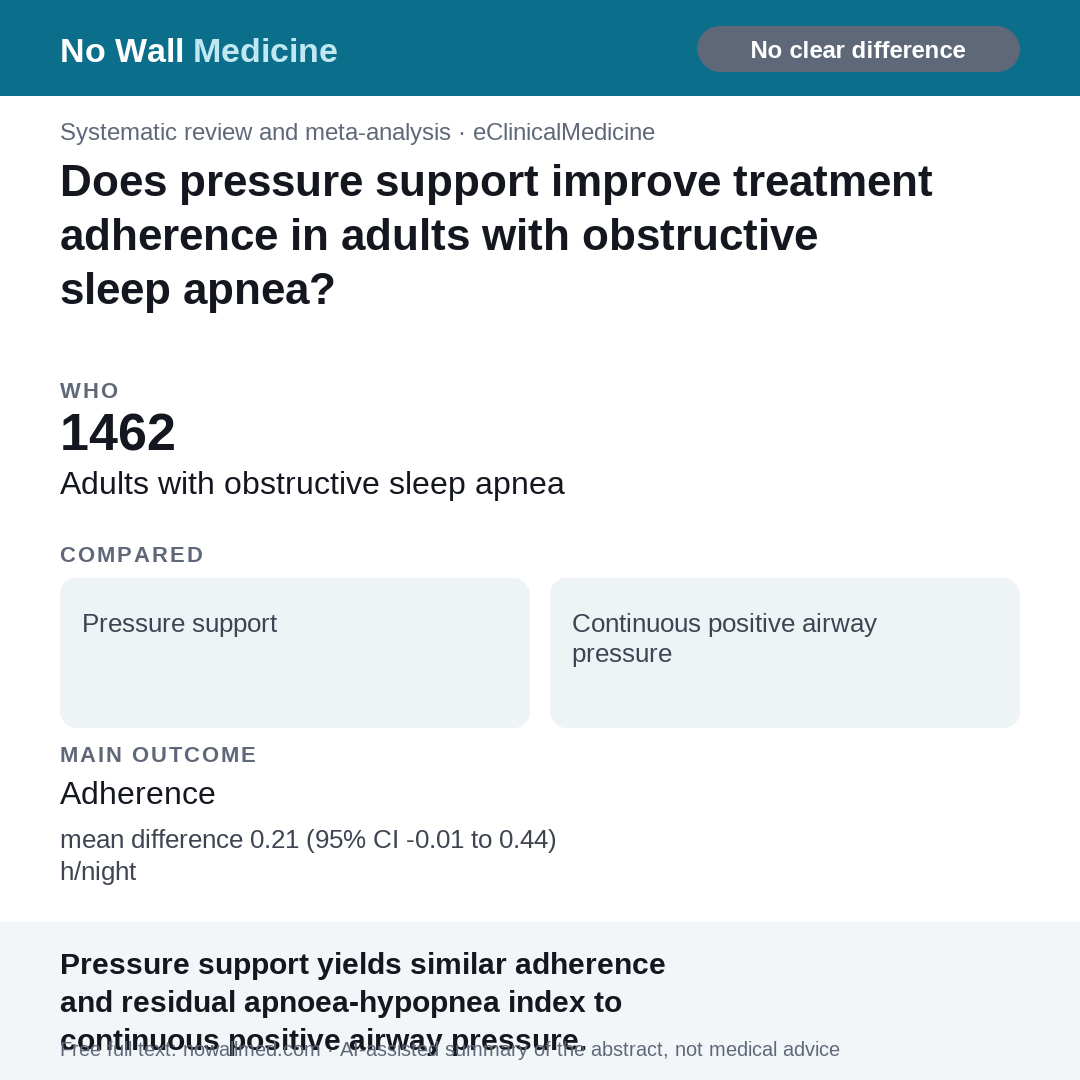
Clinical question: Does pressure support improve treatment adherence in adults with obstructive sleep apnea?
Why it matters: There is little evidence regarding whether adding pressure support to continuous positive airway pressure improves how well patients use their devices.
Key points
- Researchers analyzed twenty-one studies involving 1462 participants to compare pressure support against continuous positive airway pressure for obstructive sleep apnea.
- Pressure support did not significantly change adherence compared to continuous positive airway pressure with a mean difference of 0.21 [-0.01, 0.44] hours per night.
- While pressure support reduced air leaks, it showed no difference in Epworth Sleepiness Scale scores or residual apnea-hypopnea index results.
Limitation the authors note: The certainty of evidence for the results was rated as very-low-to-moderate.
Headline and key points written with AI from the paper’s abstract, with every number checked against it. Read the paper before relying on them.
Spotted a mistake? Suggest a correction