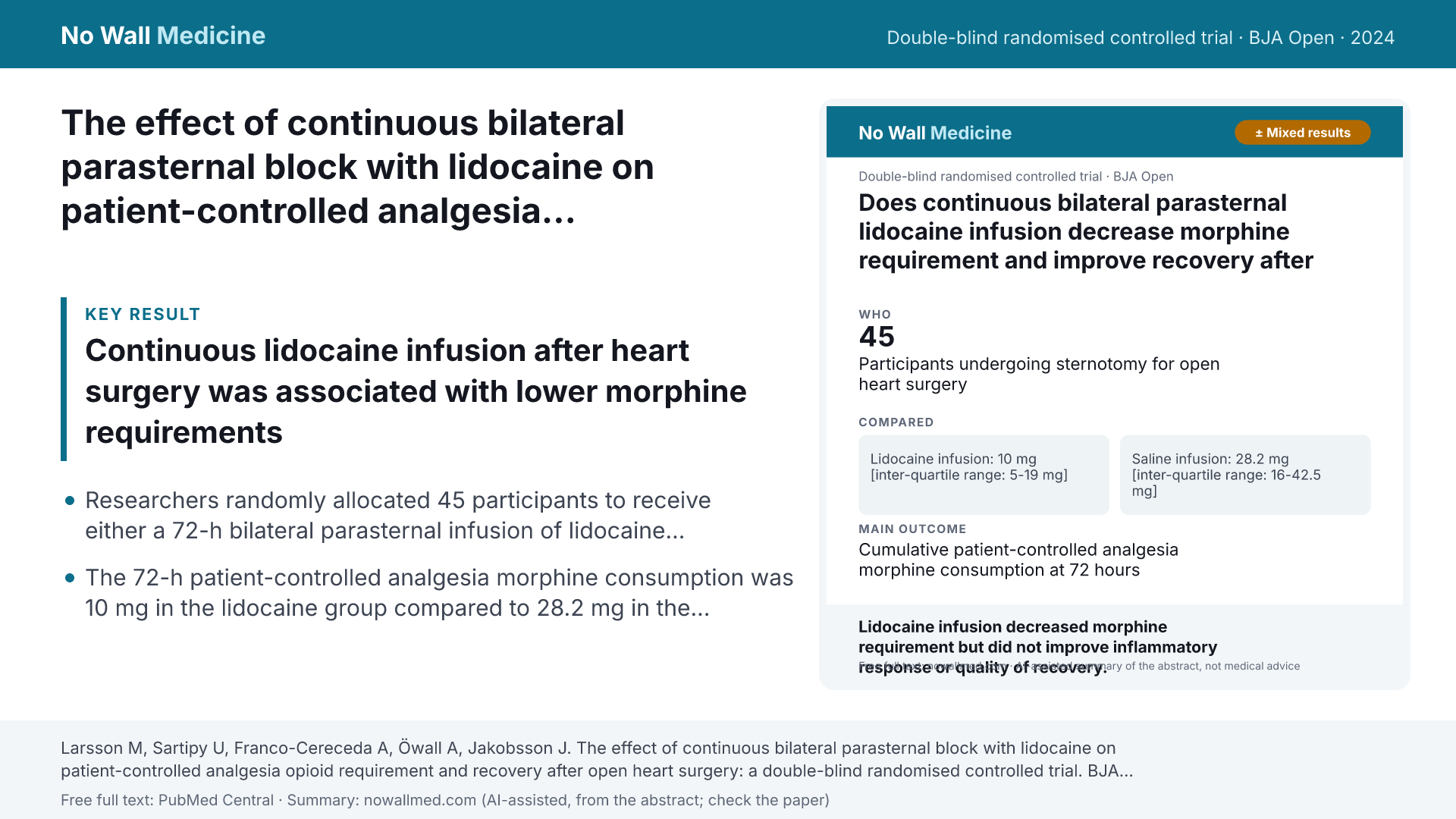
Continuous lidocaine infusion after heart surgery was associated with lower morphine requirements
The effect of continuous bilateral parasternal block with lidocaine on patient-controlled analgesia opioid requirement and recovery after open heart surgery: a double-blind randomised controlled trial
Double-blind randomised controlled trialMixed results
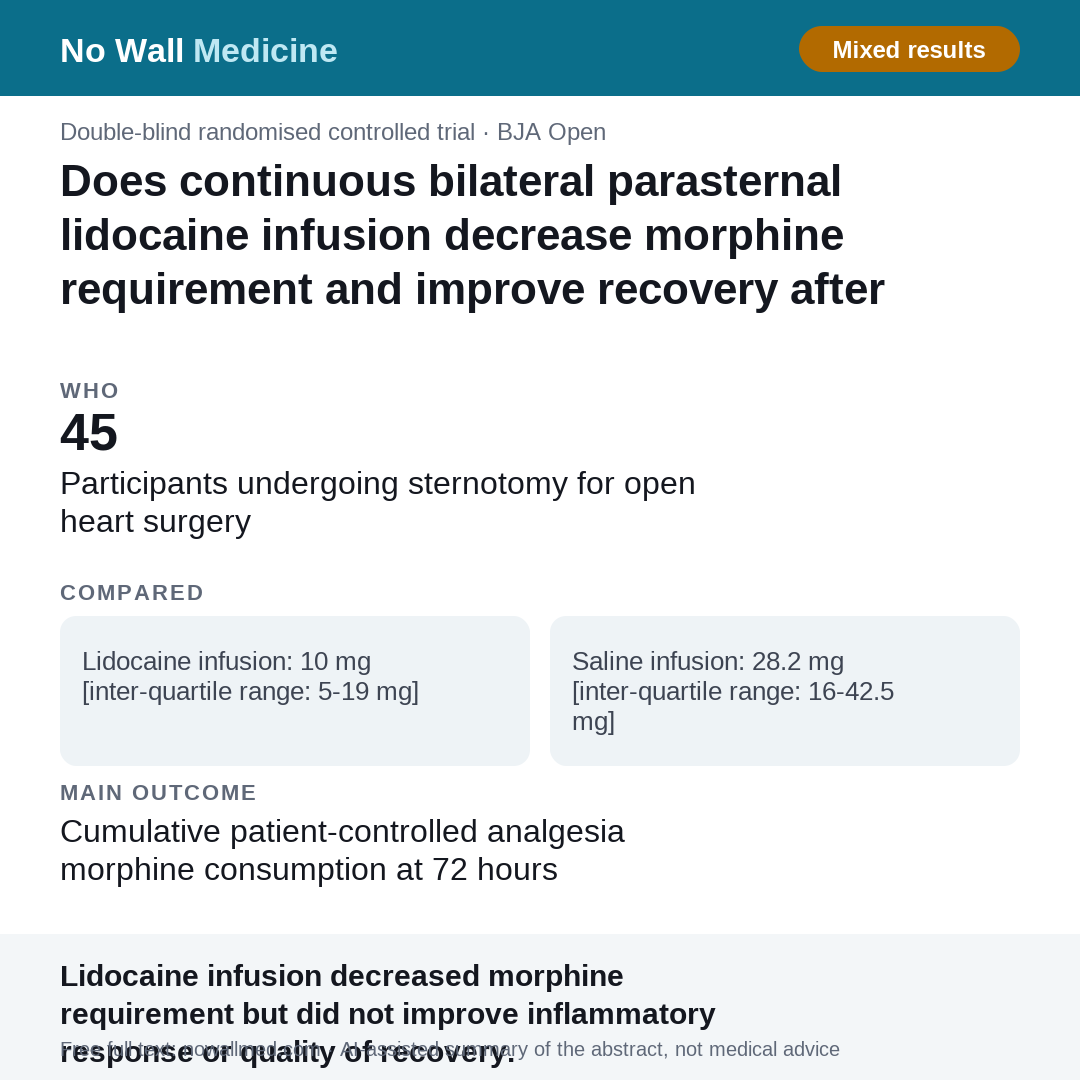
Does continuous bilateral parasternal lidocaine infusion decrease morphine requirement and improve recovery after open heart surgery?
Who
45
Participants undergoing sternotomy for open heart surgery
Compared
Lidocaine infusion: 10 mg [inter-quartile range: 5-19 mg]
Saline infusion: 28.2 mg [inter-quartile range: 16-42.5 mg]
Main outcome
Cumulative patient-controlled analgesia morphine consumption at 72 hours
Bottom line: Lidocaine infusion decreased morphine requirement but did not improve inflammatory response or quality of recovery.
BJA Open · 2024-04-20Download image
Clinical question: Does continuous bilateral parasternal lidocaine infusion decrease morphine requirement and improve recovery after open heart surgery?
Why it matters: It was unknown if a 72-h bilateral parasternal lidocaine infusion could decrease pain and the inflammatory response while improving recovery after open heart surgery.
Key points
- Researchers randomly allocated 45 participants to receive either a 72-h bilateral parasternal infusion of lidocaine or saline after wound closure during open heart surgery.
- The 72-h patient-controlled analgesia morphine consumption was 10 mg in the lidocaine group compared to 28.2 mg in the saline group.
- Lidocaine infusion was not associated with changes in interleukin-6 concentrations or Quality of Recovery-15 scores during a 3-month follow-up.
Headline and key points written with AI from the paper’s abstract, with every number checked against it. Read the paper before relying on them.
Was this summary helpful?
Cite this article
Larsson M, Sartipy U, Franco-Cereceda A, Öwall A, Jakobsson J. The effect of continuous bilateral parasternal block with lidocaine on patient-controlled analgesia opioid requirement and recovery after open heart surgery: a double-blind randomised controlled trial. BJA Open. 2024. doi:10.1016/j.bjao.2024.100279
Spotted a mistake? Suggest a correction
Top studies every Monday
The week’s key trials and guidelines in your specialties, plus any topics you follow. By email, free.
Get the weekly digest