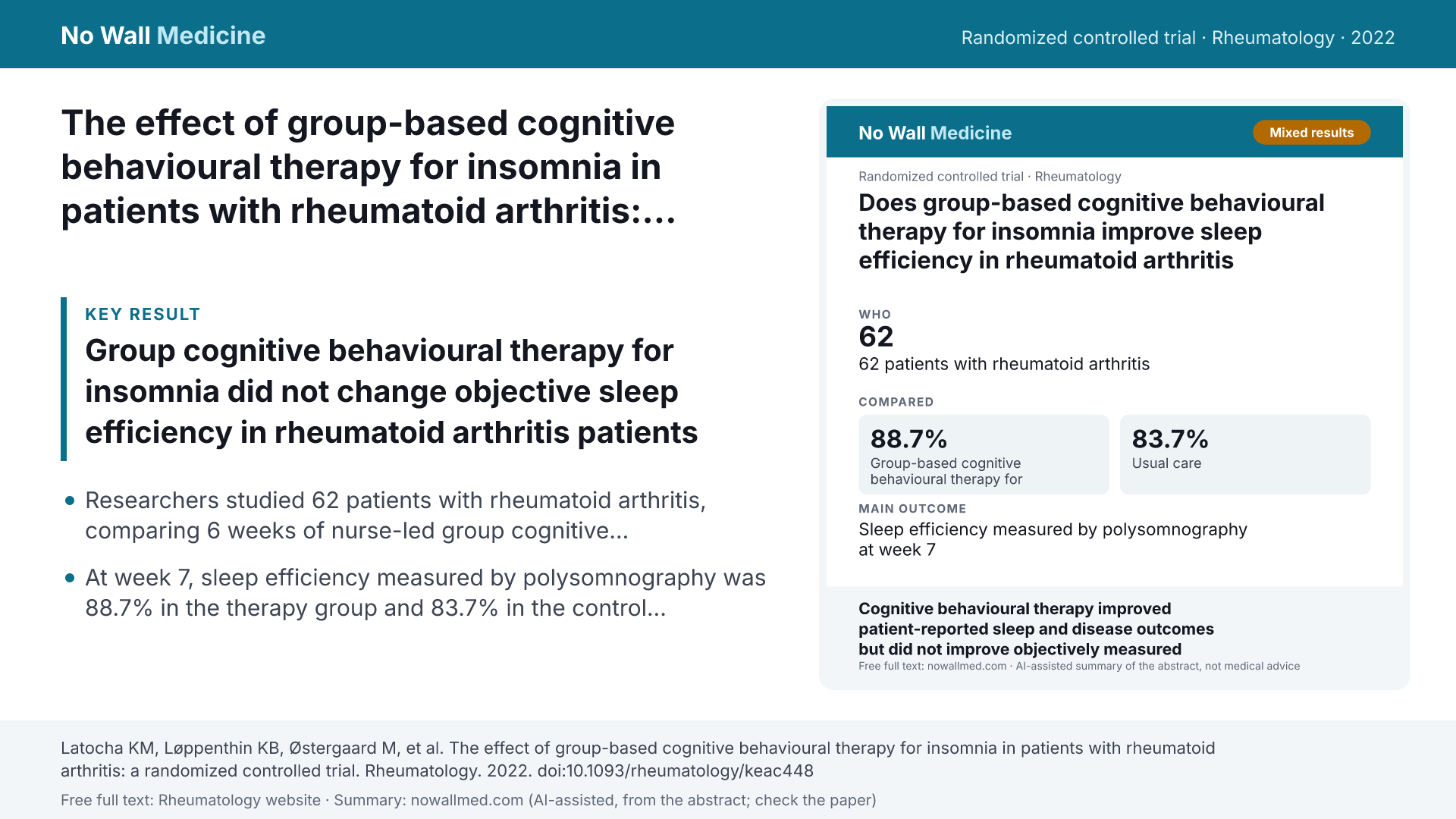
Group cognitive behavioural therapy for insomnia did not change objective sleep efficiency in rheumatoid arthritis patients
The effect of group-based cognitive behavioural therapy for insomnia in patients with rheumatoid arthritis: a randomized controlled trial
Randomized controlled trialMixed results
Does group-based cognitive behavioural therapy for insomnia improve sleep efficiency in rheumatoid arthritis patients?
Who
62
62 patients with rheumatoid arthritis
Compared
88.7%Group-based cognitive behavioural therapy for insomnia
83.7%Usual care
Main outcome
Sleep efficiency measured by polysomnography at week 7
Result: difference: 5.03 (95% CI -0.37 to 10.43)
Bottom line: Cognitive behavioural therapy improved patient-reported sleep and disease outcomes but did not improve objectively measured sleep efficiency.
Rheumatology · 2022-08-12Download image
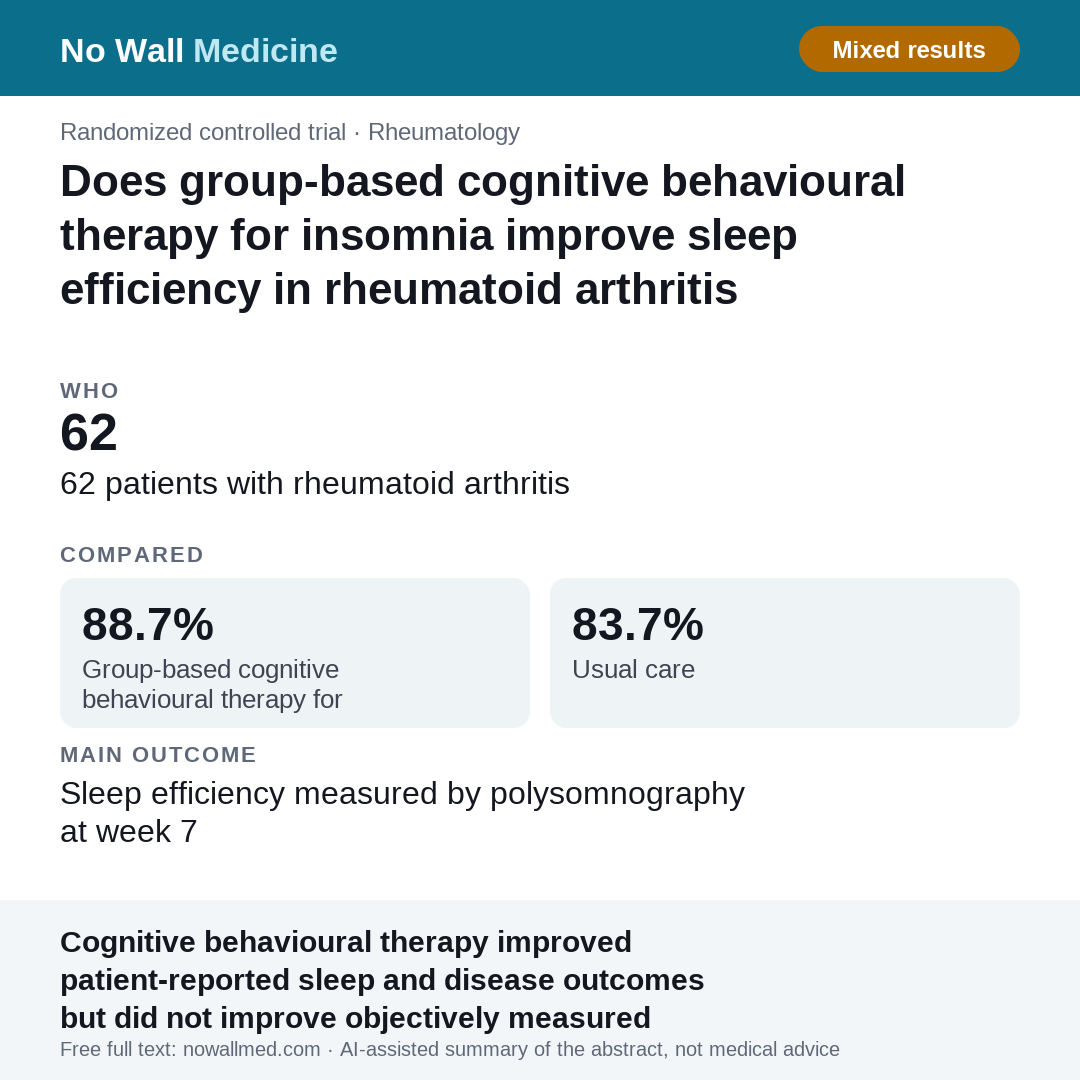
Clinical question: Does group-based cognitive behavioural therapy for insomnia improve sleep efficiency in rheumatoid arthritis patients?
Key points
- Researchers studied 62 patients with rheumatoid arthritis, comparing 6 weeks of nurse-led group cognitive behavioural therapy for insomnia to usual care.
- At week 7, sleep efficiency measured by polysomnography was 88.7% in the therapy group and 83.7% in the control group, which was not a statistically significant difference.
- At week 26, patient-reported outcomes showed significant differences, including an Insomnia Severity Index change of -9.85 and a rheumatoid arthritis impact of disease change of -1.36.
Headline and key points written with AI from the paper’s abstract, with every number checked against it. Read the paper before relying on them.
Was this summary helpful?
Subject terms
Headline, design, result, key points, caveat and citation as plain text.
Cite this article
Latocha KM, Løppenthin KB, Østergaard M, et al. The effect of group-based cognitive behavioural therapy for insomnia in patients with rheumatoid arthritis: a randomized controlled trial. Rheumatology. 2022. doi:10.1093/rheumatology/keac448
Spotted a mistake? Suggest a correction