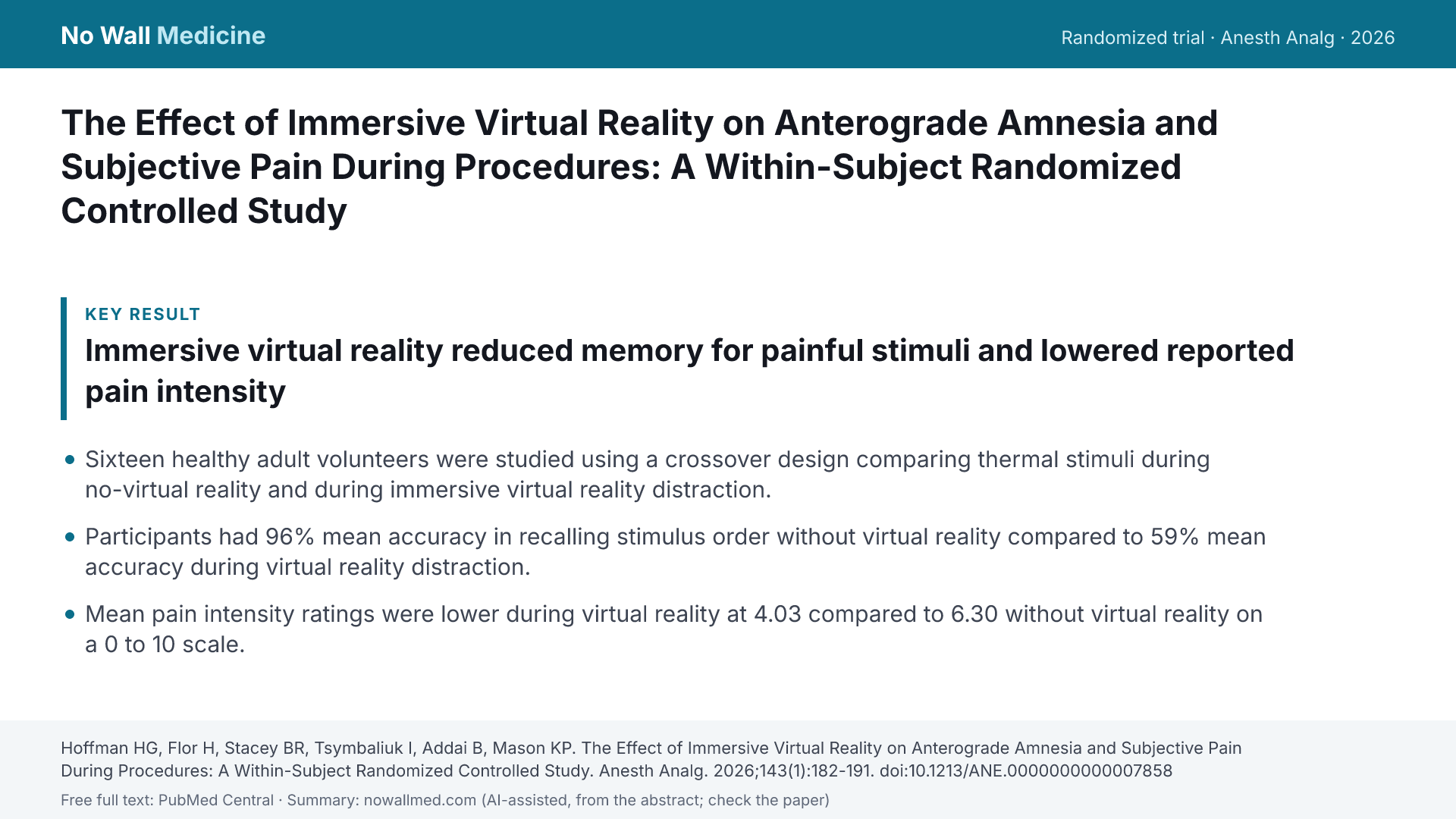
Immersive virtual reality reduced memory for painful stimuli and lowered reported pain intensity
The Effect of Immersive Virtual Reality on Anterograde Amnesia and Subjective Pain During Procedures: A Within-Subject Randomized Controlled Study
Why it matters: Researchers wanted to explore whether immersive virtual reality distraction reduces anterograde amnesia, which is the inability to form new memories, for painful experiences.
Key points
- Sixteen healthy adult volunteers were studied using a crossover design comparing thermal stimuli during no-virtual reality and during immersive virtual reality distraction.
- Participants had 96% mean accuracy in recalling stimulus order without virtual reality compared to 59% mean accuracy during virtual reality distraction.
- Mean pain intensity ratings were lower during virtual reality at 4.03 compared to 6.30 without virtual reality on a 0 to 10 scale.
Headline and key points written with AI from the paper’s abstract, with every number checked against it. Read the paper before relying on them.
Was this summary helpful?
Subject terms
Headline, design, result, key points, caveat and citation as plain text.
Cite this article
Hoffman HG, Flor H, Stacey BR, Tsymbaliuk I, Addai B, Mason KP. The Effect of Immersive Virtual Reality on Anterograde Amnesia and Subjective Pain During Procedures: A Within-Subject Randomized Controlled Study. Anesth Analg. 2026;143(1):182-191. doi:10.1213/ANE.0000000000007858
Spotted a mistake? Suggest a correction