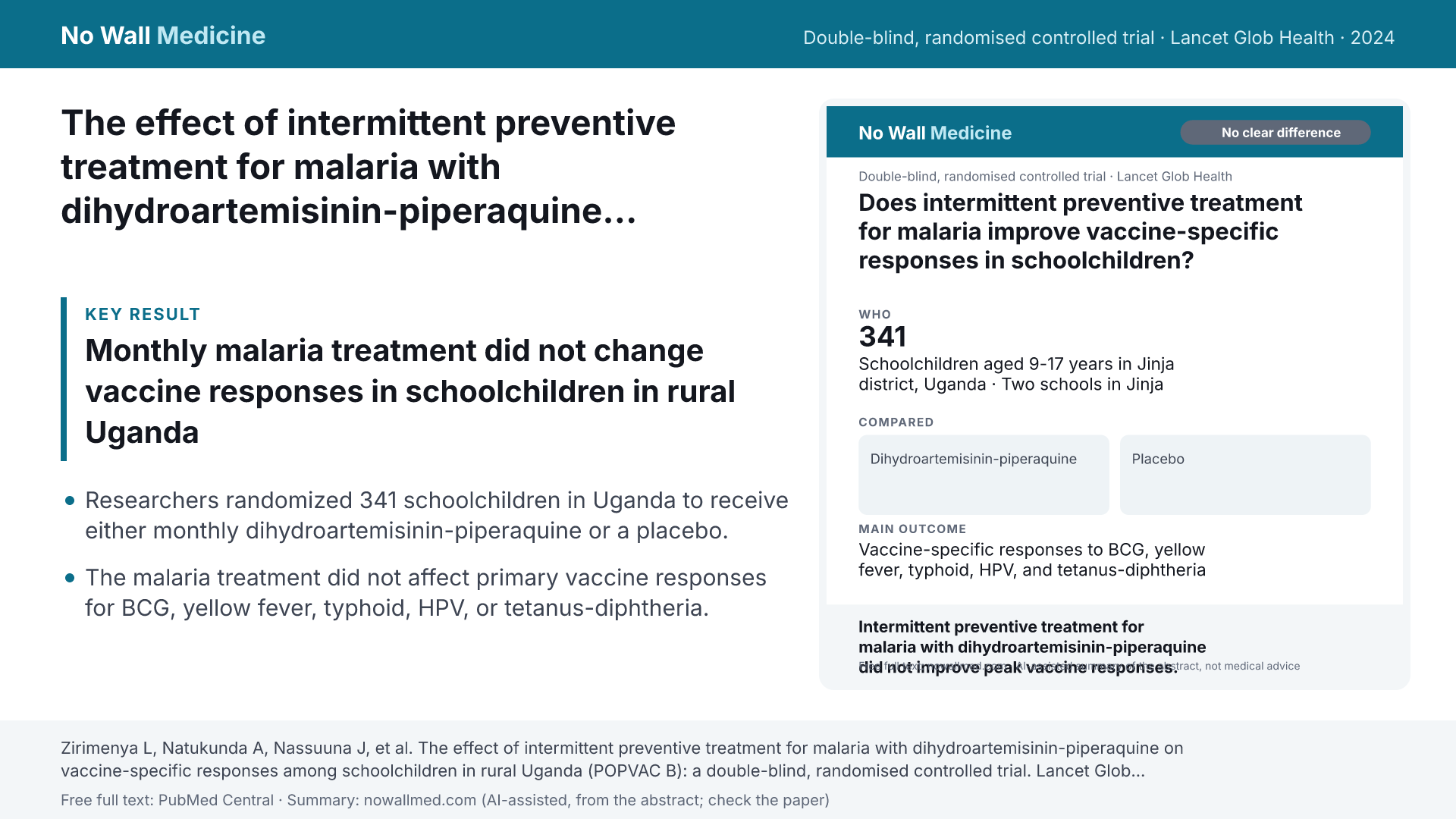
Monthly malaria treatment did not change vaccine responses in schoolchildren in rural Uganda
The effect of intermittent preventive treatment for malaria with dihydroartemisinin-piperaquine on vaccine-specific responses among schoolchildren in rural Uganda (POPVAC B): a double-blind, randomised controlled trial
Double-blind, randomised controlled trialNo clear difference
Does intermittent preventive treatment for malaria improve vaccine-specific responses in schoolchildren?
Who
341
Schoolchildren aged 9-17 years in Jinja district, Uganda · Two schools in Jinja district, Uganda
Compared
Dihydroartemisinin-piperaquine
Placebo
Main outcome
Vaccine-specific responses to BCG, yellow fever, typhoid, HPV, and tetanus-diphtheria
Bottom line: Intermittent preventive treatment for malaria with dihydroartemisinin-piperaquine did not improve peak vaccine responses.
Funded by: UK Medical Research Council
Lancet Glob Health · 2024-10-19Download image
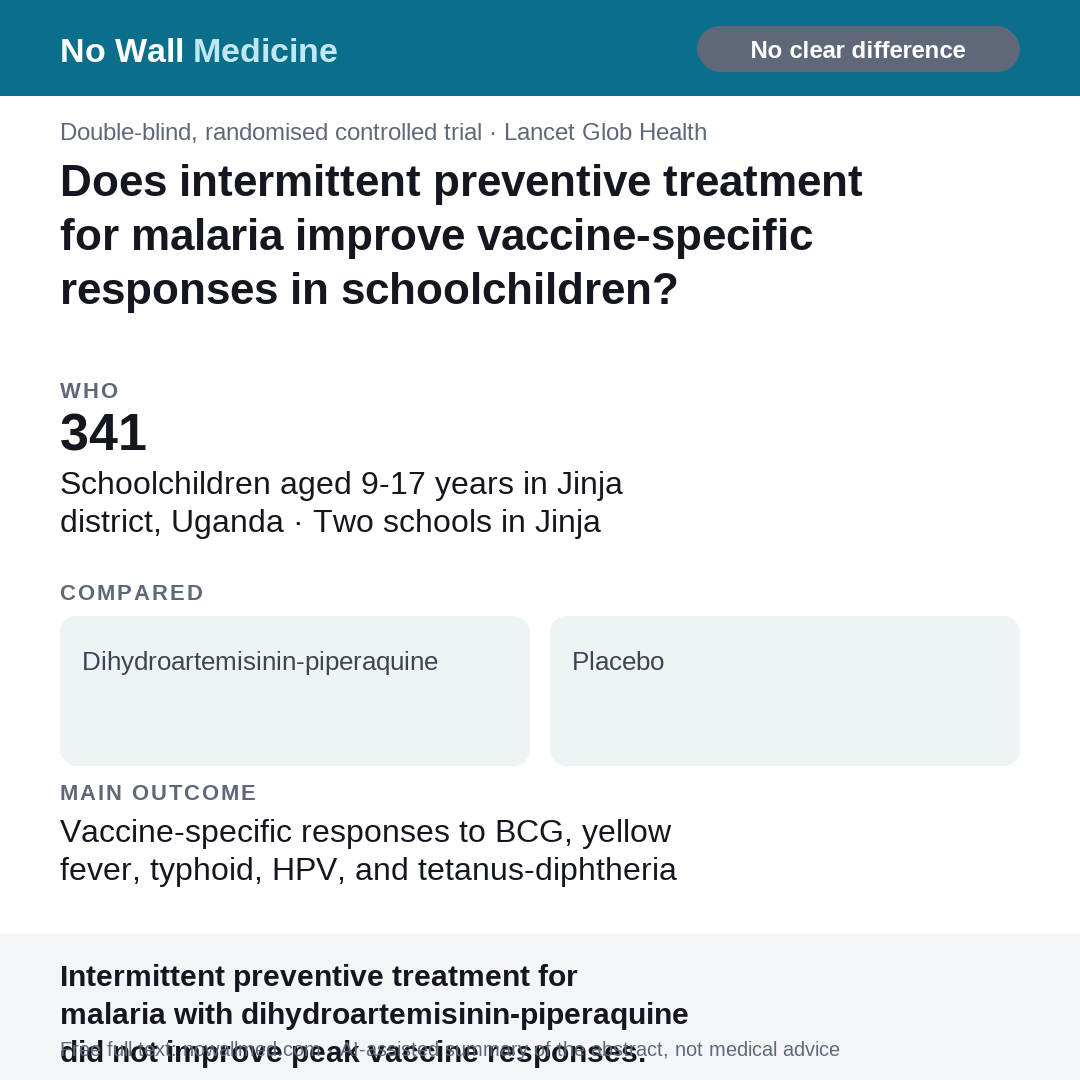
Clinical question: Does intermittent preventive treatment for malaria improve vaccine-specific responses in schoolchildren?
Key points
- Researchers randomized 341 schoolchildren in Uganda to receive either monthly dihydroartemisinin-piperaquine or a placebo.
- The malaria treatment did not affect primary vaccine responses for BCG, yellow fever, typhoid, HPV, or tetanus-diphtheria.
- While malaria prevalence dropped from 64% or 58% at enrollment to 6% or lower in the treatment group, vaccine immunity levels remained similar to the placebo group.
Headline and key points written with AI from the paper’s abstract, with every number checked against it. Read the paper before relying on them.
Was this summary helpful?
Abstract
Background
Several important vaccines differ in immunogenicity and efficacy between populations. We hypothesised that malaria suppresses responses to unrelated vaccines and that this effect can be reversed-at least partially-by monthly malaria intermittent preventive treatment (IPT) in high-transmission settings. Methods
We conducted an individually randomised, double-blind, placebo-controlled trial of the effect of malaria IPT with dihydroartemisinin-piperaquine on vaccine responses among schoolchildren aged 9-17 years in Jinja district, Uganda. Participants were recruited from two schools and did not have exposure to vaccines of interest after the age of 5 years, with the exception of human papillomavirus (HPV). Computer-generated 1:1 randomisation was implemented in REDCap. 3-day courses of dihydroartemisinin-piperaquine (dosage by weight) or placebo were administered monthly, including twice before the first vaccination. Trial participants were vaccinated with the live parenteral BCG vaccine (Serum Institute of India, Pune, India) at week 0; yellow fever vaccine (YF-17D; Sanofi Pasteur, Lyon, France); live oral typhoid vaccine (Ty21a; PaxVax, London, UK), and quadrivalent virus-like particle HPV vaccine (Merck, Rahway, NJ, USA) at week 4; and toxoid vaccines (tetanus-diphtheria; Serum Institute of India) and an HPV booster at week 28. An additional HPV vaccination at week 8 was provided to female participants older than 14 years who had not previously been vaccinated, and a tetanus-diphtheria booster was given after completion of the trial at week 52. Primary outcomes were vaccine responses at week 8 and, for tetanus-diphtheria, at week 52, and analysis was done in the intention-to-treat population. Malaria parasite prevalence at enrolment and during follow-up was determined retrospectively by PCR. The safety population comprised all randomly allocated participants. The trial was registered at the ISRCTN Registry (ISRCTN62041885) and is complete. Findings
Between May 25 and July 14, 2021, we assessed 388 potential participants for eligibility. We enrolled and randomly allocated 341 participants to the two groups (170 [50%] to dihydroartemisinin-piperaquine and 171 [50%] to placebo); 192 (56%) were female and 149 (44%) participants were male. 145 (85%) participants in the dihydroartemisinin-piperaquine group and 140 participants (82%) in the placebo group were followed up until the week 52 endpoint. At enrolment, 109 (64%) of all participants in the dihydroartemisinin-piperaquine group and 99 (58%) of 170 participants in the placebo group had malaria; this reduced to 6% or lower at all follow-up visits in the dihydroartemisinin-piperaquine group. There was no effect of dihydroartemisinin-piperaquine versus placebo on primary outcomes: BCG-specific IFNγ ELISpot response had a geometric mean ratio (GMR) of 1·09 (95% CI 0·93-1·29), p=0·28; yellow fever neutralising antibody was 1·19 (0·91-1·54), p=0·20 for plaque reduction neutralising reference tests (PRNT50) titres (the reciprocal of the last plasma dilution that reduced by 50%) and 1·24 (0·97-1·58), p=0·09 for PRNT90 titres (reciprocal of the last plasma dilution that reduced by 90%); and IgG to Salmonella enterica serovar Typhi O-lipopolysaccharide was 1·09 (0·81-1·46), p=0·58, HPV-16 was 0·72 (0·44-1·77), p=0·19, HPV-18 was 0·71 (0·47-1·09), p=0·11; tetanus toxoid was 1·22 (0·91-1·62), p=0·18, and diphtheria toxoid was 0·97 (0·83-1·13), p=0·72. There was some evidence that dihydroartemisinin-piperaquine reduced waning of the yellow fever response. Interpretation
IPT for malaria with dihydroartemisinin-piperaquine did not improve peak vaccine responses, despite reducing malaria prevalence. Possible longer-term effects on response waning should be further explored. Funding
UK Medical Research Council. Translation
For the Luganda translation of the abstract see Supplementary Materials section.
Abstract reproduced under the article’s CC BY licence.
Subject terms
Cite this article
Zirimenya L, Natukunda A, Nassuuna J, et al. The effect of intermittent preventive treatment for malaria with dihydroartemisinin-piperaquine on vaccine-specific responses among schoolchildren in rural Uganda (POPVAC B): a double-blind, randomised controlled trial. Lancet Glob Health. 2024;12(11):e1838-e1848. doi:10.1016/S2214-109X(24)00281-X
Spotted a mistake? Suggest a correction