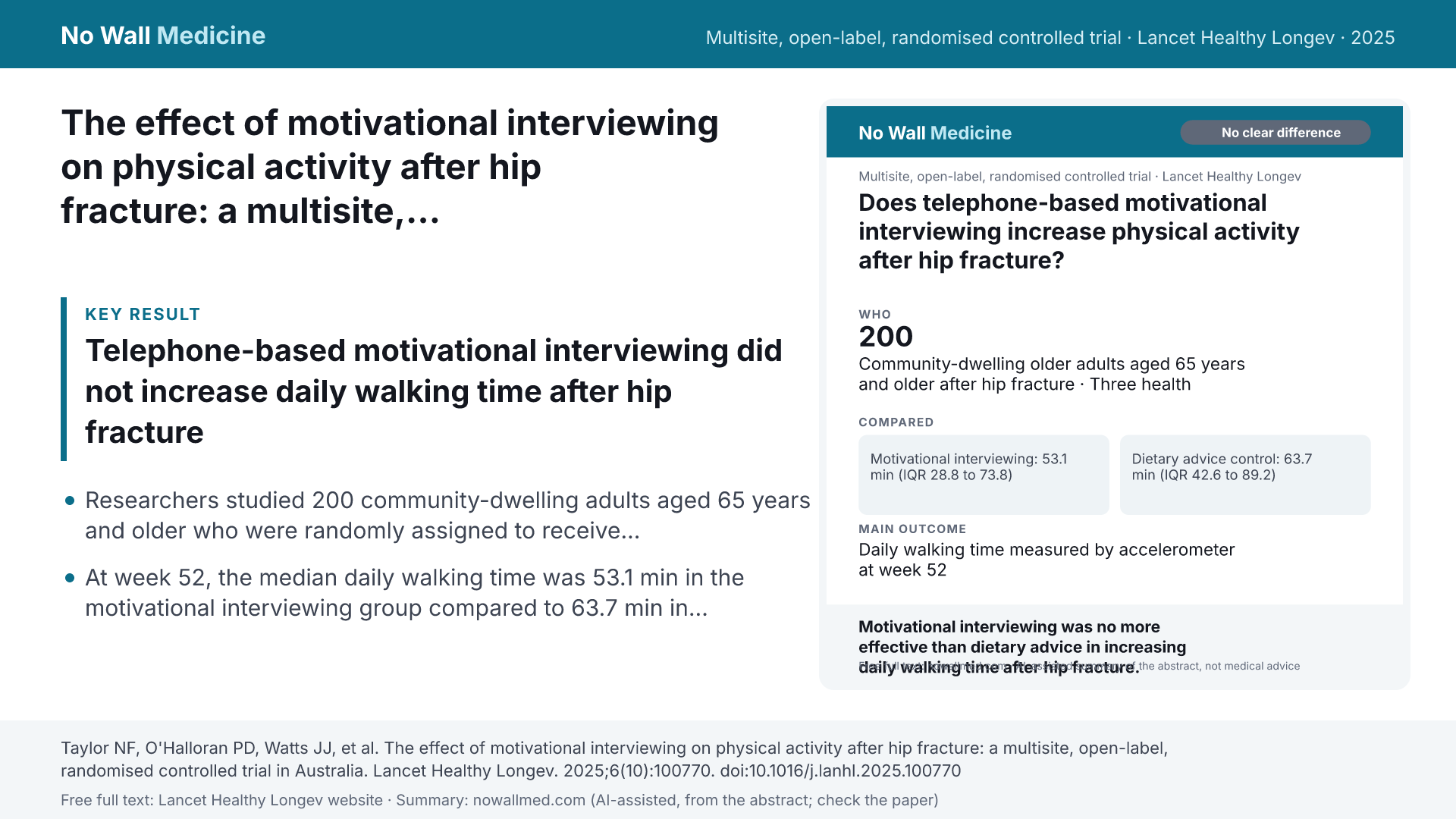
Telephone-based motivational interviewing did not increase daily walking time after hip fracture
The effect of motivational interviewing on physical activity after hip fracture: a multisite, open-label, randomised controlled trial in Australia
Multisite, open-label, randomised controlled trialNo clear difference
Does telephone-based motivational interviewing increase physical activity after hip fracture?
Who
200
Community-dwelling older adults aged 65 years and older after hip fracture · Three health networks in Melbourne, Australia
Compared
Motivational interviewing: 53.1 min (IQR 28.8 to 73.8)
Dietary advice control: 63.7 min (IQR 42.6 to 89.2)
Main outcome
Daily walking time measured by accelerometer at week 52
Result: mean difference 4.1% (95% CI -16.6 to 21.1)
Bottom line: Motivational interviewing was no more effective than dietary advice in increasing daily walking time after hip fracture.
Funded by: National Health and Medical Research Council, Australia
Lancet Healthy Longev · 2025-11-03Download image
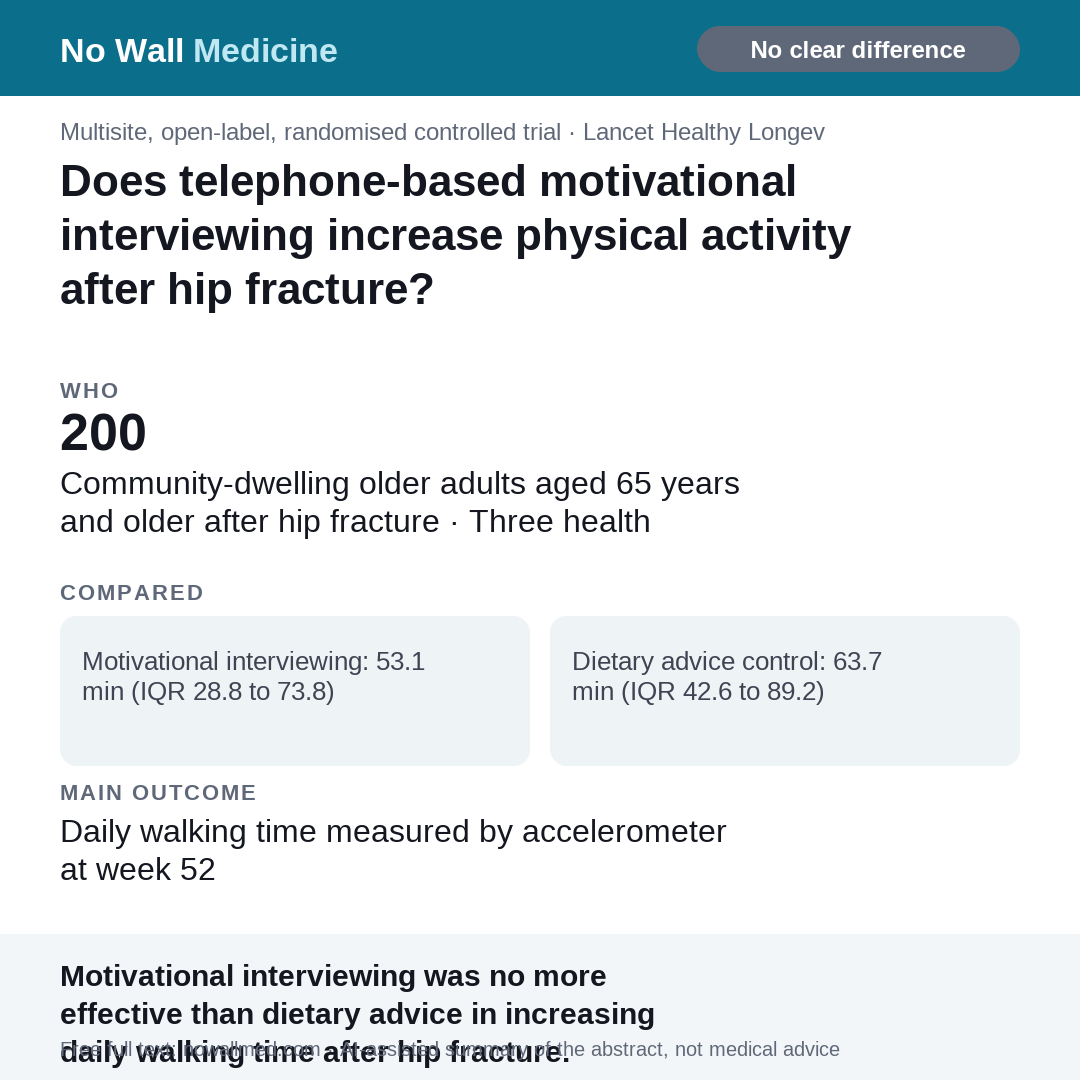
Clinical question: Does telephone-based motivational interviewing increase physical activity after hip fracture?
Why it matters: There is little guidance on how to incorporate the management of psychosocial factors into rehabilitation for older adults after a hip fracture.
Key points
- Researchers studied 200 community-dwelling adults aged 65 years and older who were randomly assigned to receive either motivational interviewing or dietary advice.
- At week 52, the median daily walking time was 53.1 min in the motivational interviewing group compared to 63.7 min in the control group.
- There were no significant differences between the groups, with a mean difference of 4.1% (95% CI -16.6 to 21.1).
Headline and key points written with AI from the paper’s abstract, with every number checked against it. Read the paper before relying on them.
Was this summary helpful?
Subject terms
Cite this article
Taylor NF, O'Halloran PD, Watts JJ, Peiris CL, Prendergast LA, Porter J. The effect of motivational interviewing on physical activity after hip fracture: a multisite, open-label, randomised controlled trial in Australia. Lancet Healthy Longev. 2025. doi:10.1016/j.lanhl.2025.100770
Spotted a mistake? Suggest a correction
Top studies every Monday
The week’s key trials and guidelines in your specialties, plus any topics you follow. By email, free.
Get the weekly digest