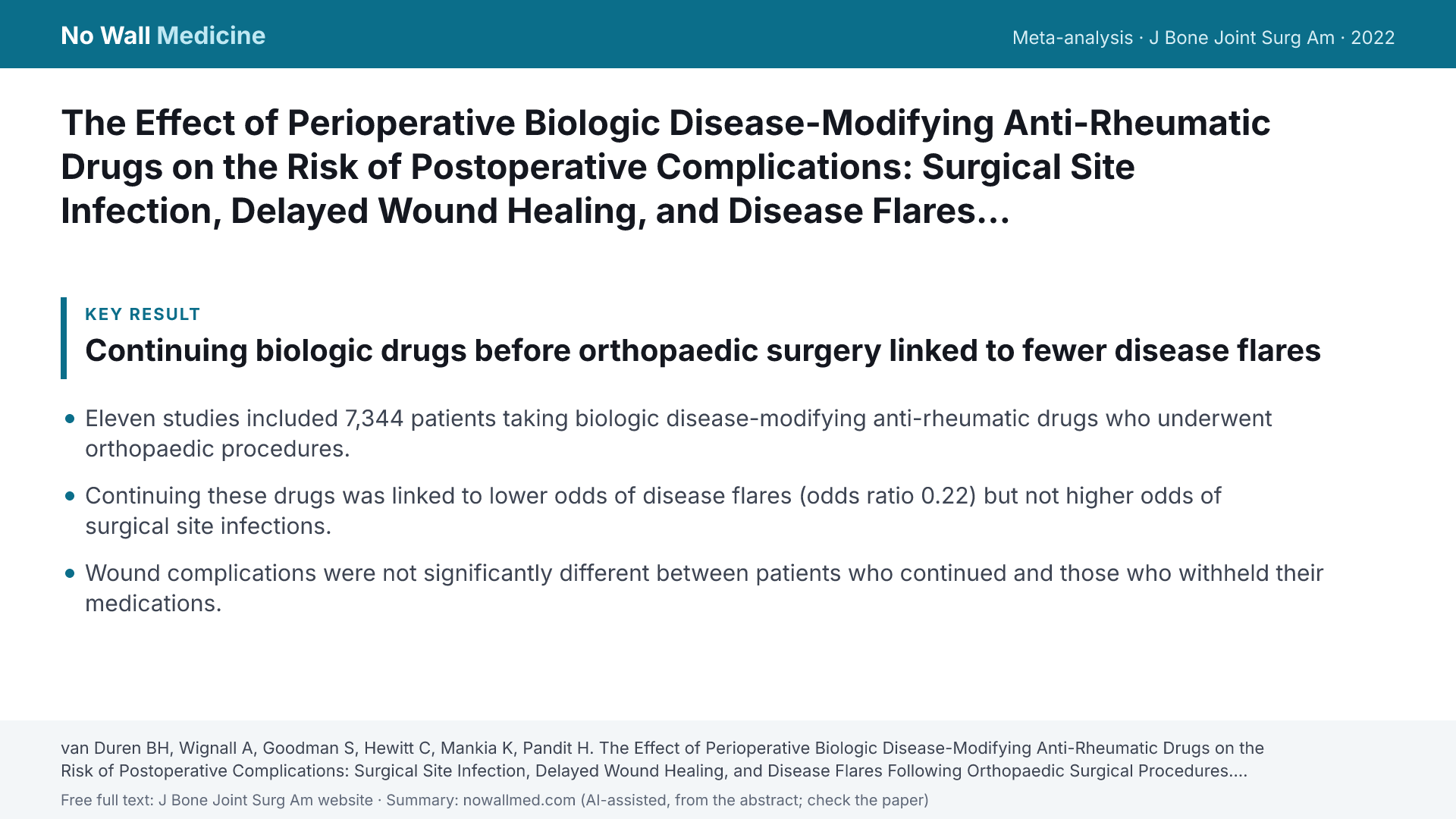
Continuing biologic drugs before orthopaedic surgery linked to fewer disease flares
The Effect of Perioperative Biologic Disease-Modifying Anti-Rheumatic Drugs on the Risk of Postoperative Complications: Surgical Site Infection, Delayed Wound Healing, and Disease Flares Following Orthopaedic Surgical Procedures
Why it matters: Applies to patients on biologic drugs undergoing orthopaedic surgery; suggests continuing treatment may reduce disease flares without increasing infection risk.
Key points
- Eleven studies included 7,344 patients taking biologic disease-modifying anti-rheumatic drugs who underwent orthopaedic procedures.
- Continuing these drugs was linked to lower odds of disease flares (odds ratio 0.22) but not higher odds of surgical site infections.
- Wound complications were not significantly different between patients who continued and those who withheld their medications.
Limitation the authors note: The authors note the evidence is limited by the retrospective and heterogeneous nature of the data and possibly a lack of study power.
Headline and key points written with AI from the paper’s abstract, with every number checked against it. Read the paper before relying on them.
Was this summary helpful?
Subject terms
Headline, design, result, key points, caveat and citation as plain text.
Cite this article
van Duren BH, Wignall A, Goodman S, Hewitt C, Mankia K, Pandit H. The Effect of Perioperative Biologic Disease-Modifying Anti-Rheumatic Drugs on the Risk of Postoperative Complications: Surgical Site Infection, Delayed Wound Healing, and Disease Flares Following Orthopaedic Surgical Procedures. J Bone Joint Surg Am. 2022. doi:10.2106/JBJS.21.00811
Spotted a mistake? Suggest a correction