Cognitive training did not change the rate of postoperative delirium after hip or knee replacement
The effect of perioperative cognitive training on postoperative delirium in older patients undergoing total hip and knee arthroplasty: a prospective randomised trial
Prospective randomized trialNo clear difference
Does cognitive training ameliorate postoperative delirium in older patients undergoing hip or knee arthroplasty?
Who
122
Individuals aged 60-79 undergoing elective total hip and knee arthroplasties
Compared
9.8%cognitive training
6.6%routine care
Main outcome
incidence of postoperative delirium
Bottom line: Cognitive training may not mitigate postoperative delirium incidence in older patients undergoing hip or knee arthroplasty.
Age Ageing · 2025-03-10Download image
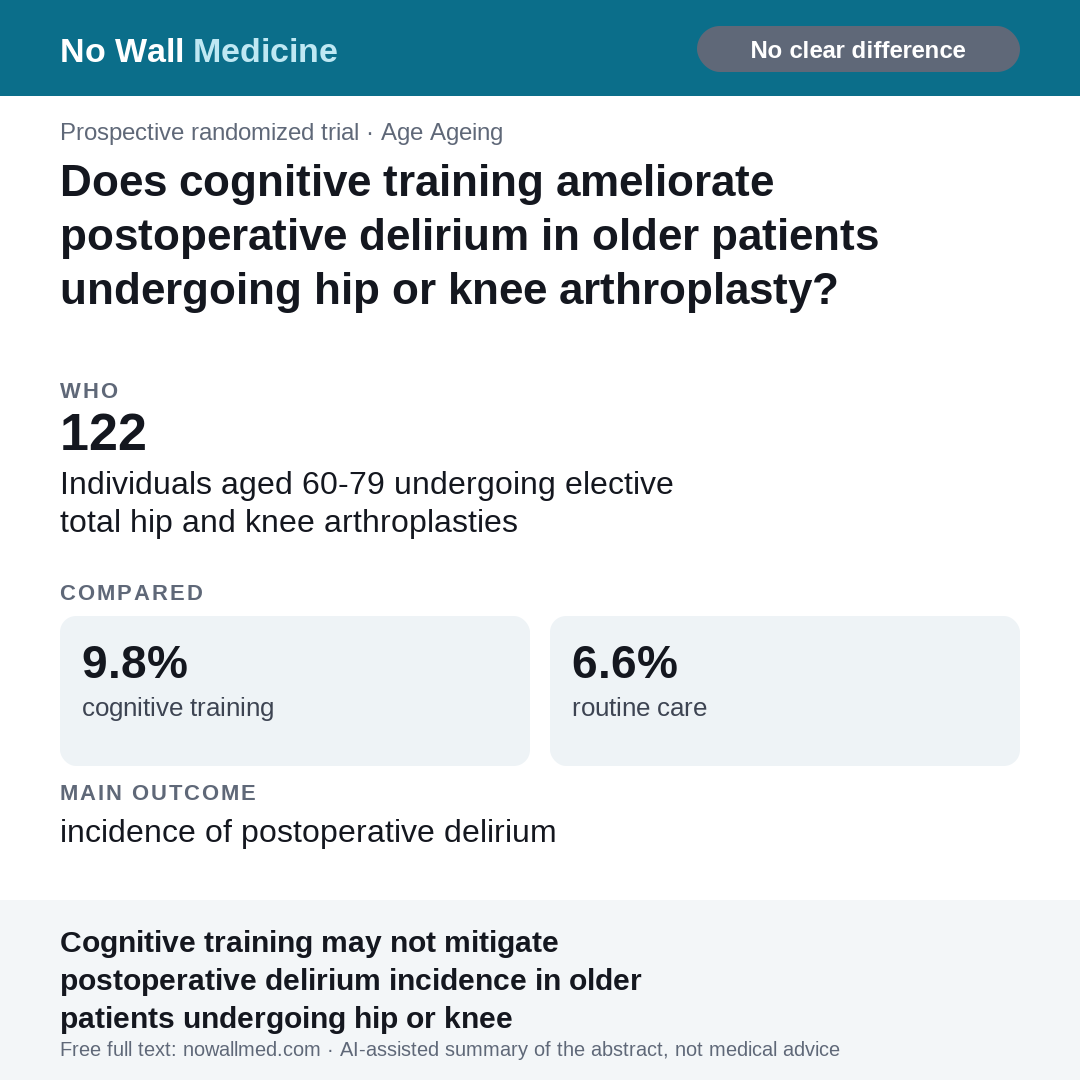
Clinical question: Does cognitive training ameliorate postoperative delirium in older patients undergoing hip or knee arthroplasty?
Why it matters: It is unknown if cognitive training can reduce the incidence of postoperative delirium in older patients undergoing hip or knee replacement surgery.
Key points
- Researchers studied 122 patients aged 60-79 undergoing elective total hip or knee replacement surgery under general anesthesia.
- The overall incidence of postoperative delirium, a state of sudden confusion, was 8.2%, with no significant difference between cognitive training (9.8%) and routine care (6.6%).
- The compliance rate for the cognitive training group was 4.0% and training time was less than expected.
Headline and key points written with AI from the paper’s abstract, with every number checked against it. Read the paper before relying on them.
Topics
Cite this article
Lia T, Yua C, Lv F, Feng Z, Hou Y, Ren L. The effect of perioperative cognitive training on postoperative delirium in older patients undergoing total hip and knee arthroplasty: a prospective randomised trial. Age Ageing. 2025. doi:10.1093/ageing/afaf020
Spotted a mistake? Suggest a correction
Top studies every Monday
The week’s key trials and guidelines in your specialties, plus any topics you follow. By email, free.
Get the weekly digest