Repeated ropivacaine boluses via catheters did not improve pain control after cardiac surgery
The Effect of Repeated Bilateral Deep Parasternal Intercostal Plane Catheter Boluses on Analgesia After Cardiac Surgery: A Randomized Controlled Trial
Randomized, placebo-controlled trialNo clear difference
Do repeated ropivacaine boluses via bilateral deep parasternal intercostal plane catheters improve analgesia after cardiac surgery?
Who
120
Adult patients undergoing elective coronary artery bypass grafting or heart valve replacement
Compared
Ropivacaine
Placebo
Main outcome
Postoperative pain intensity
Bottom line: Repeated ropivacaine boluses via bilateral deep parasternal intercostal plane catheters did not improve pain control or reduce opioid consumption.
Anesth Analg · 2026-08-11Download image
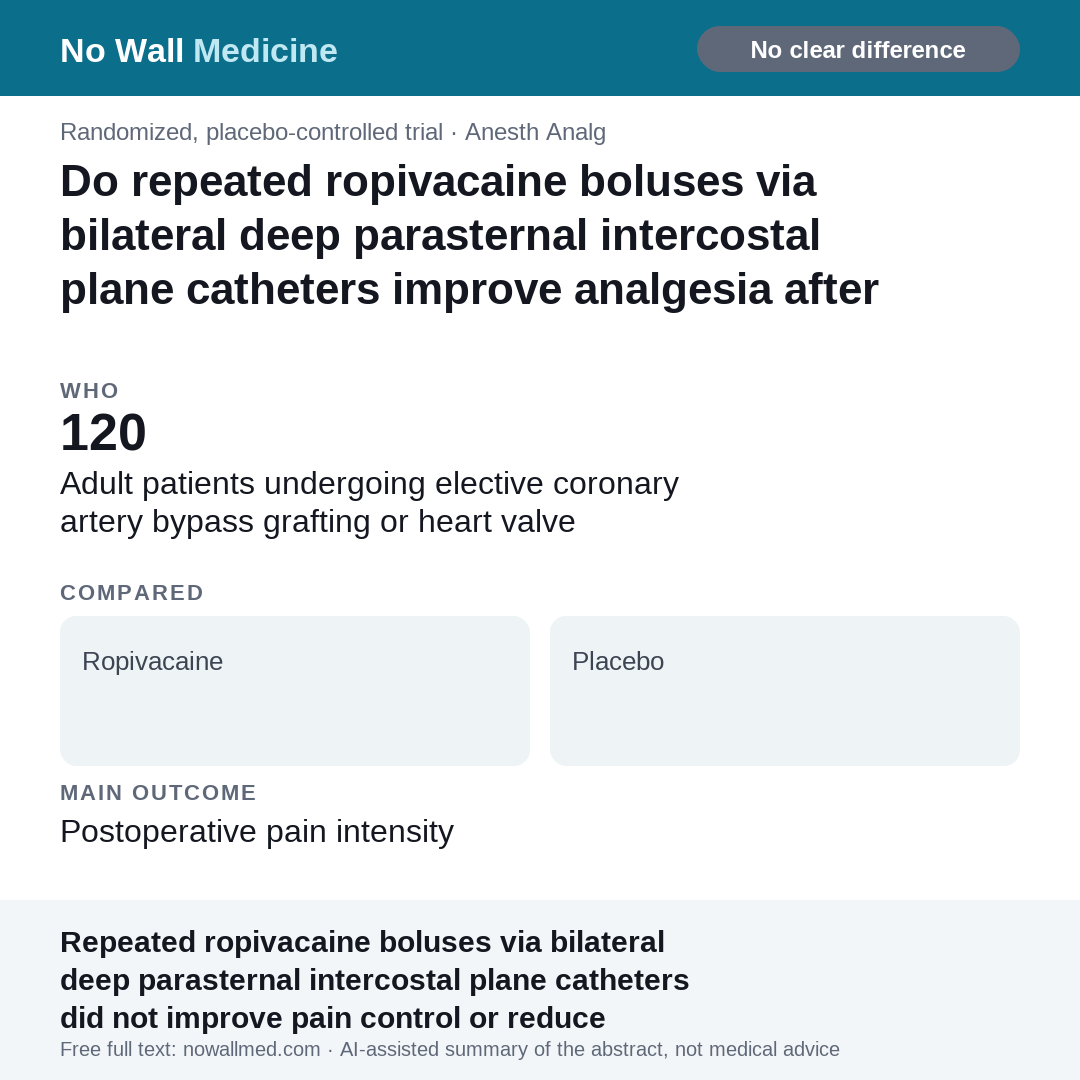
Clinical question: Do repeated ropivacaine boluses via bilateral deep parasternal intercostal plane catheters improve analgesia after cardiac surgery?
Why it matters: Doctors need to know if repeated local anesthetic injections through catheters can improve pain management for patients undergoing heart surgery.
Key points
- Researchers studied 120 adult patients undergoing heart bypass surgery or heart valve replacement to compare ropivacaine boluses against a saline placebo via catheters.
- The study found no significant differences in pain intensity or cumulative oxycodone use between the ropivacaine and placebo groups over 72 hours.
- Nausea and vomiting occurred in 46.7% of the ropivacaine group compared to 30% in the placebo group, and five patients had symptoms of local anesthetic systemic toxicity.
Headline and key points written with AI from the paper’s abstract, with every number checked against it. Read the paper before relying on them.
Cite this article
Kuuskoski RA, Saari TI, Karvonen SI, Singh B, Tiainen SM, Rantanen MJM. The Effect of Repeated Bilateral Deep Parasternal Intercostal Plane Catheter Boluses on Analgesia After Cardiac Surgery: A Randomized Controlled Trial. Anesth Analg. 2026. doi:10.1213/ANE.0000000000008211
Spotted a mistake? Suggest a correction