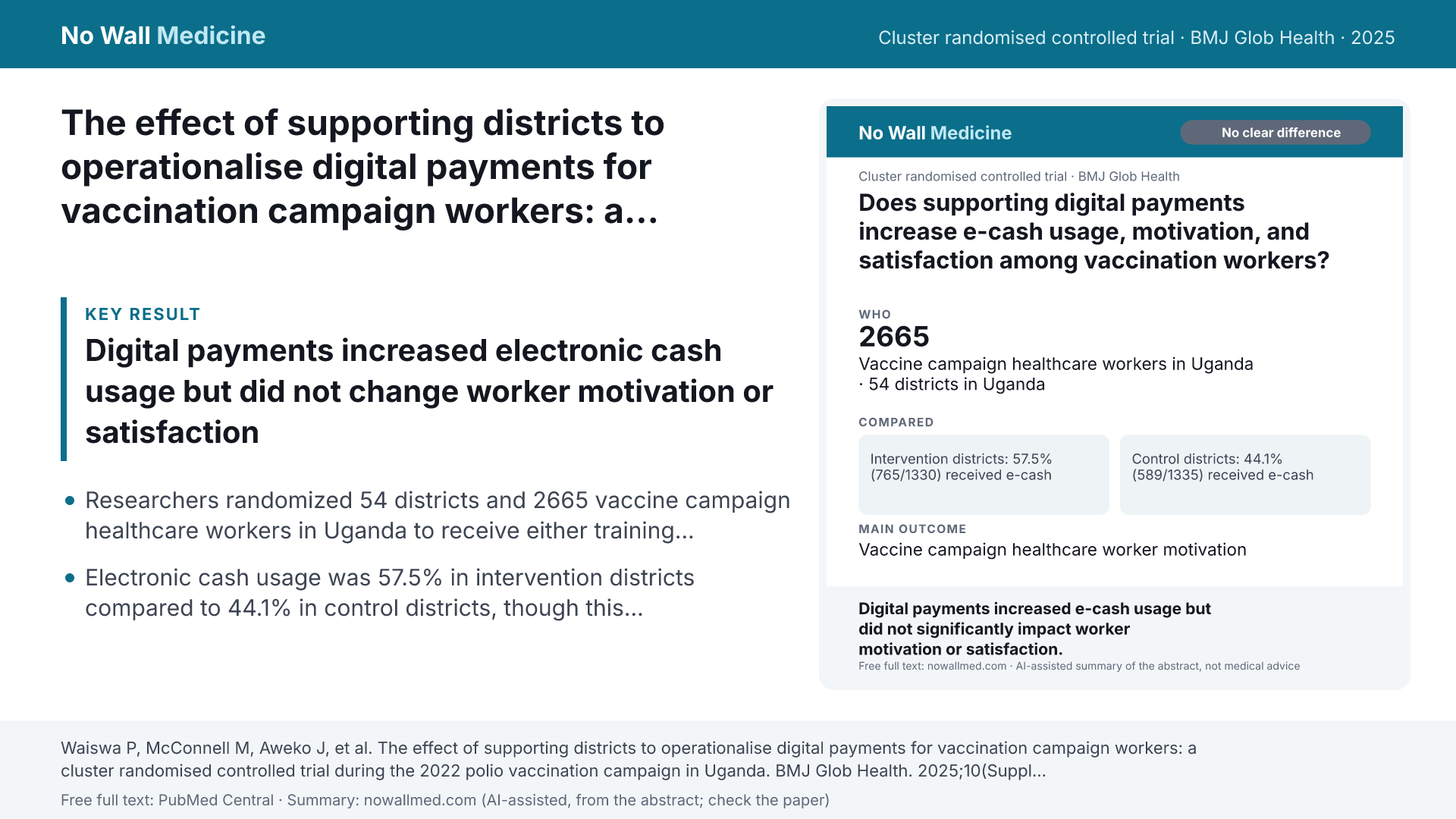
Digital payments increased electronic cash usage but did not change worker motivation or satisfaction
The effect of supporting districts to operationalise digital payments for vaccination campaign workers: a cluster randomised controlled trial during the 2022 polio vaccination campaign in Uganda
Cluster randomised controlled trialNo clear difference
Does supporting digital payments increase e-cash usage, motivation, and satisfaction among vaccination workers?
Who
2665
Vaccine campaign healthcare workers in Uganda · 54 districts in Uganda
Compared
Intervention districts: 57.5% (765/1330) received e-cash
Control districts: 44.1% (589/1335) received e-cash
Main outcome
Vaccine campaign healthcare worker motivation
Result: adjusted odds ratio 0.82 (95% CI 0.47 to 1.44)
Bottom line: Digital payments increased e-cash usage but did not significantly impact worker motivation or satisfaction.
BMJ Glob Health · 2025-09-10Download image
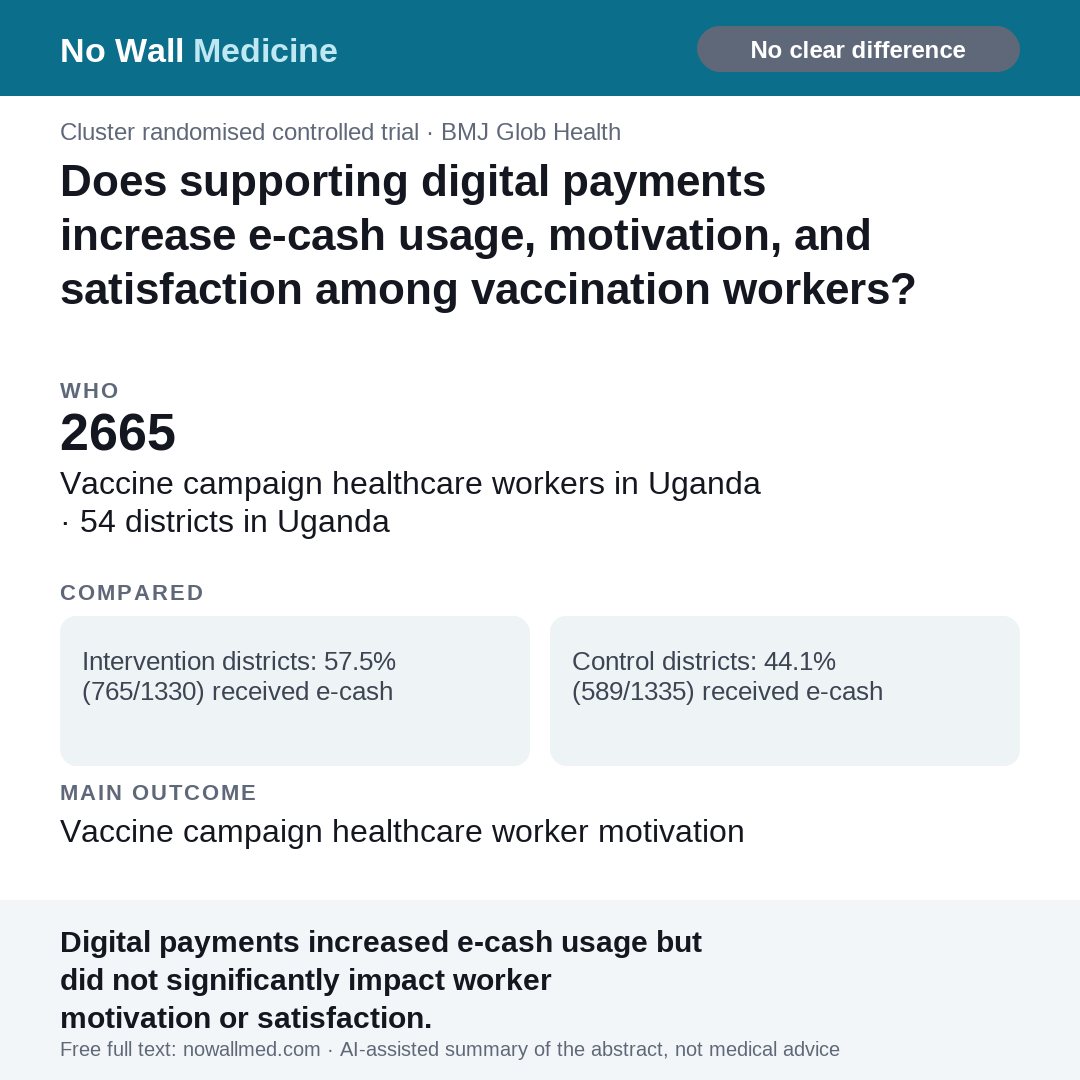
Clinical question: Does supporting digital payments increase e-cash usage, motivation, and satisfaction among vaccination workers?
Why it matters: It is unclear if supporting districts to implement electronic cash payments instead of cash improves the motivation and satisfaction of vaccination campaign workers.
Key points
- Researchers randomized 54 districts and 2665 vaccine campaign healthcare workers in Uganda to receive either training on electronic cash platforms or standard support.
- Electronic cash usage was 57.5% in intervention districts compared to 44.1% in control districts, though this difference was not statistically significant.
- There was no significant difference in motivation or satisfaction between the two groups of healthcare workers.
Headline and key points written with AI from the paper’s abstract, with every number checked against it. Read the paper before relying on them.
Was this summary helpful?
Abstract
Introduction
A motivated and satisfied health workforce is critical for the success of mass vaccination campaigns targeting diseases like polio. This study examined whether supporting districts to implement electronic cash (e-cash) payments, instead of cash, increased e-cash usage and improved vaccine campaign healthcare workers' (VCHWs) motivation and satisfaction during an oral poliovirus vaccination campaign in 2022 in Uganda. Methods
In November 2022, 54 districts and 2665 VCHWs were enrolled and randomised. Intervention districts received training on navigating the government e-cash platform, user roles, beneficiary data upload and payment report generation. Control districts received standard support. Data collected included mode of payment (cash or e-cash), VCHW motivation (primary outcome) and satisfaction with the payment method. Primary analysis was on an intention-to-treat basis, with 589 (44.1%) VCHWs in control and 765 (57.5%) in intervention districts receiving e-cash. Results
E-cash payments were more common in intervention districts (765/1330, 57.5%) compared with controls (589/1335, 44.1%). VCHWs in intervention districts were more likely to be paid via e-cash (adjusted OR (AOR) 3.15; 95% CI: 0.40 to 10.70; p=0.079). Nearly all VCHWs (97.6%) received payments after campaign completion. There was no significant difference in motivation (AOR=0.82; 95% CI: 0.47 to 1.44; p=0.498) or satisfaction (AOR=1.01; 95% CI: 0.77 to 1.55; p=0.641) between groups. Participants reported e-cash as convenient, transparent, time-saving and cost-saving. Conclusion
Supporting districts to operationalise digital payments increased e-cash usage among vaccination workers, despite delays. However, it did not significantly impact motivation or satisfaction. Trial registration number
NCT05684081.
Abstract reproduced under the article’s CC BY licence.
Subject terms
Cite this article
Waiswa P, McConnell M, Aweko J, et al. The effect of supporting districts to operationalise digital payments for vaccination campaign workers: a cluster randomised controlled trial during the 2022 polio vaccination campaign in Uganda. BMJ Glob Health. 2025. doi:10.1136/bmjgh-2024-016666
Spotted a mistake? Suggest a correction