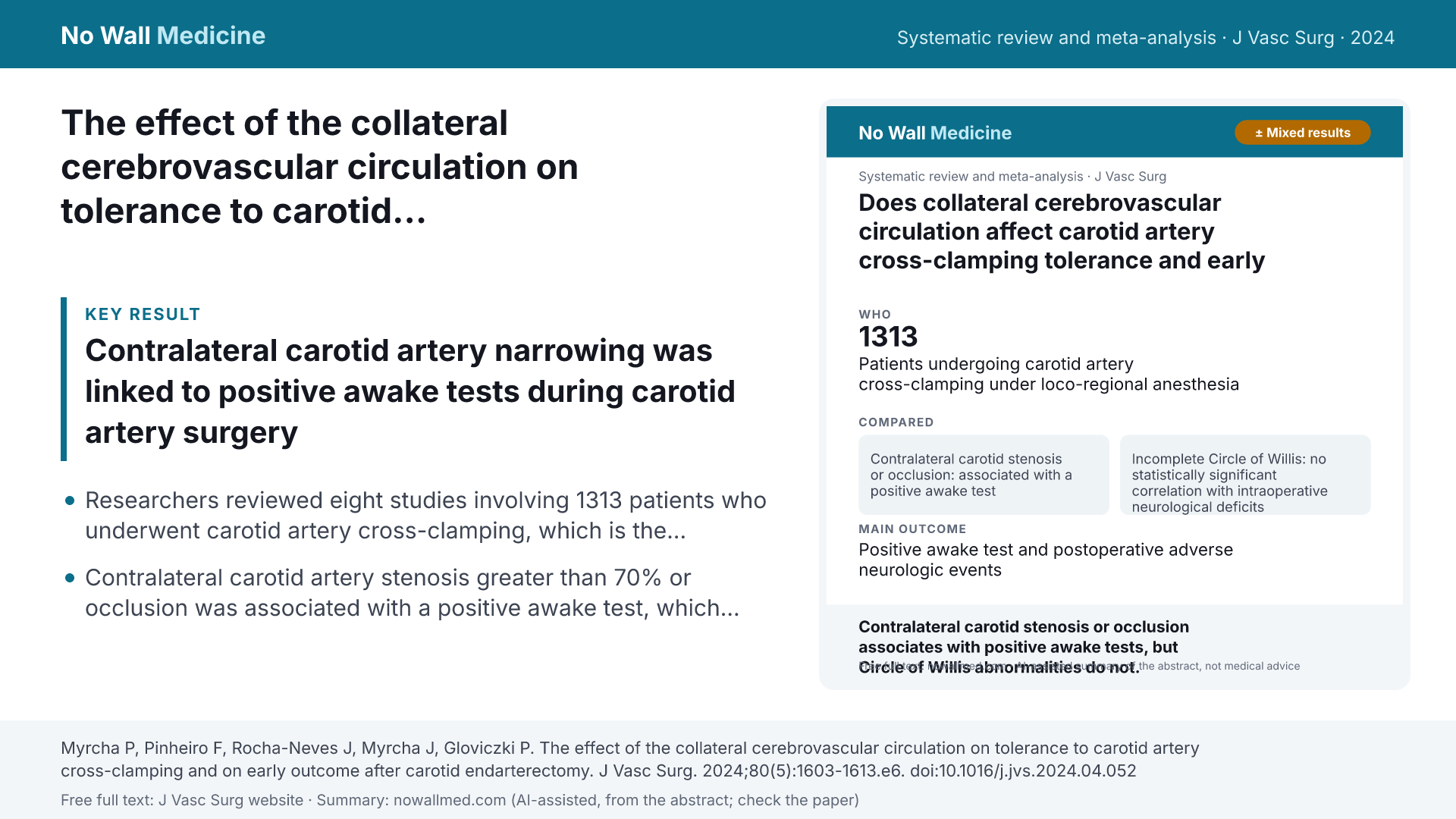
Contralateral carotid artery narrowing was linked to positive awake tests during carotid artery surgery
The effect of the collateral cerebrovascular circulation on tolerance to carotid artery cross-clamping and on early outcome after carotid endarterectomy
Systematic review and meta-analysisMixed results
Does collateral cerebrovascular circulation affect carotid artery cross-clamping tolerance and early outcomes?
Who
1313
Patients undergoing carotid artery cross-clamping under loco-regional anesthesia
Compared
Contralateral carotid stenosis or occlusion: associated with a positive awake test
Incomplete Circle of Willis: no statistically significant correlation with intraoperative neurological deficits
Main outcome
Positive awake test and postoperative adverse neurologic events
Bottom line: Contralateral carotid stenosis or occlusion associates with positive awake tests, but Circle of Willis abnormalities do not.
J Vasc Surg · 2024-04-26 · Save PNG
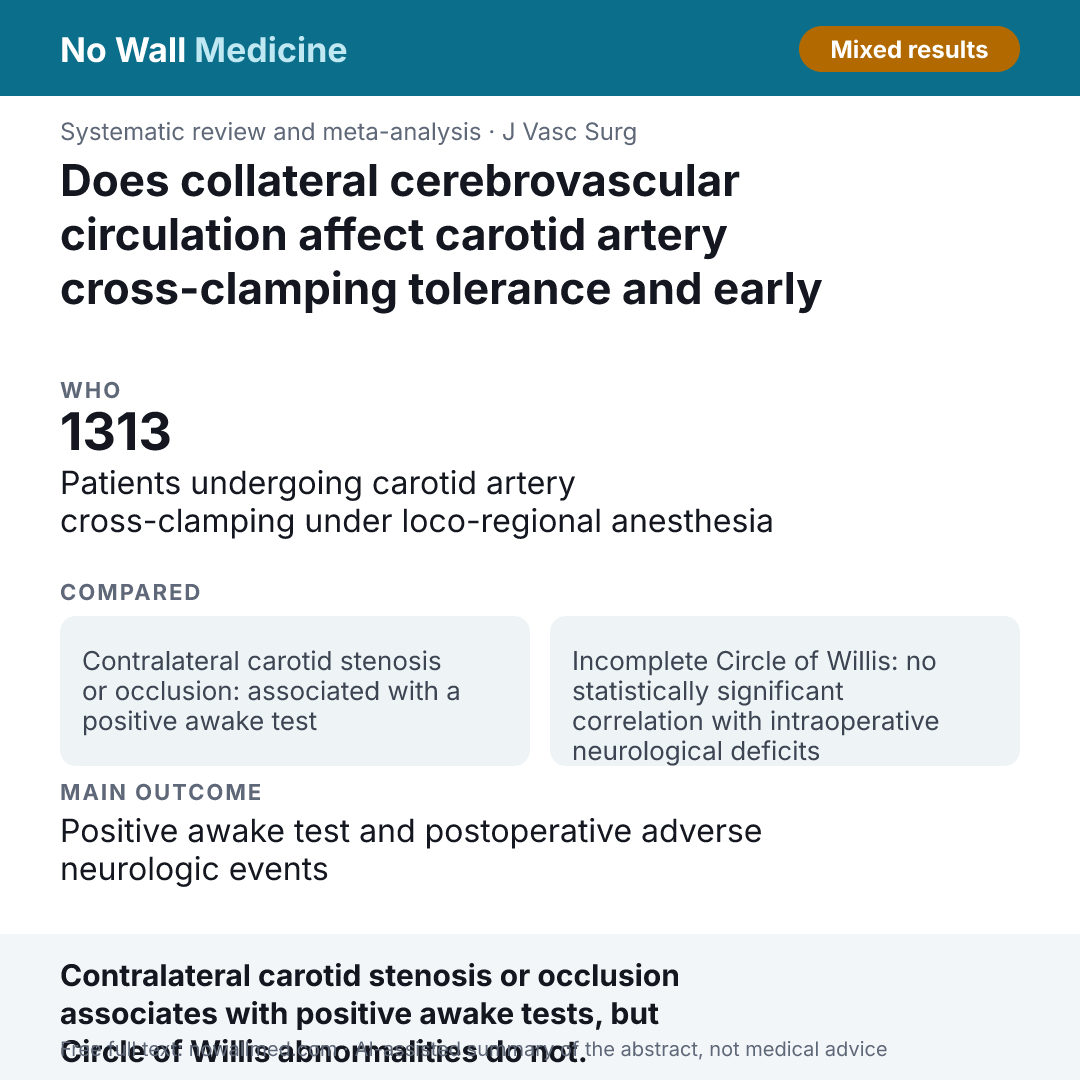
Clinical question: Does collateral cerebrovascular circulation affect carotid artery cross-clamping tolerance and early outcomes?
Key points
- Researchers reviewed eight studies involving 1313 patients who underwent carotid artery cross-clamping, which is the temporary stopping of blood flow during carotid endarterectomy.
- Contralateral carotid artery stenosis greater than 70% or occlusion was associated with a positive awake test, which is an intraoperative sign of neurologic deficit.
- An incomplete Circle of Willis, the network of blood vessels at the base of the brain, was not statistically linked to intraoperative neurologic deficits.
Headline and key points written with AI from the paper’s abstract, with every number checked against it. Read the paper before relying on them.
Was this summary helpful?
Subject terms
Headline, design, result, key points, caveat and citation as plain text.
Cite this article
Myrcha P, Pinheiro F, Rocha-Neves J, Myrcha J, Gloviczki P. The effect of the collateral cerebrovascular circulation on tolerance to carotid artery cross-clamping and on early outcome after carotid endarterectomy. J Vasc Surg. 2024;80(5):1603-1613.e6. doi:10.1016/j.jvs.2024.04.052
Spotted a mistake? Suggest a correction