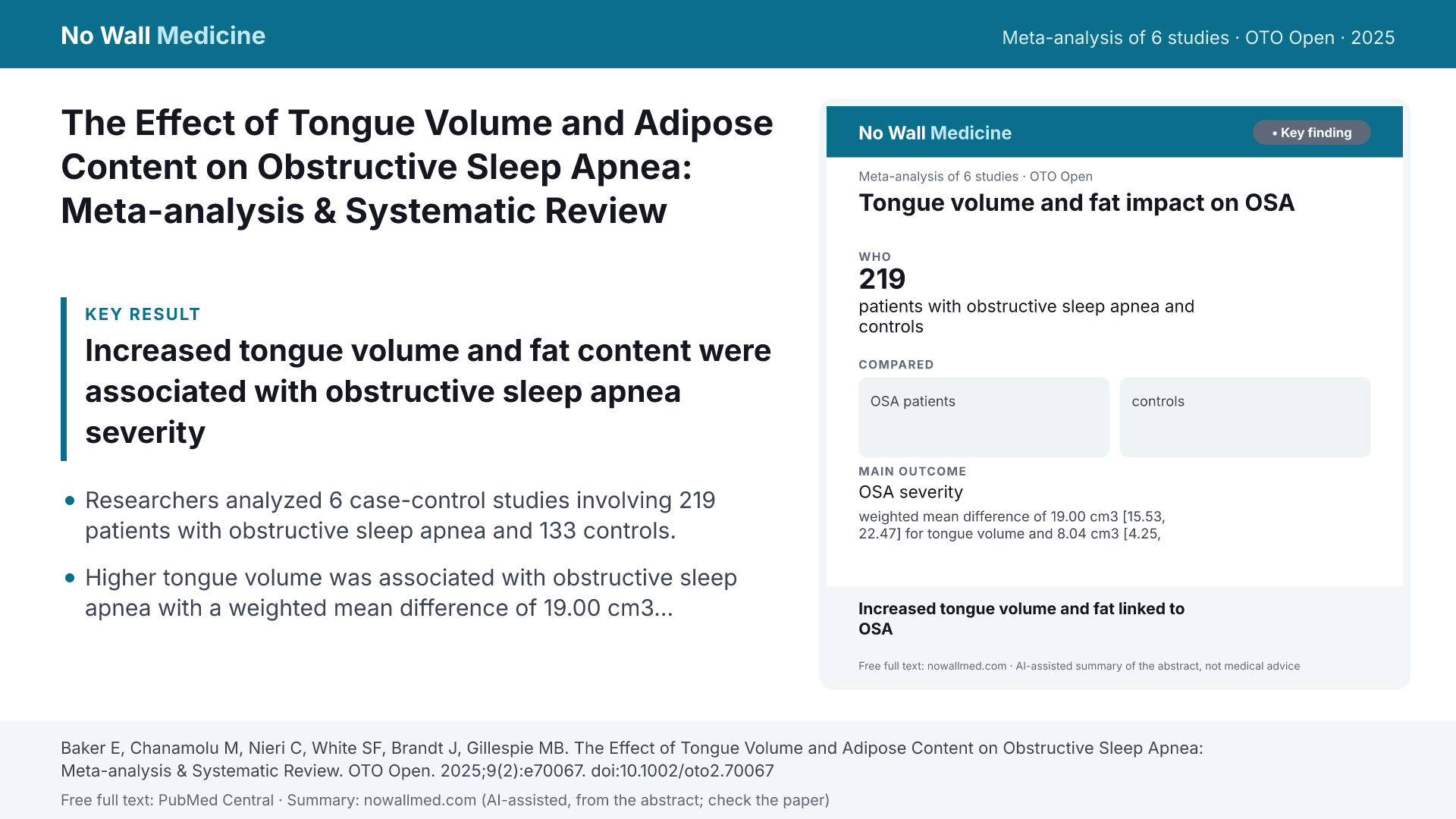
Increased tongue volume and fat content were associated with obstructive sleep apnea severity
The Effect of Tongue Volume and Adipose Content on Obstructive Sleep Apnea: Meta-analysis & Systematic Review
Meta-analysis of 6 studiesKey finding
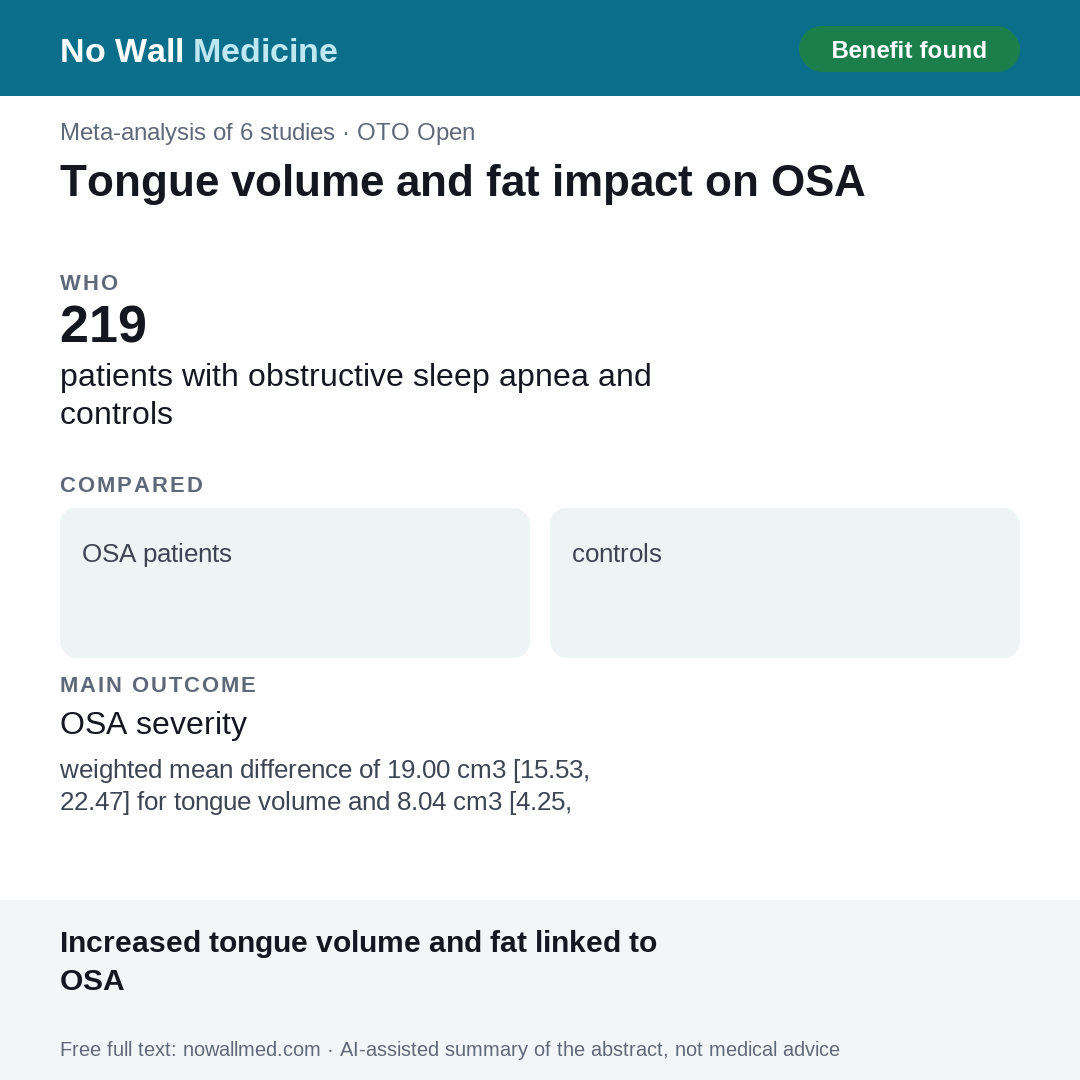
Tongue volume and fat impact on OSA
Who
219
patients with obstructive sleep apnea and controls
Compared
OSA patients
controls
Main outcome
OSA severity
Result: weighted mean difference of 19.00 cm3 [15.53, 22.47] for tongue volume and 8.04 cm3 [4.25, 11.82] for tongue fat
Bottom line: Increased tongue volume and fat linked to OSA
Limitation: small study sizes and risk of bias
OTO Open · 2025-04-25Download image
Key points
- Researchers analyzed 6 case-control studies involving 219 patients with obstructive sleep apnea and 133 controls.
- Higher tongue volume was associated with obstructive sleep apnea with a weighted mean difference of 19.00 cm3 [15.53, 22.47].
- Increased tongue fat was also associated with obstructive sleep apnea with a weighted mean difference of 8.04 cm3 [4.25, 11.82].
Limitation the authors note: The included studies were case-control designs with low or moderate risks of bias.
Headline and key points written with AI from the paper’s abstract, with every number checked against it. Read the paper before relying on them.
Was this summary helpful?
Headline, design, result, key points, caveat and citation as plain text.
Cite this article
Baker E, Chanamolu M, Nieri C, White SF, Brandt J, Gillespie MB. The Effect of Tongue Volume and Adipose Content on Obstructive Sleep Apnea: Meta-analysis & Systematic Review. OTO Open. 2025. doi:10.1002/oto2.70067
Spotted a mistake? Suggest a correction