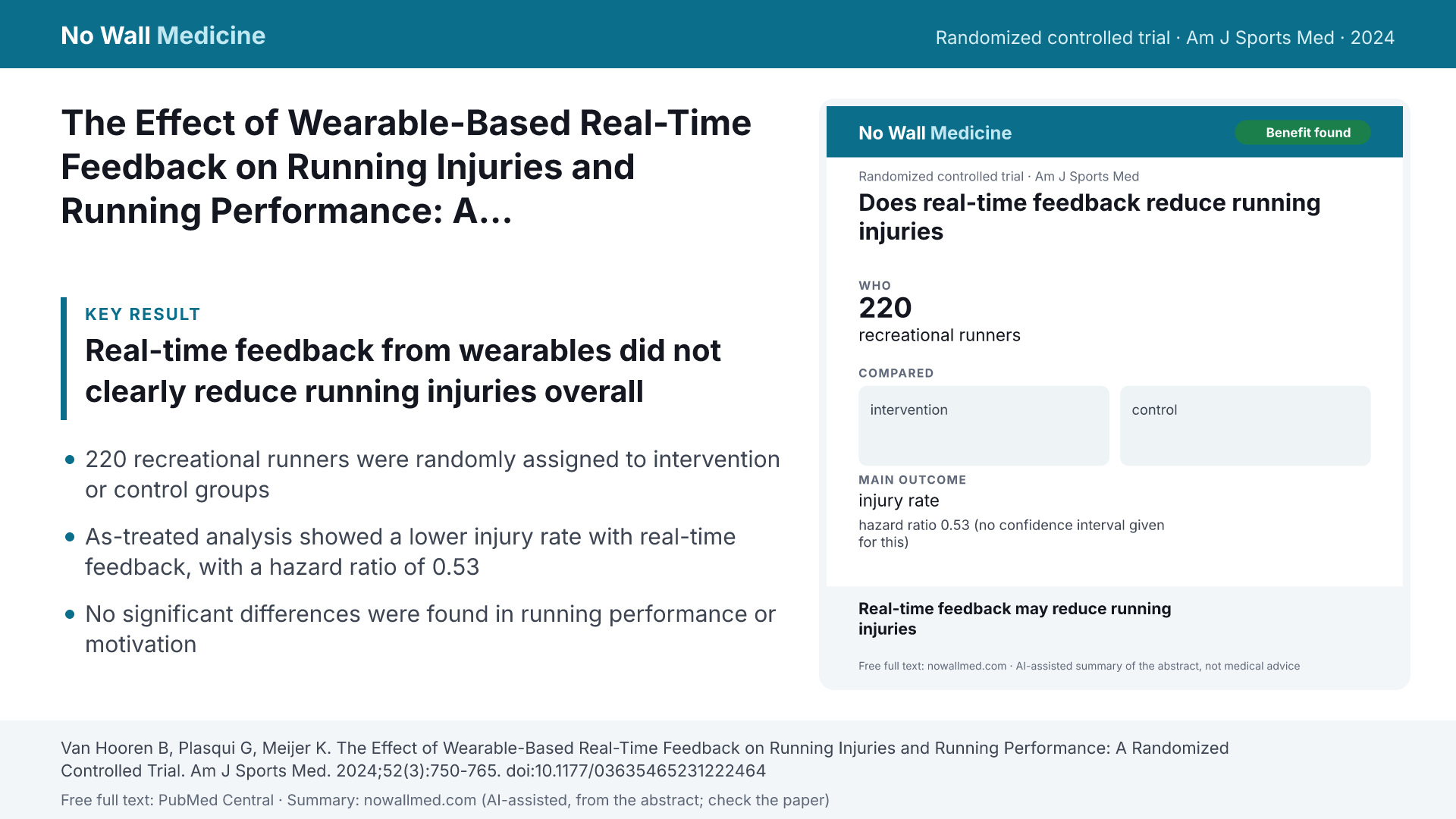
The Effect of Wearable-Based Real-Time Feedback on Running Injuries and Running Performance: A Randomized Controlled Trial
Key result: Real-time feedback from wearables did not clearly reduce running injuries overall
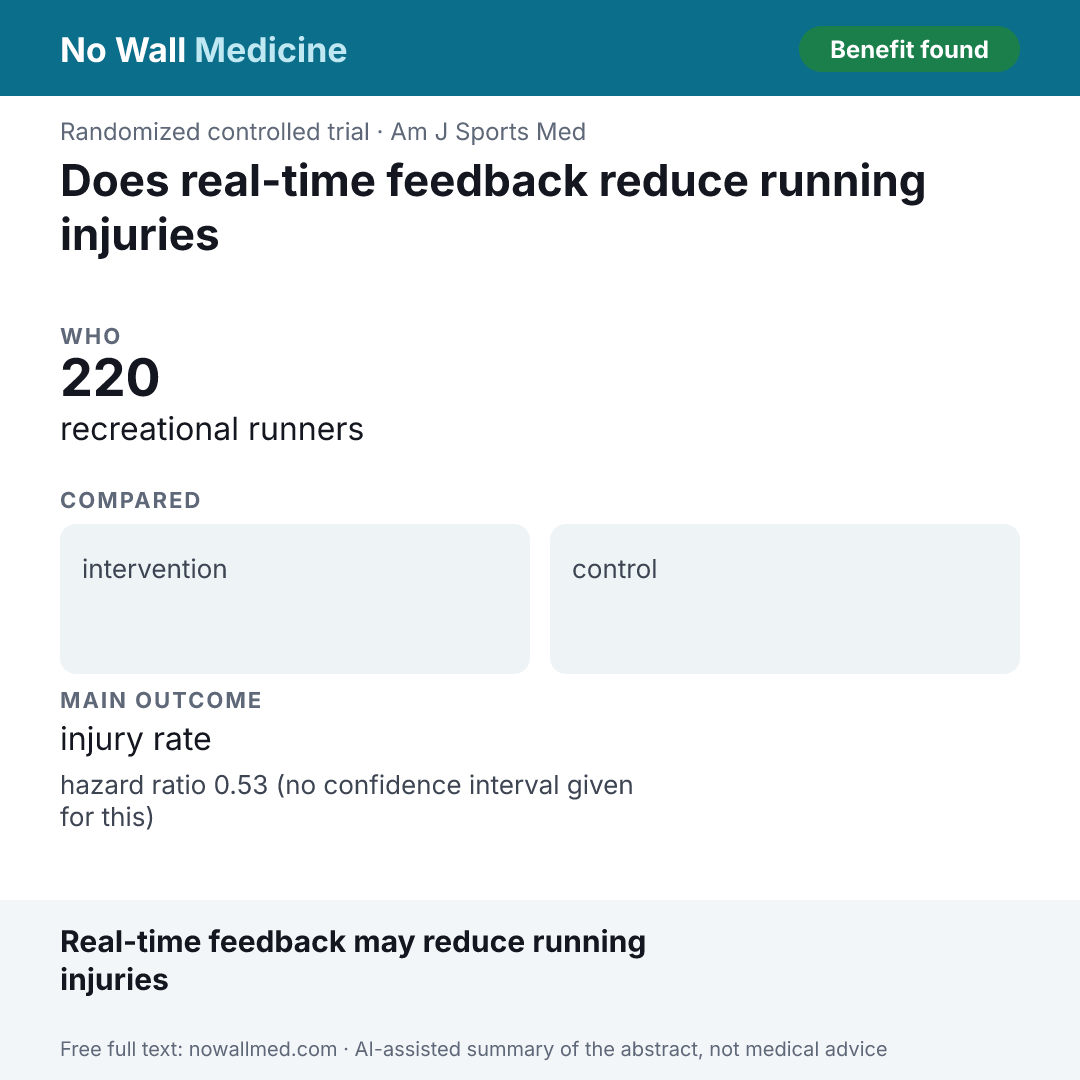
Randomized controlled trialBenefit found
Does real-time feedback reduce running injuries
Who
220
recreational runners
Compared
intervention
control
Main outcome
injury rate
Result: hazard ratio 0.53 (no confidence interval given for this)
Bottom line: Real-time feedback may reduce running injuries
Am J Sports Med · 2024-01-29 · Save PNG
Key points
- 220 recreational runners were randomly assigned to intervention or control groups.
- As-treated analysis showed a lower injury rate with real-time feedback, with a hazard ratio of 0.53.
- No significant differences were found in running performance or motivation.
Limitation the authors note: 53 of 160 participants used incorrect wearable settings, potentially nullifying interventional effects
Discussion prompts
- Would these patients look like yours? Who was left out?
- Is the main outcome one that matters to patients?
- Is the difference large enough to change what you do?
Cite: Van Hooren B, Plasqui G, Meijer K. The Effect of Wearable-Based Real-Time Feedback on Running Injuries and Running Performance: A Randomized Controlled Trial. Am J Sports Med. 2024;52(3):750-765. doi:10.1177/03635465231222464
Free full text: PubMed Central · Summary and visual abstract: nowallmed.com/a/the-effect-of-wearable-based-real-time-feedback-on-running-injuries-pzz52h/ (AI-assisted from the abstract; check the paper before relying on it).