Conversational agents showed benefits for physical activity, pain, anxiety, and quality of life in cancer patients
The Effectiveness and Feasibility of Conversational Agents in Supporting Care for Patients With Cancer: Systematic Review and Meta-Analysis
Systematic review and meta-analysisBenefit found
Are conversational agents effective and feasible for supporting cancer patient care?
Who
1817
Patients with cancer
Compared
Conversational agents
Control
Main outcome
Physical activity, pain, anxiety, depression, psychological distress, and quality of life
Result: MD=1.44 (95% CI 0.36-2.52) for physical activity; MD=-0.91 (95% CI -1.44 to -0.38) for pain; SMD=-0.19 (95% CI -0.35 to -0.02) for anxiety; SMD=0.35 (95% CI 0.03-0.67) for quality of life
Bottom line: Conversational agents are feasible and effective for improving physical activity, pain, anxiety, and quality of life in cancer patients.
Limitation: User engagement tended to decline over time and psychological benefits were limited.
J Med Internet Res · 2025-08-08Download image
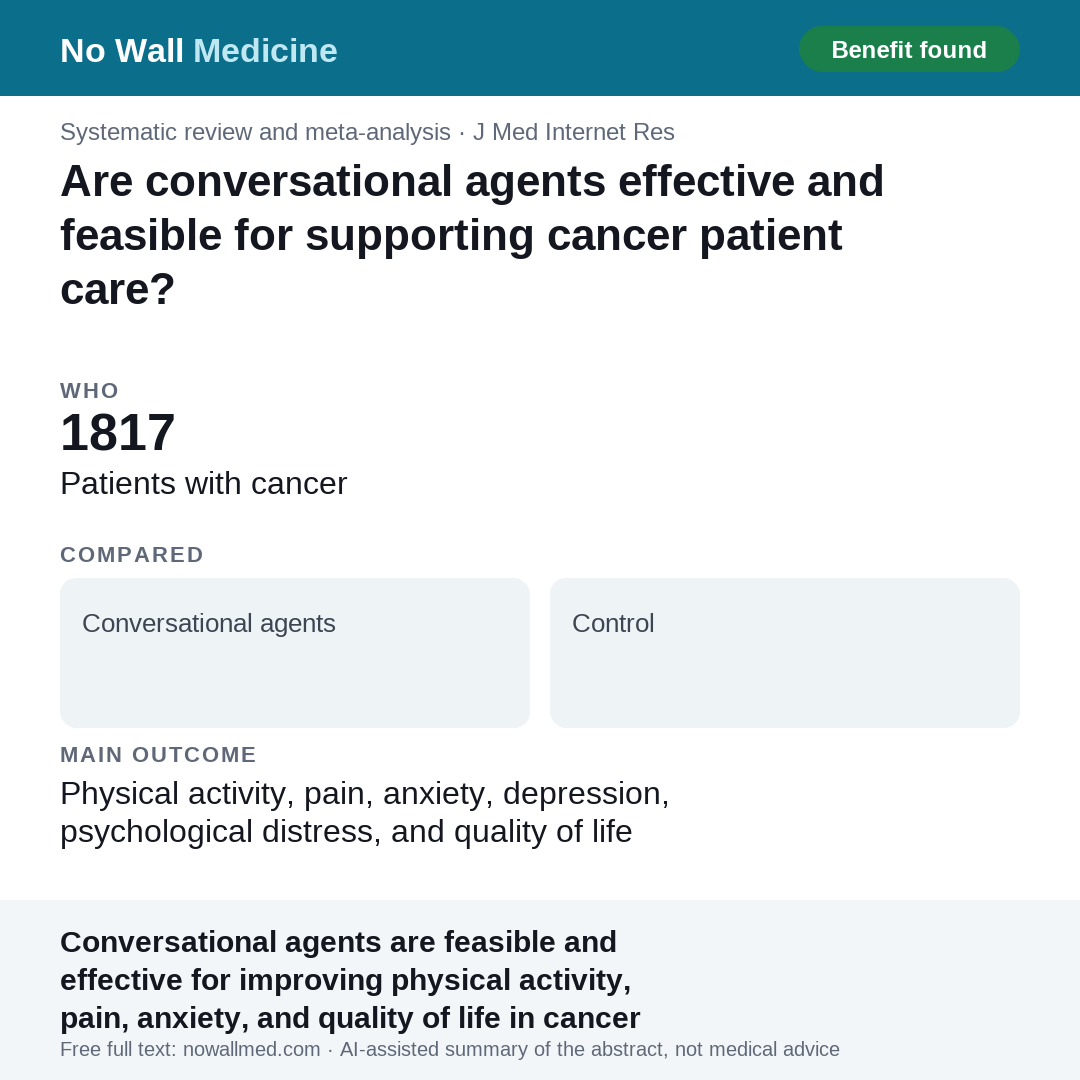
Clinical question: Are conversational agents effective and feasible for supporting cancer patient care?
Why it matters: Evidence is limited regarding whether conversational agents are feasible and effective for supporting the complex physical and psychosocial needs of cancer patients.
Key points
- Researchers analyzed 17 studies involving 1817 patients with cancer to evaluate conversational agents, which are digital tools that use natural language to interact with users.
- Meta-analysis of 10 studies showed improvements in physical activity (MD=1.44, 95% CI 0.36-2.52), pain (MD=-0.91, 95% CI -1.44 to -0.38), anxiety (SMD=-0.19, 95% CI -0.35 to -0.02), and quality of life (SMD=0.35, 95% CI 0.03-0.67).
- No significant effects were observed for depression (SMD=-0.07, 95% CI -0.42 to 0.27) or psychological distress (SMD=-0.33, 95% CI -0.66 to 0.01).
Limitation the authors note: User engagement tended to decline over time, and the authors noted that robust evidence from large-scale randomized controlled trials is still needed.
Headline and key points written with AI from the paper’s abstract, with every number checked against it. Read the paper before relying on them.
Topics
Cite this article
Jiang XH, Yuan XH, Zhao H, Peng JS. The Effectiveness and Feasibility of Conversational Agents in Supporting Care for Patients With Cancer: Systematic Review and Meta-Analysis. J Med Internet Res. 2025. doi:10.2196/76968
Spotted a mistake? Suggest a correction
Top studies every Monday
The week’s key trials and guidelines in your specialties, by email. Free.
Get the weekly digest