All feedback methods improve performance in cardiac arrest simulation training for healthcare professionals
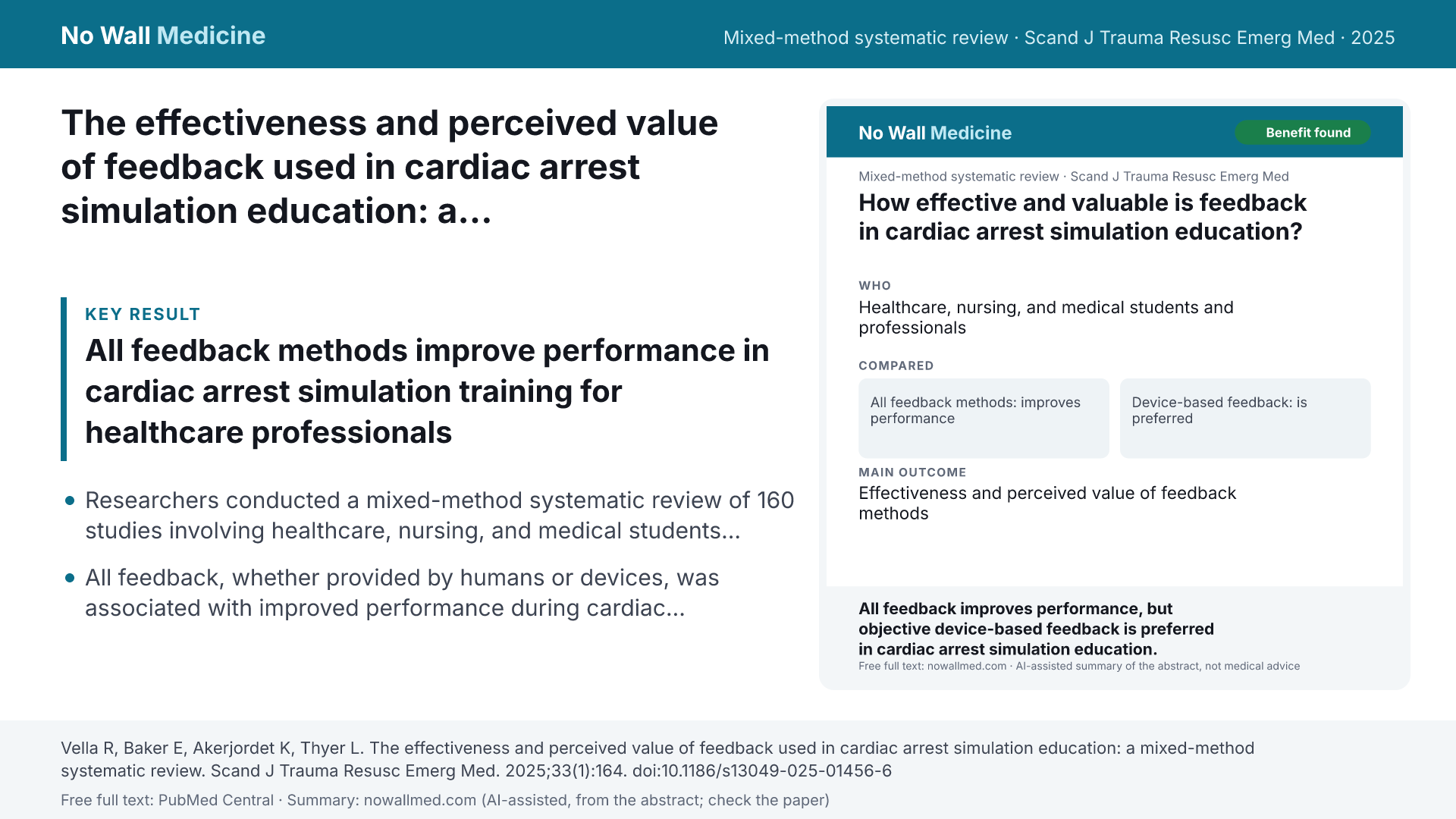
The effectiveness and perceived value of feedback used in cardiac arrest simulation education: a mixed-method systematic review
Mixed-method systematic reviewBenefit found
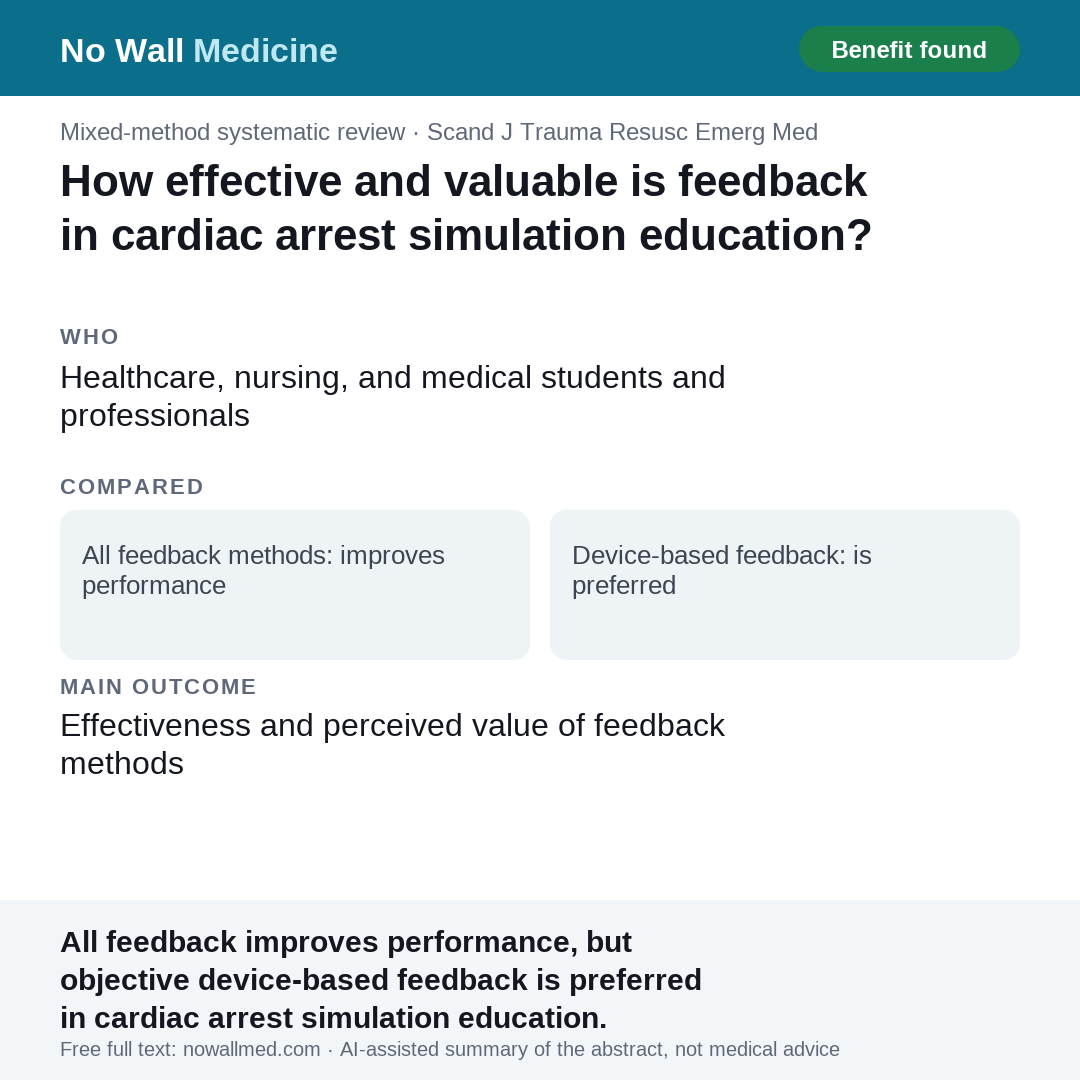
How effective and valuable is feedback in cardiac arrest simulation education?
Who
Healthcare, nursing, and medical students and professionals
Compared
All feedback methods: improves performance
Device-based feedback: is preferred
Main outcome
Effectiveness and perceived value of feedback methods
Bottom line: All feedback improves performance, but objective device-based feedback is preferred in cardiac arrest simulation education.
Limitation: Limited research on non-technical aspects and qualitative explorations of participant experiences.
Scand J Trauma Resusc Emerg Med · 2025-10-10Download image
Clinical question: How effective and valuable is feedback in cardiac arrest simulation education?
Why it matters: It is unclear how different feedback methods impact performance and how learners perceive their value during cardiac arrest simulation training.
Key points
- Researchers conducted a mixed-method systematic review of 160 studies involving healthcare, nursing, and medical students and professionals.
- All feedback, whether provided by humans or devices, was associated with improved performance during cardiac arrest simulations.
- Participants expressed a preference for objective, device-based feedback over other methods.
Limitation the authors note: Current literature primarily focuses on technical skills and lacks sufficient research on non-technical aspects and qualitative participant experiences.
Headline and key points written with AI from the paper’s abstract, with every number checked against it. Read the paper before relying on them.
Was this summary helpful?
Subject terms
Cite this article
Vella R, Baker E, Akerjordet K, Thyer L. The effectiveness and perceived value of feedback used in cardiac arrest simulation education: a mixed-method systematic review. Scand J Trauma Resusc Emerg Med. 2025. doi:10.1186/s13049-025-01456-6
Spotted a mistake? Suggest a correction