Chatbot intervention for eating disorder waitlists improved pathology, depression, and anxiety symptoms
The Effectiveness of a Chatbot Single-Session Intervention for People on Waitlists for Eating Disorder Treatment: Randomized Controlled Trial
Multicenter 2-armed randomized controlled trialBenefit found
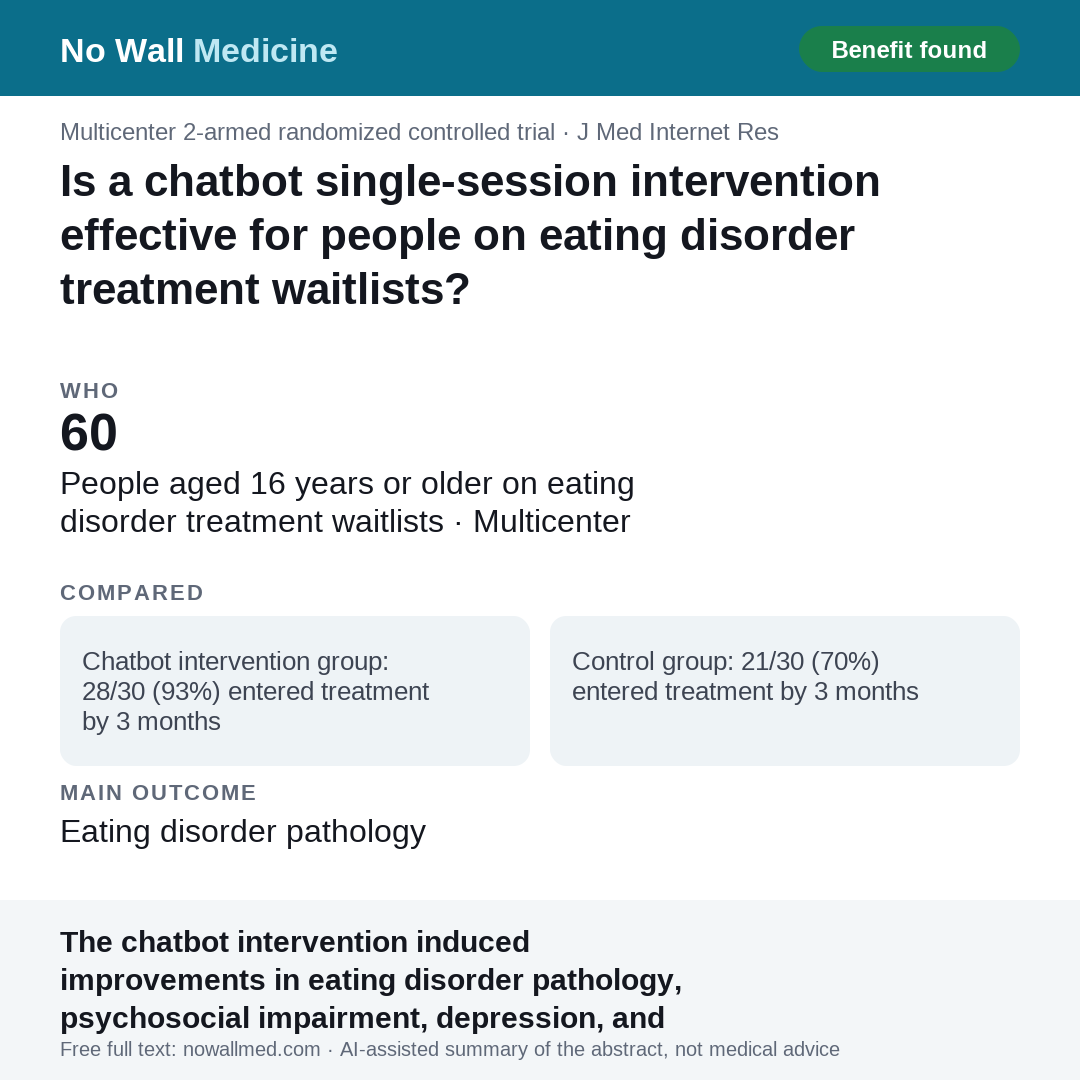
Is a chatbot single-session intervention effective for people on eating disorder treatment waitlists?
Who
60
People aged 16 years or older on eating disorder treatment waitlists · Multicenter
Compared
Chatbot intervention group: 28/30 (93%) entered treatment by 3 months
Control group: 21/30 (70%) entered treatment by 3 months
Main outcome
Eating disorder pathology
Result: Cohen d=0.15-0.53
Bottom line: The chatbot intervention induced improvements in eating disorder pathology, psychosocial impairment, depression, and anxiety maintained up to 3 months.
Limitation: Further research is needed to determine the longer-term effectiveness of ED ESSI.
J Med Internet Res · 2025-05-21Download image
Clinical question: Is a chatbot single-session intervention effective for people on eating disorder treatment waitlists?
Why it matters: The effectiveness of a single-session intervention delivered by a chatbot for people waiting for eating disorder treatment has not been investigated.
Key points
- Researchers conducted a randomized controlled trial with 60 people aged 16 or older waiting for eating disorder treatment, comparing a chatbot to web-based information.
- The chatbot group showed significantly greater reductions in eating disorder pathology, psychosocial impairment, depression, and anxiety at 1 and 3 months compared to the control group.
- A higher proportion of participants in the chatbot group (28/30, 93%) entered treatment by 3 months compared to the control group (21/30, 70%).
Limitation the authors note: Further research is needed to determine the longer-term effectiveness of ED ESSI.
Headline and key points written with AI from the paper’s abstract, with every number checked against it. Read the paper before relying on them.
Topics
Cite this article
Sharp G, Dwyer B, Randhawa A, McGrath I, Hu H. The Effectiveness of a Chatbot Single-Session Intervention for People on Waitlists for Eating Disorder Treatment: Randomized Controlled Trial. J Med Internet Res. 2025. doi:10.2196/70874
Spotted a mistake? Suggest a correction
Top studies every Monday
The week’s key trials and guidelines in your specialties, plus any topics you follow. By email, free.
Get the weekly digest