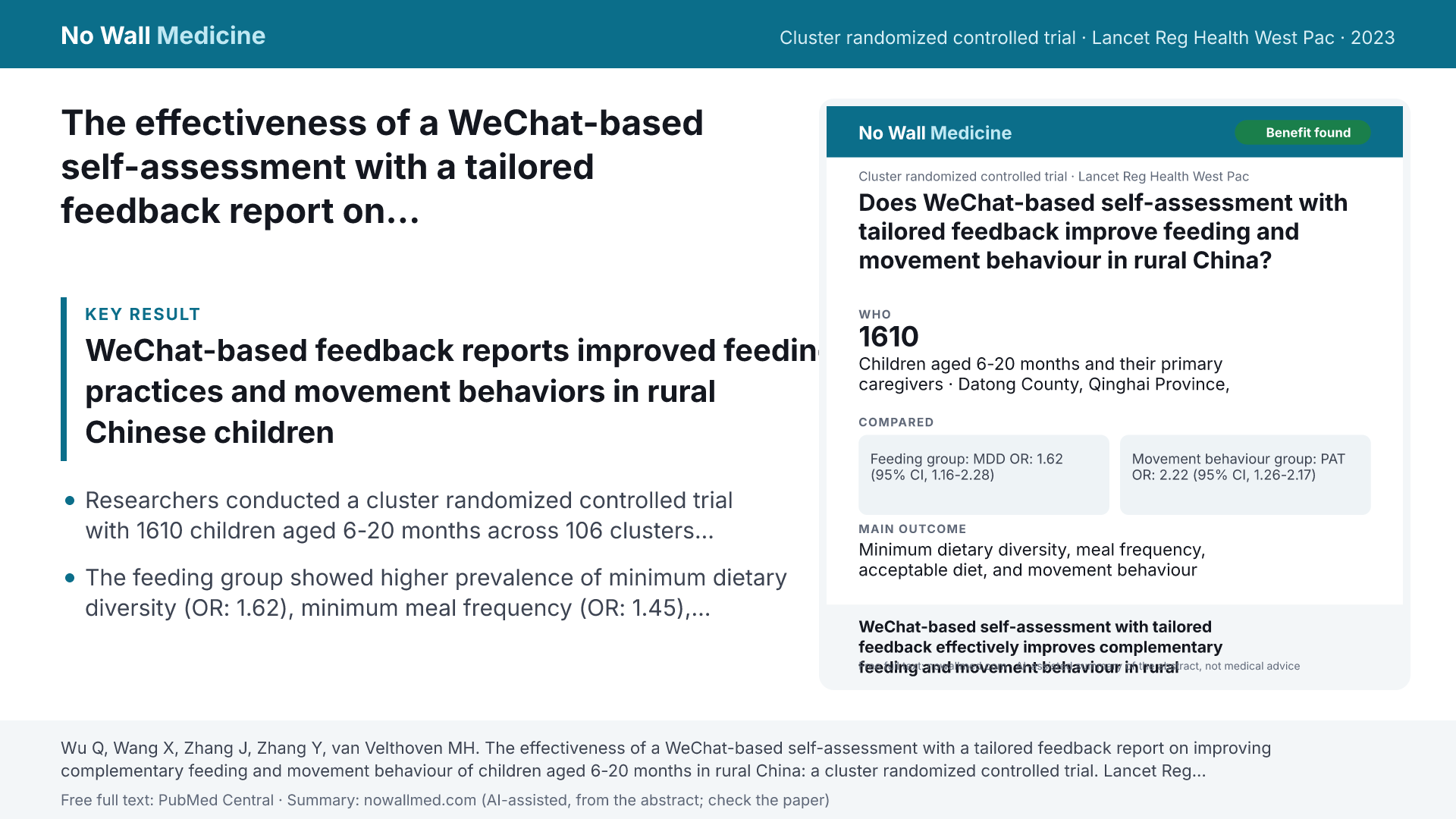
WeChat-based feedback reports improved feeding practices and movement behaviors in rural Chinese children
The effectiveness of a WeChat-based self-assessment with a tailored feedback report on improving complementary feeding and movement behaviour of children aged 6-20 months in rural China: a cluster randomized controlled trial
Cluster randomized controlled trialBenefit found
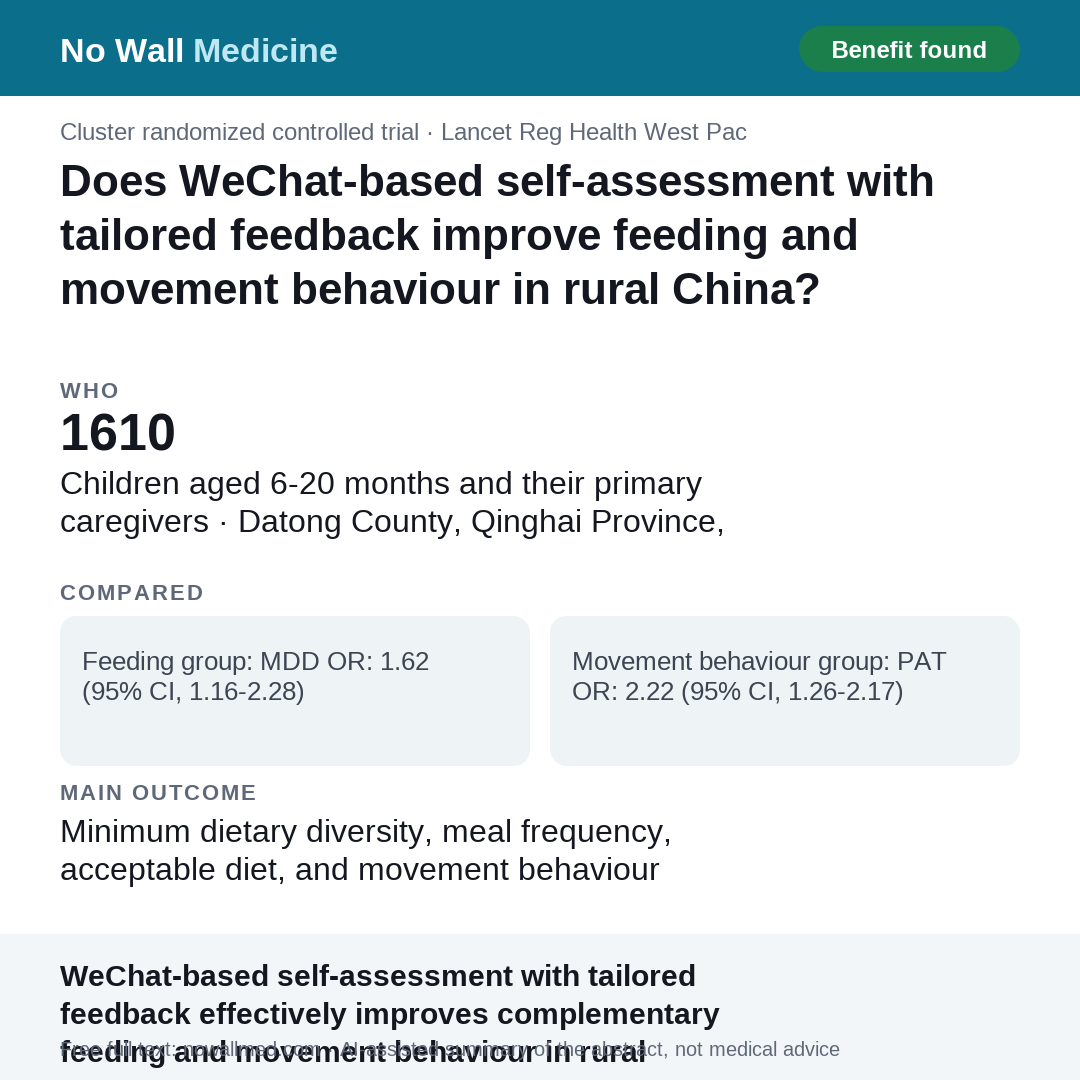
Does WeChat-based self-assessment with tailored feedback improve feeding and movement behaviour in rural China?
Who
1610
Children aged 6-20 months and their primary caregivers · Datong County, Qinghai Province, China
Compared
Feeding group: MDD OR: 1.62 (95% CI, 1.16-2.28)
Movement behaviour group: PAT OR: 2.22 (95% CI, 1.26-2.17)
Main outcome
Minimum dietary diversity, meal frequency, acceptable diet, and movement behaviour
Result: MDD OR: 1.62 (95% CI, 1.16-2.28); PAT OR: 2.22 (95% CI, 1.26-2.17)
Bottom line: WeChat-based self-assessment with tailored feedback effectively improves complementary feeding and movement behaviour in rural China.
Funded by: Capital Institute of Pediatrics
Lancet Reg Health West Pac · 2023-05-29Download image
Clinical question: Does WeChat-based self-assessment with tailored feedback improve feeding and movement behaviour in rural China?
Why it matters: It was unknown if using the WeChat social media app to provide self-assessments and tailored feedback could improve infant feeding and movement behaviors in rural areas.
Key points
- Researchers conducted a cluster randomized controlled trial with 1610 children aged 6-20 months across 106 clusters in rural China.
- The feeding group showed higher prevalence of minimum dietary diversity (OR: 1.62), minimum meal frequency (OR: 1.45), and minimum acceptable diet (OR: 1.51) compared to the movement group.
- The movement behavior group had higher proportions of children meeting physical activity time (OR: 2.22) and outdoor time (OR: 1.94) recommendations at the second follow-up.
Headline and key points written with AI from the paper’s abstract, with every number checked against it. Read the paper before relying on them.
Was this summary helpful?
Abstract
Background
Appropriate infant feeding and movement behaviour (i.e. physical activity, sedentary behaviour, sleep) play an important role in children's healthy development during the first two years of life. The popular Chinese social media app 'WeChat' has become a potential data collection and health promotion tool. We aimed to evaluate the effectiveness of a WeChat-based self-assessment with a tailored feedback report on improving complementary feeding practices and movement behaviour of children aged 6-20 months in rural China. Methods
We conducted a two-armed cluster randomized control trial in Datong County, Qinghai Province, China. There were 106 clusters from 257 villages allocated (1:1) to two groups: the feeding group, which received a complementary feeding recommendations feedback report; the movement behaviour group, which received movement behaviour recommendations feedback report. The feeding group acted as a control for the movement behaviour group and vice versa. Children aged 6-20 months and their primary caregivers were invited to be participants. WeChat was used to collect the data on outcomes and to deliver the interventions. Participants received the interventions by filling out the WeChat self-assessment questionnaire and reading tailored feedback reports at baseline, at the first 1-month follow-up and at the second 2-month follow-up. Outcome measures included changes in the prevalence of minimum dietary diversity (MDD), minimum meal frequency (MMF), minimum acceptable diet (MAD); and the proportion of children who met physical activity time (PAT), outdoor time (OT) and screen time (ST) recommendation between the two groups at the two follow-ups. This study is registered at Chinese Clinical Trial Registry-ChiCTR2200062529. Findings
Between September 28th and October 12th 2022, we recruited 1610 children in 106 clusters, of which 53 clusters (800 children) were randomized to the feeding group and 53 clusters (810 children) to the movement behaviour group. All caregivers of children completed questionnaires at three time points without loss to follow-up. From baseline to the second follow-up, the prevalence of MDD (OR: 1.62 [95% CI, 1.16-2.28; p = 0.0058]), MMF (OR: 1.45 [95% CI, 1.03-2.04; p = 0.032]) and MAD (OR: 1.51 [95% CI, 1.12-2.05; p = 0.0081]) in the feeding group were significantly higher than that in the movement behaviour group. The proportion of children who met PAT during the last 24 h at the second follow-up (OR: 2.22 [95% CI, 1.26-2.17; p < 0.0001]) and OT at the second follow-up (OR: 1.94 [95% CI, 1.49-2.54; p < 0.0001]) significantly improved in the movement behaviour group compared to the feeding group. Furthermore, ST in the movement behaviour group showed a significant increase only at the first follow-up (OR: 1.36 [95% CI, 1.02-1.82; p = 0.036]). Interpretation
WeChat-based self-assessment with tailored feedback was an effective channel to deliver feeding and movement behaviour recommendations in rural China in our study. This approach can be applied to change feeding practices of caregivers of young children alongside routine child health care in rural China. Funding
Capital Institute of Pediatrics.
Abstract reproduced under the article’s CC BY-NC-ND licence.
Cite this article
Wu Q, Wang X, Zhang J, Zhang Y, van Velthoven MH. The effectiveness of a WeChat-based self-assessment with a tailored feedback report on improving complementary feeding and movement behaviour of children aged 6-20 months in rural China: a cluster randomized controlled trial. Lancet Reg Health West Pac. 2023. doi:10.1016/j.lanwpc.2023.100796
Spotted a mistake? Suggest a correction
Top studies every Monday
The week’s key trials and guidelines in your specialties, plus any topics you follow. By email, free.
Get the weekly digest