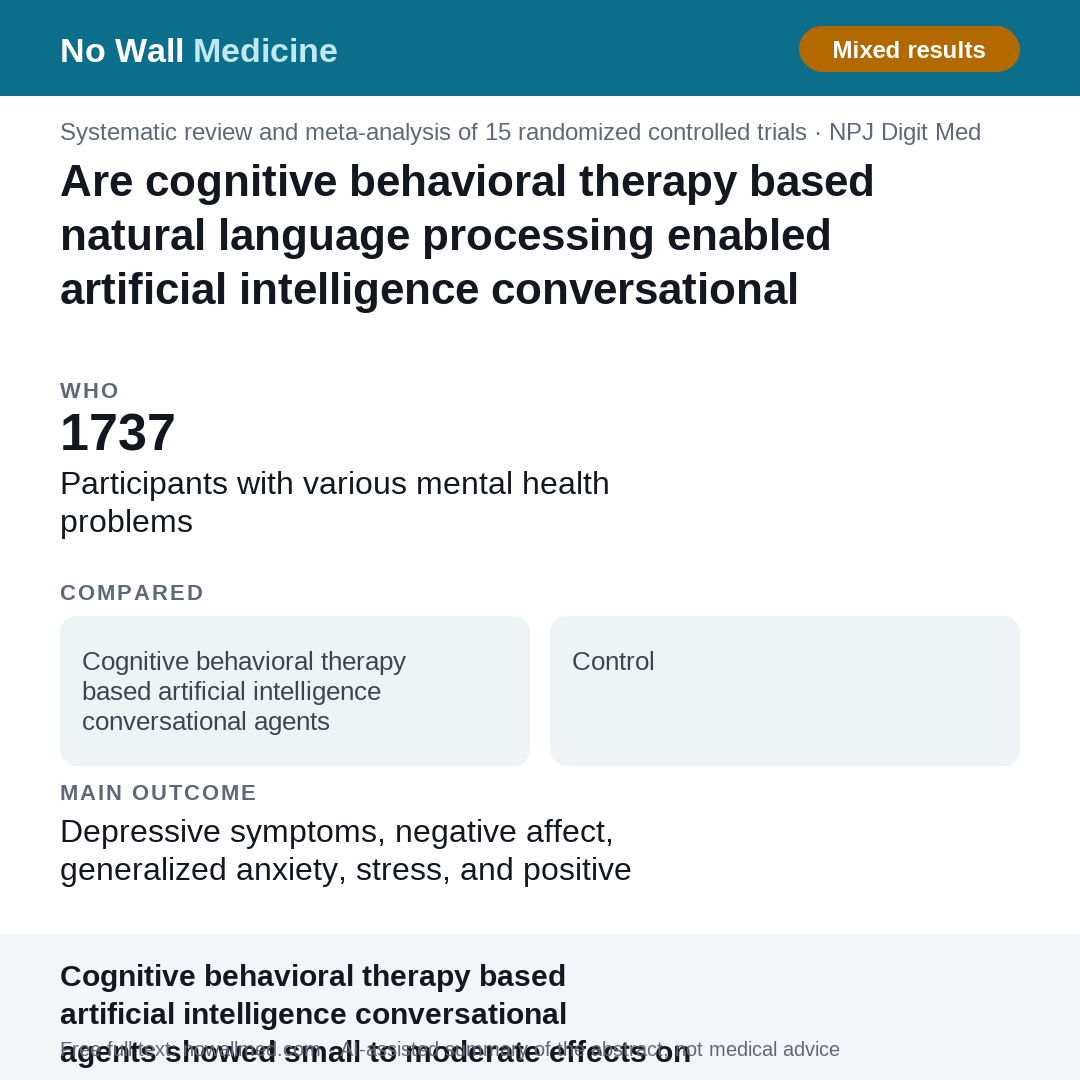
Systematic review and meta-analysis of 15 randomized controlled trialsMixed results
Are cognitive behavioral therapy based natural language processing enabled artificial intelligence conversational agents effective?
Who
1737
Participants with various mental health problems
Compared
Cognitive behavioral therapy based artificial intelligence conversational agents
Control
Main outcome
Depressive symptoms, negative affect, generalized anxiety, stress, and positive affect
Bottom line: Cognitive behavioral therapy based artificial intelligence conversational agents showed small to moderate effects on depressive symptoms and negative affect.
Limitation: Higher quality studies reported larger effect sizes, suggesting true efficacy may be underestimated.
Clinical question: Are cognitive behavioral therapy based natural language processing enabled artificial intelligence conversational agents effective?
Why it matters: The effectiveness of artificial intelligence conversational agents grounded in cognitive behavioral therapy for various mental health problems remains unclear.
Key points
Researchers analyzed 15 randomized controlled trials involving 1737 participants to evaluate the effectiveness of artificial intelligence conversational agents using natural language processing and cognitive behavioral therapy.
The agents showed a small to moderate effect on depressive symptoms and a small effect on negative affect, but effects on anxiety, stress, and positive affect were not significant.
Subgroup analyses suggested that younger age was associated with a greater reduction in depressive symptoms and that multi-modal agents may be more effective than single-modality agents.
Headline and key points written with AI from the paper’s abstract, with every number checked against it. Read the paper before relying on them.
ClinicalAge, a framework for modelling ageing trajectories from longitudinal electronic health records in the UK: a model development and validation study
A prognostic model for use at labour onset to estimate the risk of severe fetal compromise at birth: a retrospective, model development and validation study