The effectiveness of coronary computed tomography angiography and functional testing for the diagnosis of obstructive coronary artery disease: results from the individual patient data Collaborative Meta-Analysis of Cardiac CT (COME-CCT)
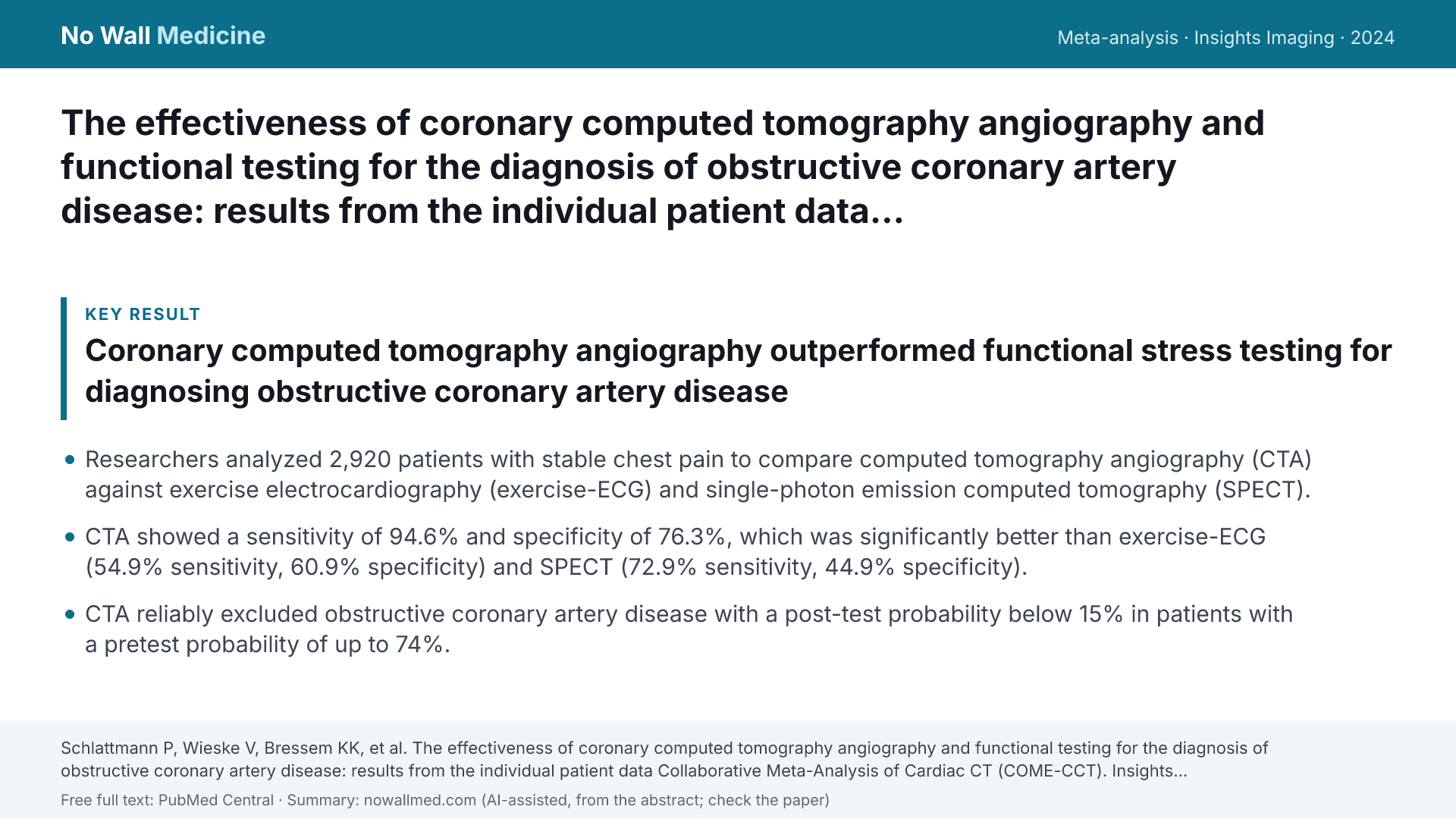
Key result: Coronary computed tomography angiography outperformed functional stress testing for diagnosing obstructive coronary artery disease
Key points
- Researchers analyzed 2,920 patients with stable chest pain to compare computed tomography angiography (CTA) against exercise electrocardiography (exercise-ECG) and single-photon emission computed tomography (SPECT).
- CTA showed a sensitivity of 94.6% and specificity of 76.3%, which was significantly better than exercise-ECG (54.9% sensitivity, 60.9% specificity) and SPECT (72.9% sensitivity, 44.9% specificity).
- CTA reliably excluded obstructive coronary artery disease with a post-test probability below 15% in patients with a pretest probability of up to 74%.
Discussion prompts
- Would these patients look like yours? Who was left out?
- Is the main outcome one that matters to patients?
- Is the difference large enough to change what you do?
Cite: Schlattmann P, Wieske V, Bressem KK, et al. The effectiveness of coronary computed tomography angiography and functional testing for the diagnosis of obstructive coronary artery disease: results from the individual patient data Collaborative Meta-Analysis of Cardiac CT (COME-CCT). Insights Imaging. 2024;15(1):208. doi:10.1186/s13244-024-01702-y
Free full text: PubMed Central · Summary and visual abstract: nowallmed.com/a/the-effectiveness-of-coronary-computed-tomography-angiography-and-ubhc9o/ (AI-assisted from the abstract; check the paper before relying on it).