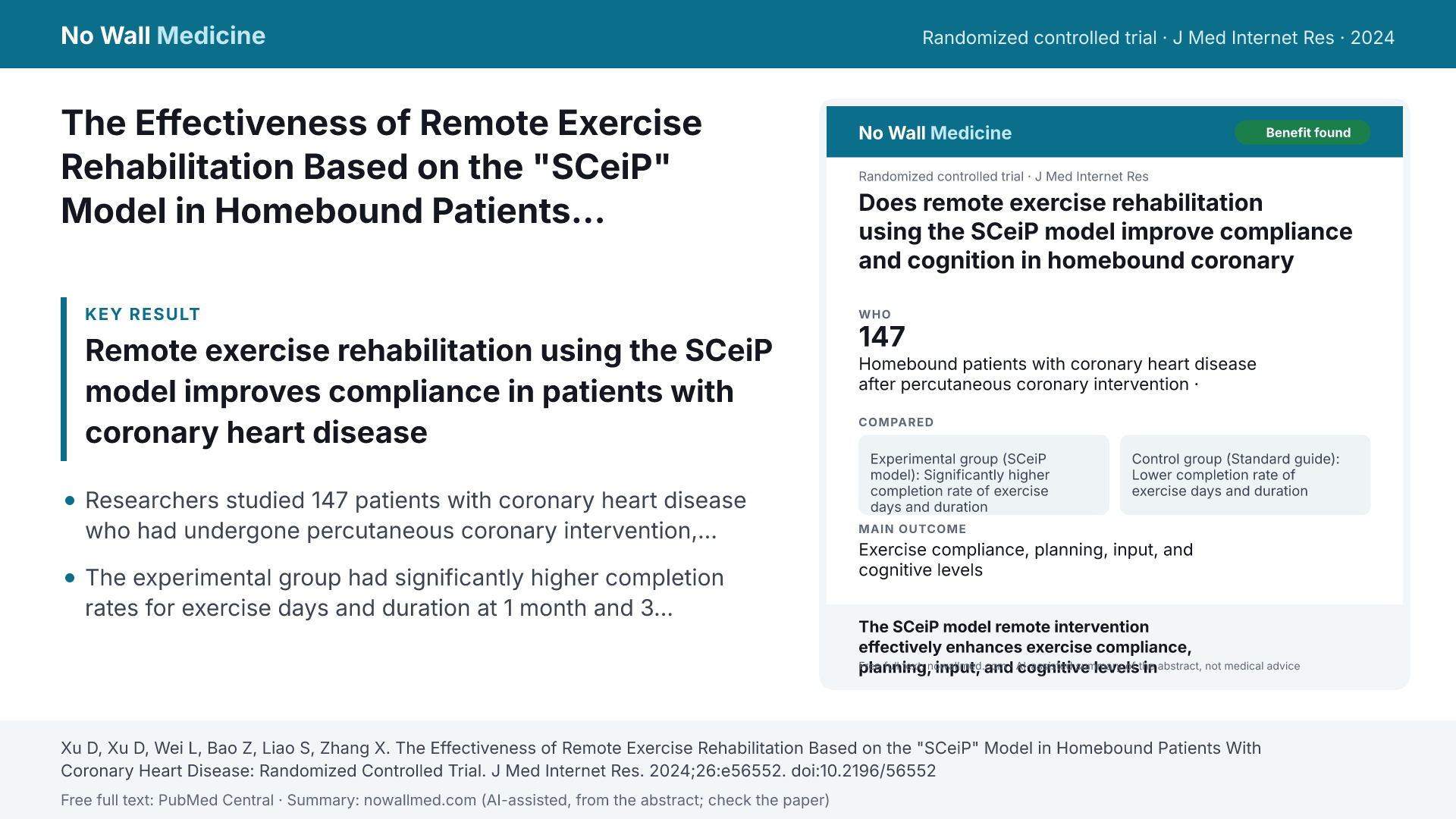
The Effectiveness of Remote Exercise Rehabilitation Based on the "SCeiP" Model in Homebound Patients With Coronary Heart Disease: Randomized Controlled Trial
Key result: Remote exercise rehabilitation using the SCeiP model improves compliance in patients with coronary heart disease
Randomized controlled trialBenefit found
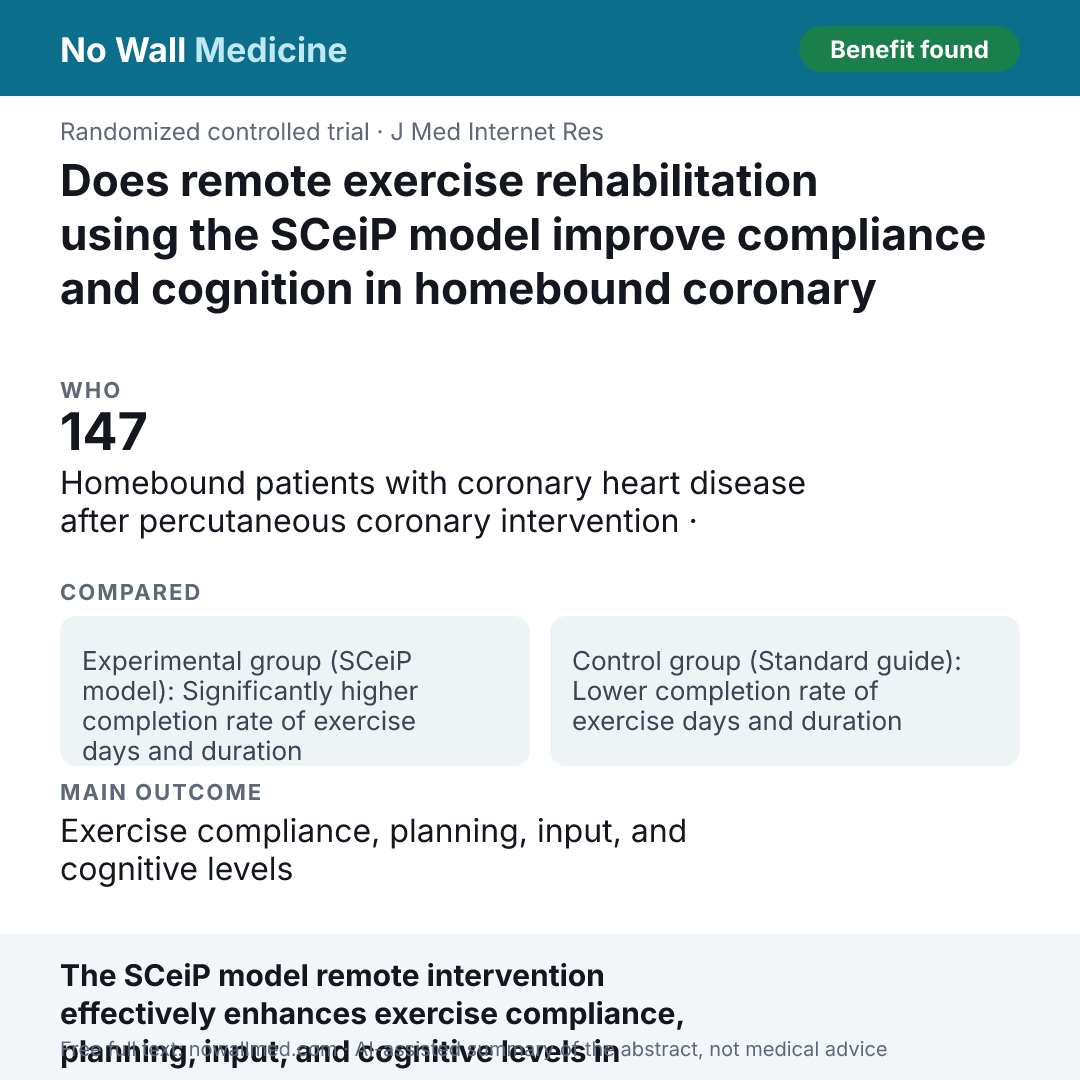
Does remote exercise rehabilitation using the SCeiP model improve compliance and cognition in homebound coronary heart disease patients?
Who
147
Homebound patients with coronary heart disease after percutaneous coronary intervention · Grade III hospital in Jiangsu Province
Compared
Experimental group (SCeiP model): Significantly higher completion rate of exercise days and duration
Control group (Standard guide): Lower completion rate of exercise days and duration
Main outcome
Exercise compliance, planning, input, and cognitive levels
Bottom line: The SCeiP model remote intervention effectively enhances exercise compliance, planning, input, and cognitive levels in coronary heart disease patients.
J Med Internet Res · 2024-11-05 · Save PNG
Key points
- Researchers studied 147 patients with coronary heart disease who had undergone percutaneous coronary intervention, comparing a remote SCeiP model to standard rehabilitation guides.
- The experimental group had significantly higher completion rates for exercise days and duration at 1 month and 3 months compared to the control group.
- Patients using the remote model showed higher levels of autonomy, exercise planning, and exercise input, alongside lower scores for process and outcome anxiety.
Why it matters: Long-term adherence to exercise rehabilitation is often low among patients with coronary heart disease.
Discussion prompts
- Would these patients look like yours? Who was left out?
- Is the main outcome one that matters to patients?
- Is the difference large enough to change what you do?
Cite: Xu D, Xu D, Wei L, Bao Z, Liao S, Zhang X. The Effectiveness of Remote Exercise Rehabilitation Based on the "SCeiP" Model in Homebound Patients With Coronary Heart Disease: Randomized Controlled Trial. J Med Internet Res. 2024;26:e56552. doi:10.2196/56552
Free full text: PubMed Central · Summary and visual abstract: nowallmed.com/a/the-effectiveness-of-remote-exercise-rehabilitation-based-on-the-z16oj6/ (AI-assisted from the abstract; check the paper before relying on it).