Tissue perfusion guided therapy did not reduce mortality in patients with shock
The effectiveness of tissue-perfusion-guided resuscitation in shock: A systematic review and meta-analysis
Meta-analysis of 8 randomized controlled trialsNo clear difference
Is tissue-perfusion-guided therapy effective compared to standard care in adult patients with shock?
Who
2394
Adult patients with shock
Compared
Tissue-perfusion-guided therapy
Standard care
Main outcome
30-day and 90-day mortality
Result: Risk Ratio 0.96 (95% CI 0.83-1.10) for 30-day mortality
Bottom line: Tissue-perfusion-guided therapy did not reduce mortality but significantly reduced early fluid administration volumes.
Limitation: The finding of shorter intensive care unit length of stay proved fragile in sensitivity analyses.
Ann Intensive Care · 2026-06-25 · Save PNG
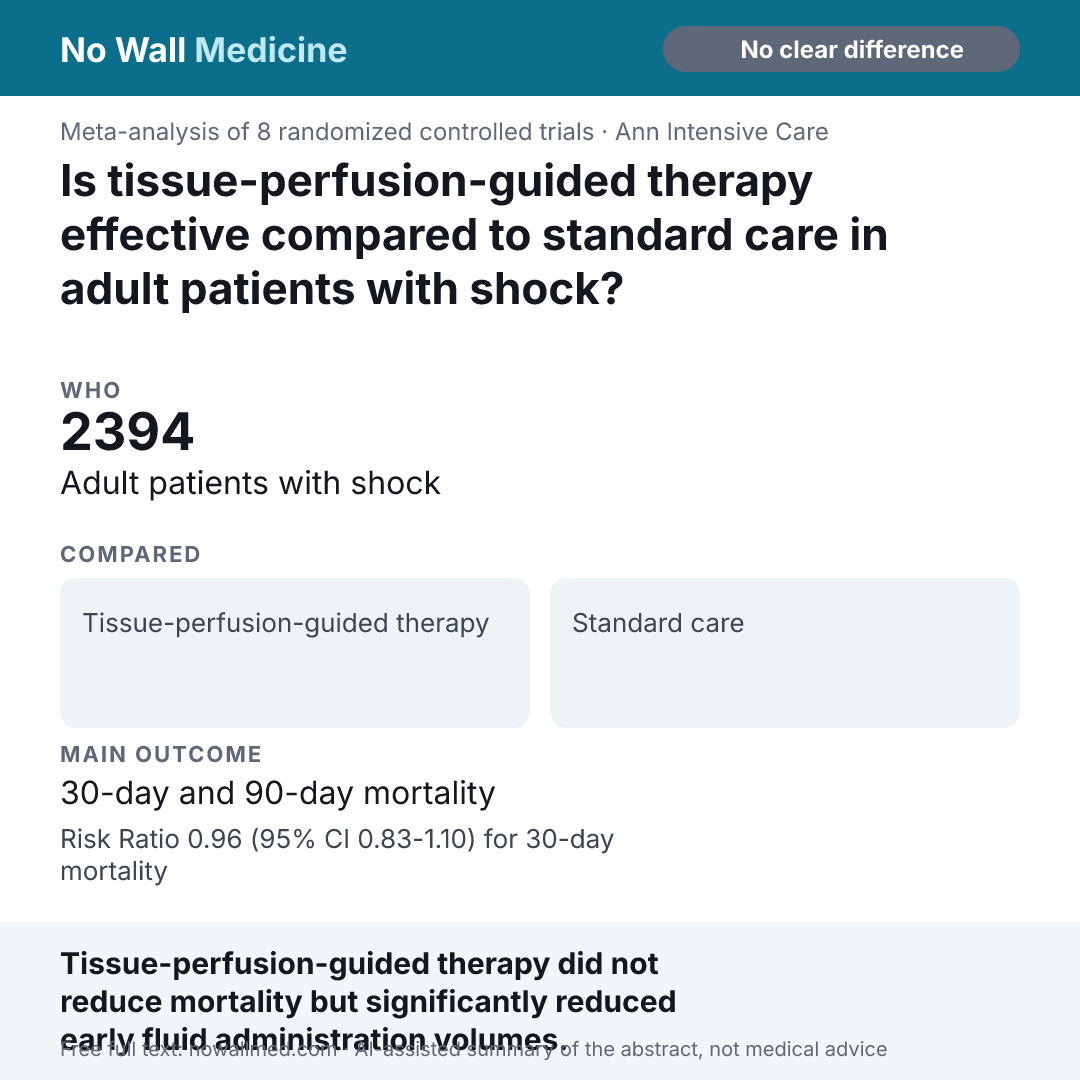
Clinical question: Is tissue-perfusion-guided therapy effective compared to standard care in adult patients with shock?
Why it matters: Standard shock resuscitation often targets large-scale blood pressure measurements, which may not improve microcirculation and can lead to fluid overload.
Key points
- Researchers analyzed eight randomized controlled trials involving 2,394 adult patients to compare tissue-perfusion-guided therapy against standard care.
- The therapy did not significantly reduce 30-day mortality (Risk Ratio 0.96; 95% CI 0.83-1.10; P = 0.49) or 90-day mortality (RR 0.94; 95% CI 0.82-1.07; P = 0.17).
- Tissue-perfusion-guided therapy significantly reduced the volume of fluid administered during the first 6-8 h of resuscitation by a mean difference of 466.95 mL.
Limitation the authors note: The finding regarding shorter intensive care unit length of stay proved fragile in sensitivity analyses.
Headline and key points written with AI from the paper’s abstract, with every number checked against it. Read the paper before relying on them.
Was this summary helpful?
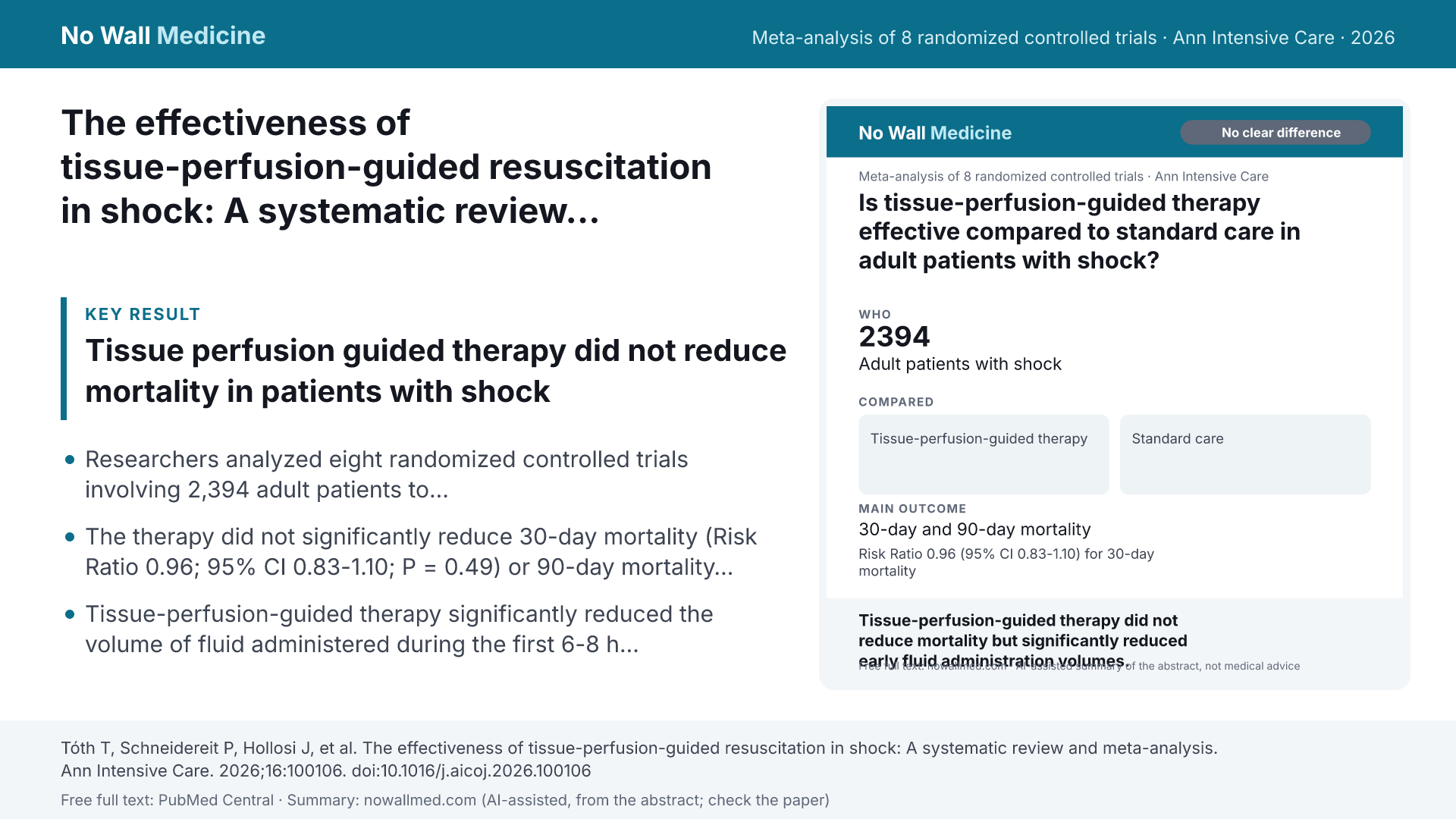
Headline, design, result, key points, caveat and citation as plain text.
Cite this article
Tóth T, Schneidereit P, Hollosi J, et al. The effectiveness of tissue-perfusion-guided resuscitation in shock: A systematic review and meta-analysis. Ann Intensive Care. 2026;16:100106. doi:10.1016/j.aicoj.2026.100106
Spotted a mistake? Suggest a correction