Cognitive-behavioural program reduces social isolation in nursing home residents
The effects of a cognitive-behavioural model-based social facilitation program on psychosocial well-being amongst Chinese nursing home residents: a randomized controlled trial
Assessor-blind, parallel-arm randomized controlled trialBenefit found
Does a cognitive-behavioural model-based social facilitation program improve psychosocial well-being in Chinese nursing home residents?
Who
180
Older adults residing in Chinese nursing homes · Chinese nursing homes
Compared
cognitive-behavioural model-based social facilitation program: significant reductions in social isolation and significant improvements in subjective well-being
control group: routine institutional care
Main outcome
social isolation and subjective well-being
Bottom line: The program reduces social isolation and enhances psychosocial well-being with clinically meaningful and sustained benefits.
Age Ageing · 2025-07-29Download image
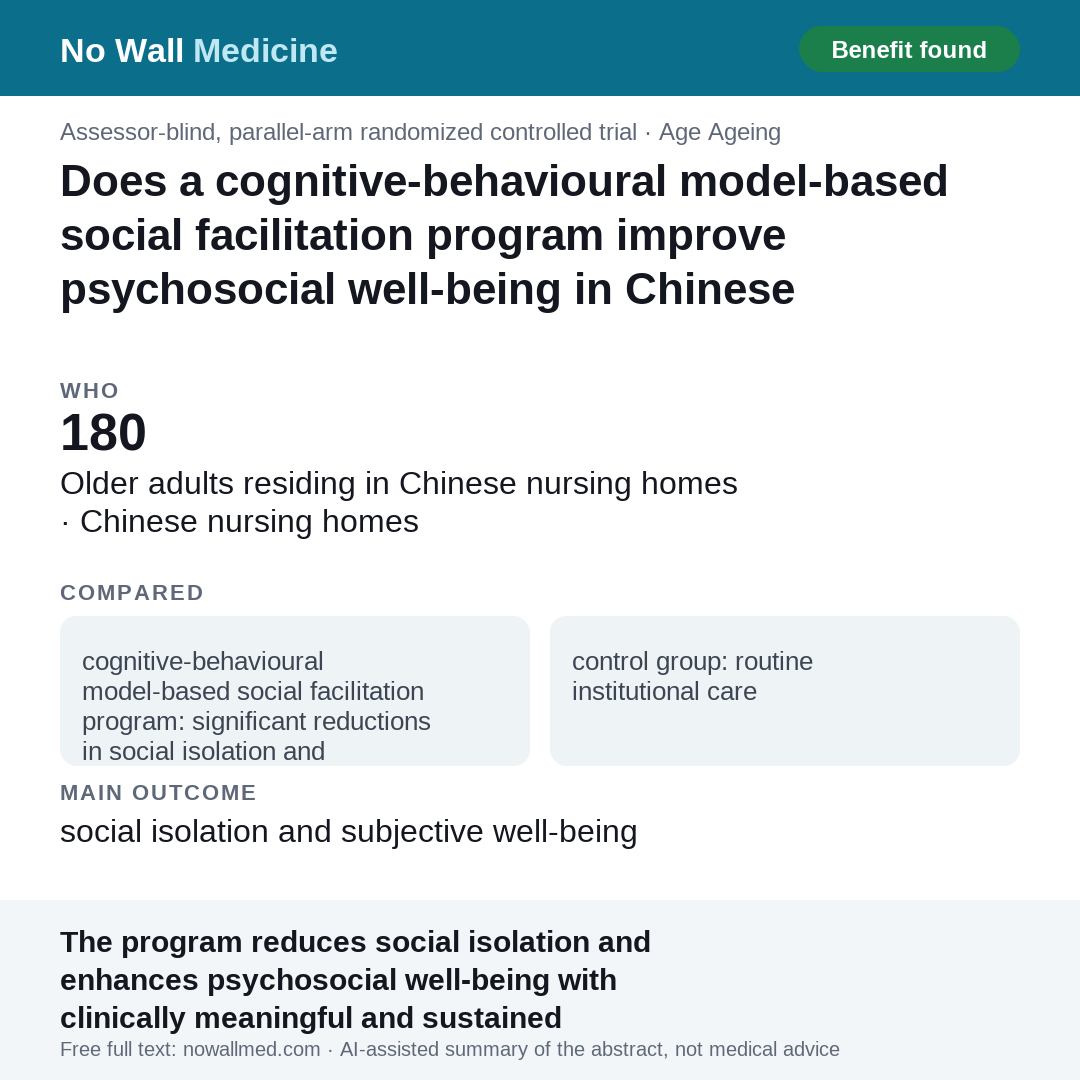
Clinical question: Does a cognitive-behavioural model-based social facilitation program improve psychosocial well-being in Chinese nursing home residents?
Why it matters: Effects of social facilitation interventions on psychosocial well-being are not well documented
Key points
- 180 Chinese nursing home residents were randomly assigned to a program or control group.
- The program group had significant reductions in social isolation and improvements in well-being.
- Benefits were sustained at 1 and 3 months after the program.
Headline and key points written with AI from the paper’s abstract, with every number checked against it. Read the paper before relying on them.
Was this summary helpful?
Subject terms
Cite this article
Liu H, Huang Q, Lu Y, Wu J, Ou B, Luo S. The effects of a cognitive-behavioural model-based social facilitation program on psychosocial well-being amongst Chinese nursing home residents: a randomized controlled trial. Age Ageing. 2025. doi:10.1093/ageing/afaf205
Spotted a mistake? Suggest a correction
Top studies every Monday
The week’s key trials and guidelines in your specialties, plus any topics you follow. By email, free.
Get the weekly digest