Structured communication tool improved function and reduced sick leave for patients with unexplained physical symptoms
The effects of a structured communication tool in patients with medically unexplained physical symptoms: a cluster randomized trial
Cluster randomized trialBenefit found
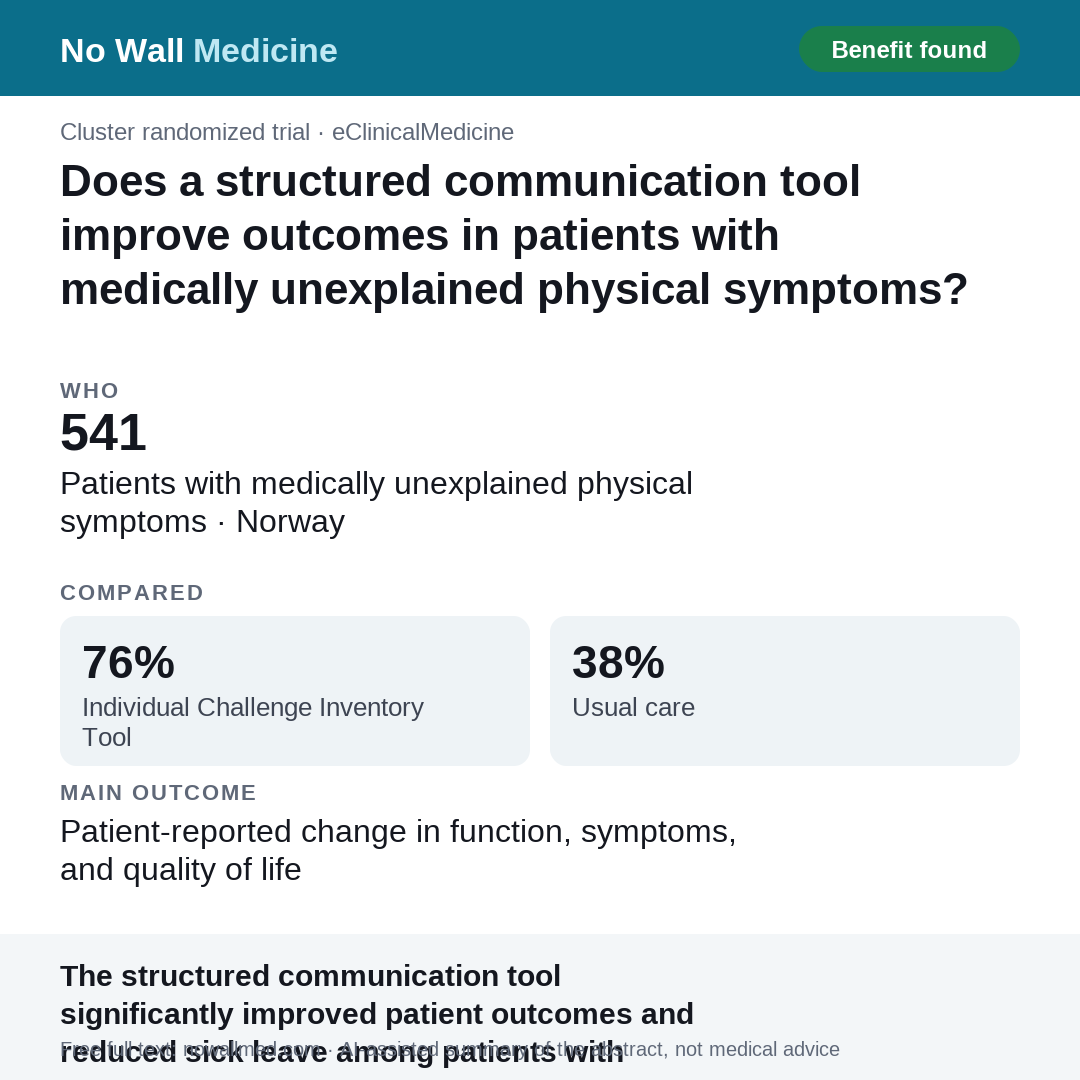
Does a structured communication tool improve outcomes in patients with medically unexplained physical symptoms?
Who
541
Patients with medically unexplained physical symptoms · Norway
Compared
76%Individual Challenge Inventory Tool (n = 223)
38%Usual care (n = 236)
Main outcome
Patient-reported change in function, symptoms, and quality of life
Result: mean difference -0.8 (95% CI -1.0 to -0.6)
Bottom line: The structured communication tool significantly improved patient outcomes and reduced sick leave among patients with medically unexplained physical symptoms.
Funded by: The Norwegian Research Fund for General Practice
eClinicalMedicine · 2023-10-06Download image
Clinical question: Does a structured communication tool improve outcomes in patients with medically unexplained physical symptoms?
Why it matters: It was unknown if a structured communication tool based on cognitive-behavioral therapy could improve outcomes for patients with medically unexplained physical symptoms.
Key points
- Researchers conducted a cluster randomized trial involving 541 patients with medically unexplained physical symptoms and 103 general practitioners.
- The intervention group showed 76% (n = 223) improvement in function, symptoms, and quality of life compared to 38% (n = 236) in the usual care group.
- Sick leave decreased from 52.0% to 25.2% in the intervention group, while the usual care group saw a decrease from 49.7% to 45.7%.
Headline and key points written with AI from the paper’s abstract, with every number checked against it. Read the paper before relying on them.
Was this summary helpful?
Cite this article
Abrahamsen C, Reme SE, Wangen KR, Lindbæk M, Werner EL. The effects of a structured communication tool in patients with medically unexplained physical symptoms: a cluster randomized trial. eClinicalMedicine. 2023. doi:10.1016/j.eclinm.2023.102262
Spotted a mistake? Suggest a correction
Top studies every Monday
The week’s key trials and guidelines in your specialties, plus any topics you follow. By email, free.
Get the weekly digest