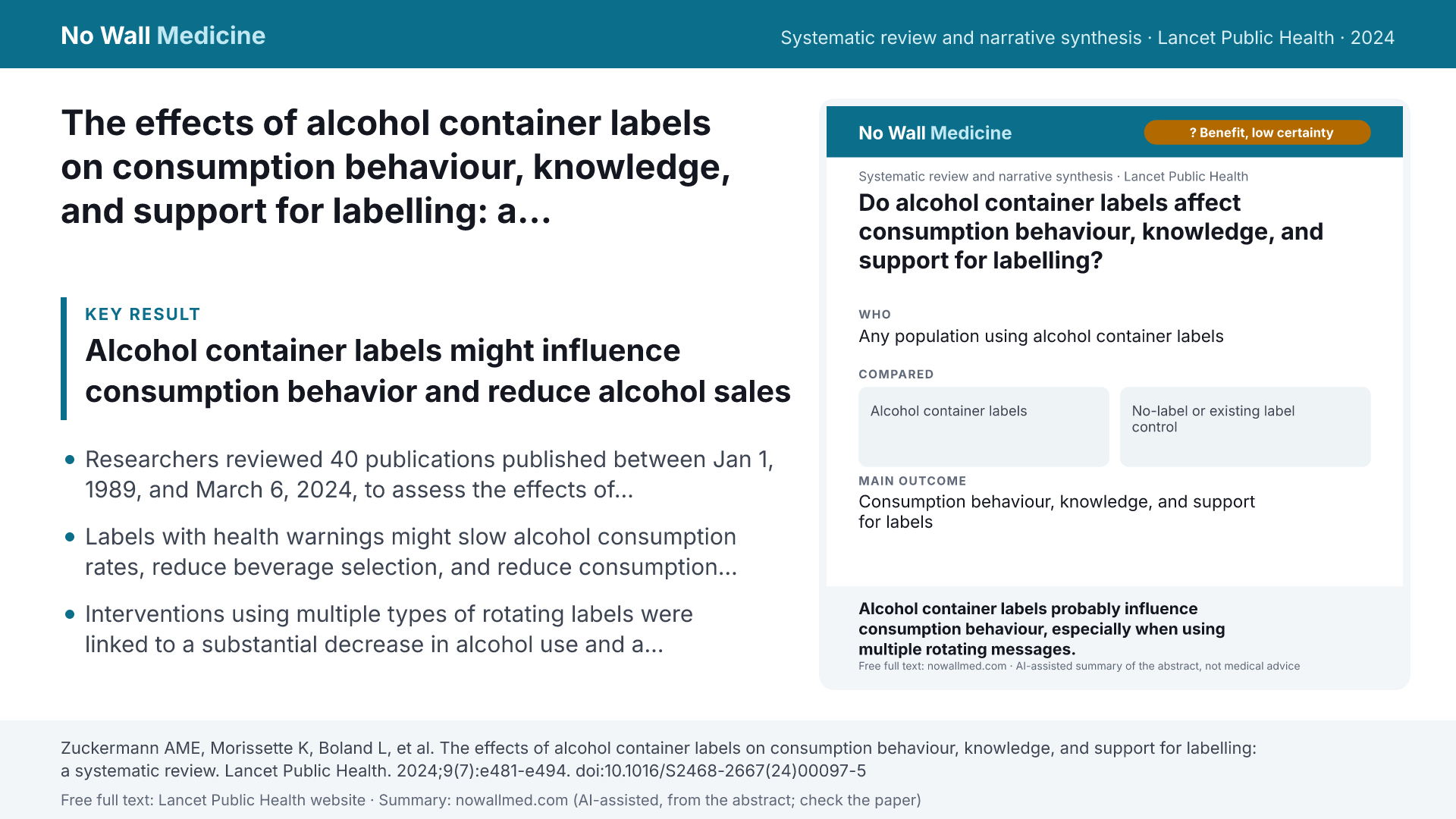
Alcohol container labels might influence consumption behavior and reduce alcohol sales
The effects of alcohol container labels on consumption behaviour, knowledge, and support for labelling: a systematic review
Systematic review and narrative synthesisBenefit found
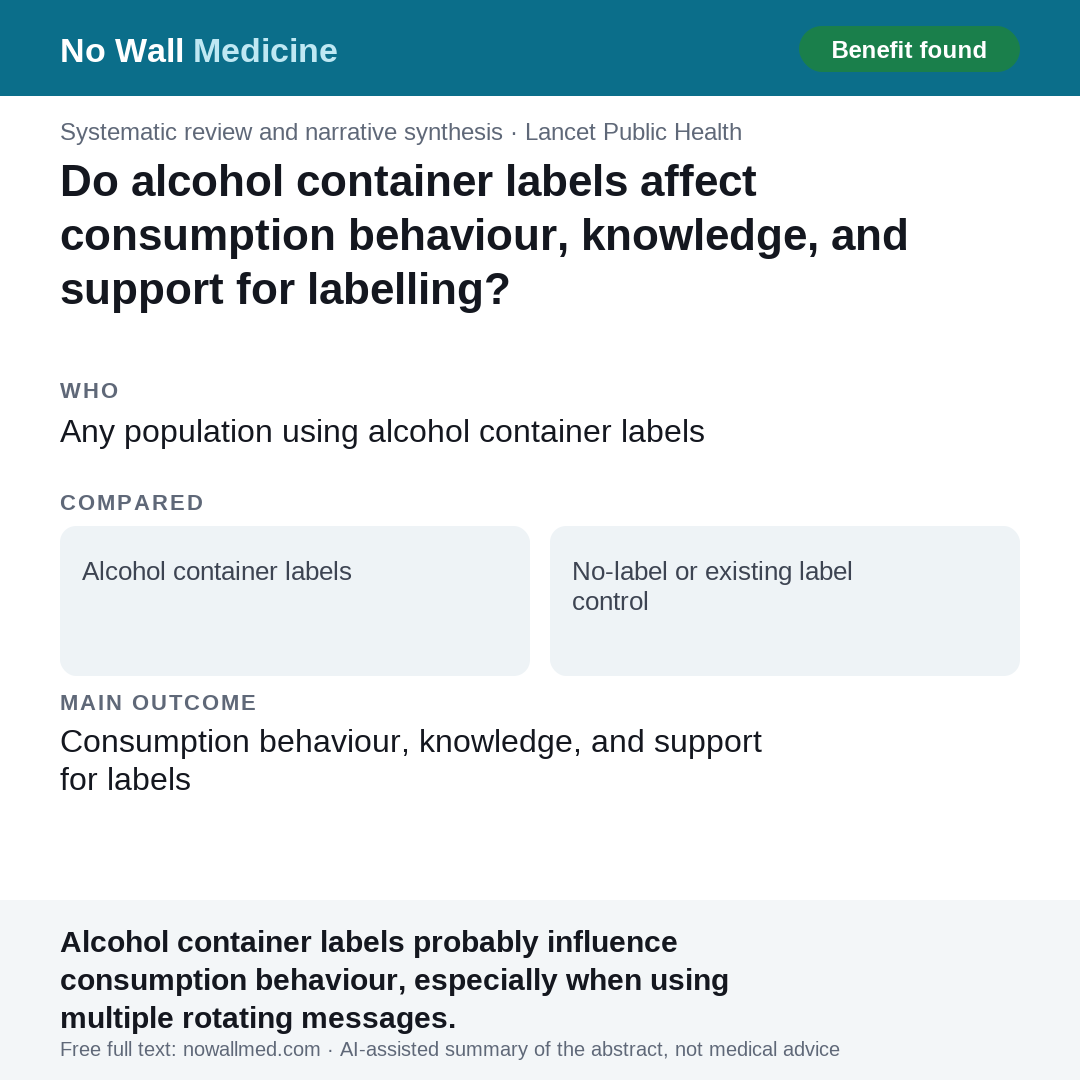
Do alcohol container labels affect consumption behaviour, knowledge, and support for labelling?
Who
Any population using alcohol container labels
Compared
Alcohol container labels
No-label or existing label control
Main outcome
Consumption behaviour, knowledge, and support for labels
Bottom line: Alcohol container labels probably influence consumption behaviour, especially when using multiple rotating messages.
Limitation: Heterogeneity in label designs and outcome measurements.
Lancet Public Health · 2024-06-29Download image
Clinical question: Do alcohol container labels affect consumption behaviour, knowledge, and support for labelling?
Why it matters: The effectiveness of different types of alcohol container labels on consumption, knowledge, and support has varied in approach and quality across previous investigations.
Key points
- Researchers reviewed 40 publications published between Jan 1, 1989, and March 6, 2024, to assess the effects of various alcohol container labels.
- Labels with health warnings might slow alcohol consumption rates, reduce beverage selection, and reduce consumption during pregnancy or before driving.
- Interventions using multiple types of rotating labels were linked to a substantial decrease in alcohol use and a reduction in alcohol sales.
Limitation the authors note: The authors noted limitations including heterogeneity in label designs and outcome measurements.
Headline and key points written with AI from the paper’s abstract, with every number checked against it. Read the paper before relying on them.
Was this summary helpful?
Abstract
Alcohol container labels might reduce population-level alcohol-related harms, but investigations of their effectiveness have varied in approach and quality. A systematic synthesis is needed to adjust for these differences and to yield evidence to inform policy. Our objectives were to establish the effects of alcohol container labels bearing one or more health warnings, standard drink information, or low-risk drinking guidance on alcohol consumption behaviour, knowledge of label message, and support for labels. We completed a systematic review according to Cochrane and synthesis without meta-analysis standards. We included all peer-reviewed studies and grey literature published from Jan 1, 1989, to March 6, 2024, in English, French, German, or Spanish that investigated the effects of alcohol container labels compared with no-label or existing label control groups in any population on alcohol consumption behaviour, knowledge of label message, or support for labels. Data were synthesised narratively as impact statements and assessed for risk of bias and certainty in the evidence. A protocol was preregistered (PROSPERO CRD42020168240). We identified 40 publications that studied 31 labels and generated 17 impact statements. 24 (60%) of 40 publications focused on consumption behaviour and we had low or very low certainty in 13 (59%) of 22 outcomes. Alcohol container labels bearing health warnings might slow the rate of alcohol consumption (low certainty), reduce alcoholic beverage selection (moderate certainty), reduce consumption during pregnancy (low certainty), and reduce consumption before driving (moderate certainty). Interventions with multiple types of rotating alcohol container labels likely substantially decrease alcohol use (moderate certainty) and reduce alcohol sales (high certainty). To the best of our knowledge, this is the first systematic review on multiple types of alcohol container labels assessing their effects for certainty in the evidence. Limitations included heterogeneity in label designs and outcome measurements. Alcohol container labels probably influence some alcohol consumption behaviour, with multiple rotating messages being particularly effective, although effects might vary depending on individual health literacy or drinking behaviour. Alcohol container labels might therefore be effective components of policies designed to address population-level alcohol-related harms.
Abstract reproduced under the article’s CC BY NC ND licence.
Subject terms
Cite this article
Zuckermann AME, Morissette K, Boland L, Garcia AJ, Domingo FR, Stockwell T. The effects of alcohol container labels on consumption behaviour, knowledge, and support for labelling: a systematic review. Lancet Public Health. 2024. doi:10.1016/S2468-2667(24)00097-5
Spotted a mistake? Suggest a correction
Top studies every Monday
The week’s key trials and guidelines in your specialties, plus any topics you follow. By email, free.
Get the weekly digest