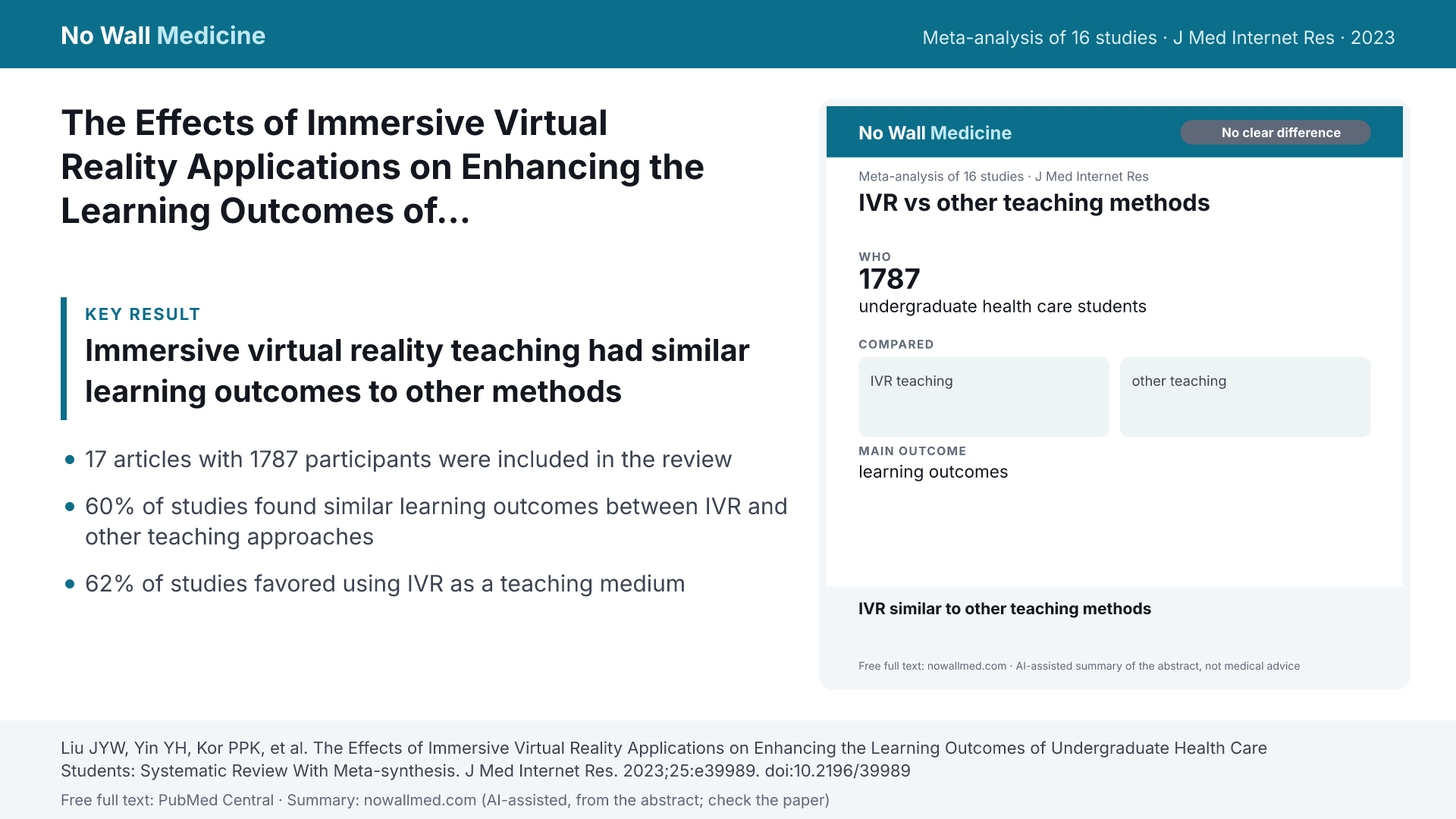
The Effects of Immersive Virtual Reality Applications on Enhancing the Learning Outcomes of Undergraduate Health Care Students: Systematic Review With Meta-synthesis
Key result: Immersive virtual reality teaching had similar learning outcomes to other methods
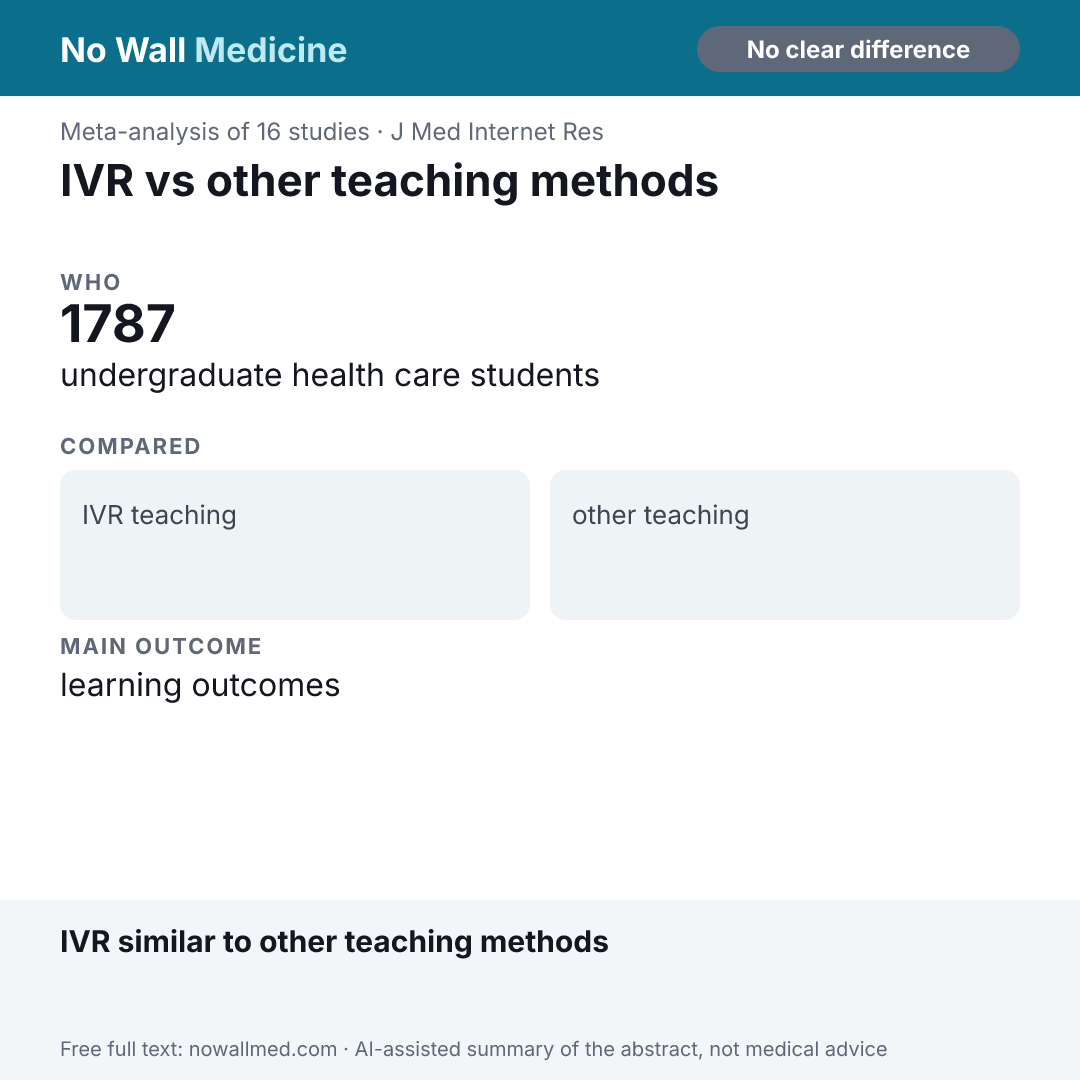
Meta-analysis of 16 studiesNo clear difference
IVR vs other teaching methods
Who
1787
undergraduate health care students
Compared
IVR teaching
other teaching
Main outcome
learning outcomes
Bottom line: IVR similar to other teaching methods
Limitation: low quality evidence
J Med Internet Res · 2023-03-06 · Save PNG
Key points
- 17 articles with 1787 participants were included in the review.
- 60% of studies found similar learning outcomes between IVR and other teaching approaches.
- 62% of studies favored using IVR as a teaching medium.
Limitation the authors note: The quality of 75% of randomized controlled trial studies was poor due to unclear descriptions of randomization and blinding procedures
Discussion prompts
- Would these patients look like yours? Who was left out?
- Is the main outcome one that matters to patients?
- Is the difference large enough to change what you do?
Cite: Liu JYW, Yin YH, Kor PPK, et al. The Effects of Immersive Virtual Reality Applications on Enhancing the Learning Outcomes of Undergraduate Health Care Students: Systematic Review With Meta-synthesis. J Med Internet Res. 2023;25:e39989. doi:10.2196/39989
Free full text: PubMed Central · Summary and visual abstract: nowallmed.com/a/the-effects-of-immersive-virtual-reality-applications-on-enhancing-1gkr0nr/ (AI-assisted from the abstract; check the paper before relying on it).