The Effects of Implementing a Mobile Health-Technology Supported Pathway on Atrial Fibrillation-Related Adverse Events Among Patients With Multimorbidity: The mAFA-II Randomized Clinical Trial
Prospective cluster randomized trialBenefit found
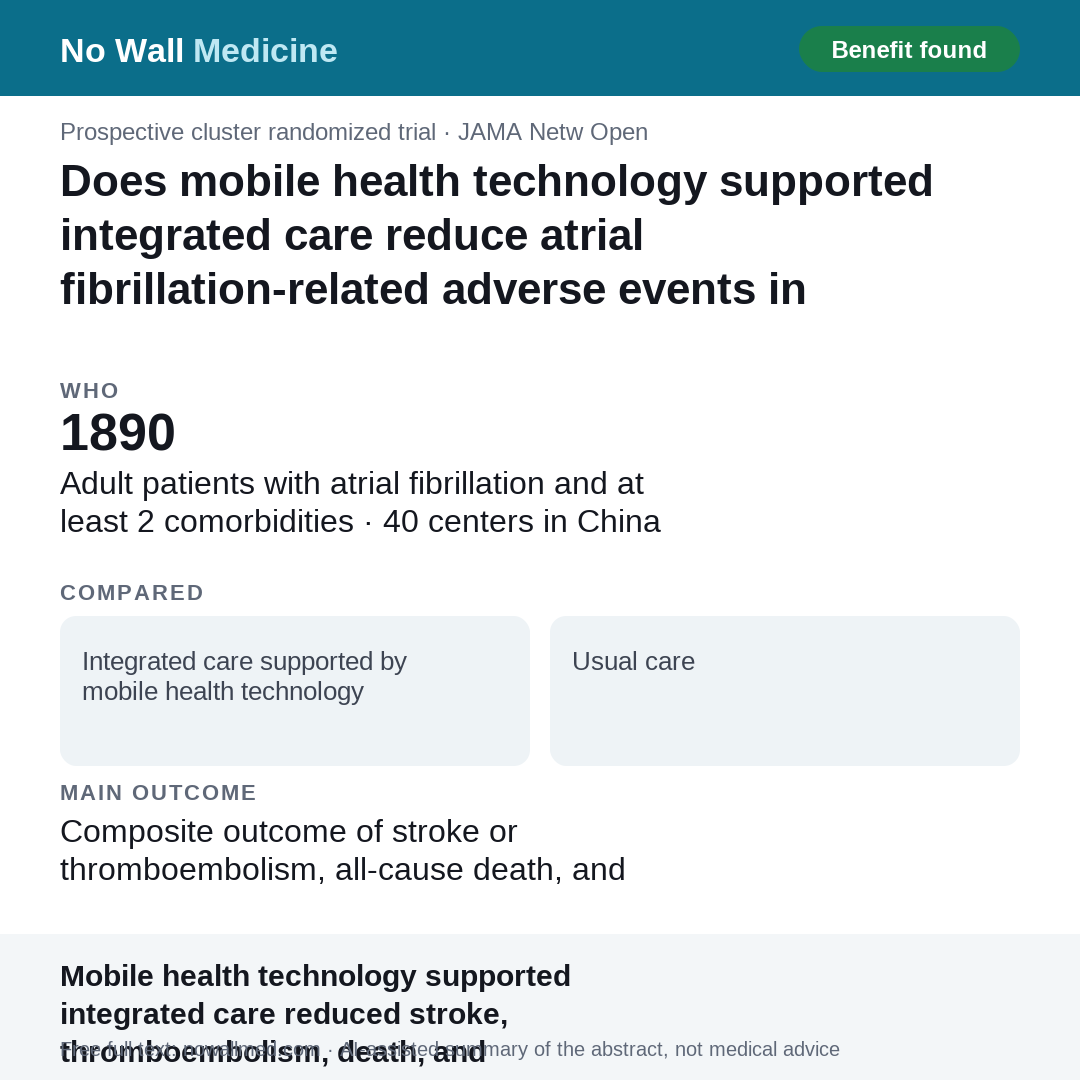
Does mobile health technology supported integrated care reduce atrial fibrillation-related adverse events in patients with multimorbidity?
Who
1890
Adult patients with atrial fibrillation and at least 2 comorbidities · 40 centers in China
Compared
Integrated care supported by mobile health technology
Usual care
Main outcome
Composite outcome of stroke or thromboembolism, all-cause death, and rehospitalization
Result: hazard ratio 0.37 (95% CI 0.26-0.53)
Bottom line: Mobile health technology supported integrated care reduced stroke, thromboembolism, death, and rehospitalization in patients with atrial fibrillation and multimorbidity.
JAMA Netw Open · 2021-12-01Download image
Clinical question: Does mobile health technology supported integrated care reduce atrial fibrillation-related adverse events in patients with multimorbidity?
Abstract
Importance
The Mobile Health Technology for Improved Screening and Optimized Integrated Care in Atrial Fibrillation (mAFA-II) trial is a prospective cluster randomized trial that found a significant reduction in the composite clinical outcome of stroke or thromboembolism, all-cause death, and rehospitalization among patients with atrial fibrillation (AF) who used a mobile health (mHealth) technology that implemented the Atrial Fibrillation Better Care (ABC) pathway (ie, A, anticoagulation/avoid stroke; B, better symptom control; and C, cardiovascular disease and comorbidity management) compared with those receiving usual care. Multimorbidity (defined as ≥2 chronic long-term conditions) is common in older patients with AF, but the impact of integrated or holistic care (based on the ABC pathway) on clinical outcomes in this population is uncertain. Objective
To evaluate whether implementation of the integrated ABC pathway, supported by mHealth technology, would reduce AF-related adverse events in patients with multimorbidity. Design, setting, and participants
This prespecified ancillary analysis of data from the extended follow-up of the mAFA II trial was conducted between June 2018 and April 2021. Adult patients with AF were included in the analysis if they had at least 2 comorbidities. Participants were enrolled across 40 centers in China. Intervention
Integrated care supported by mHealth technology (mAFA intervention) vs usual care. Main outcomes and measures
The main outcome was the composite outcome of stroke or thromboembolism, all-cause death, and rehospitalization. Cox proportional hazard modeling was performed for adverse outcomes after adjusting for cluster effect and baseline risk factors. Results
Of 1890 patients, 833 (mean [SD] age, 72.0 [12.0] years; 278 [33.4%] women) with multimorbidity were allocated to the intervention group (ABC pathway), with a mean (SD) follow-up of 419 (257) days, and 1057 patients (mean [SD] age, 72.8 [13.0] years; 443 [41.9%] women) with multimorbidity were allocated to usual care, with a mean (SD) follow-up of 457 (154) days. Compared with usual care, the composite outcome of stroke or thromboembolism, all-cause death, and rehospitalization was significantly reduced in the intervention group (hazard ratio [HR], 0.37; 95% CI, 0.26-0.53; P < .001), as were rehospitalizations alone (HR, 0.42; 95% CI, 0.27-0.64; P < .001). For the C criterion of the ABC pathway, rates of acute coronary syndrome, heart failure, and uncontrolled blood pressure during follow-up were lower in the intervention group than the usual care group (27 patients [3.2%] vs 145 patients [13.7%]; HR, 0.29; 95% CI, 0.19-0.45; P < .001). Subgroup analyses by age, prior stroke, and sex demonstrated consistently lower HRs for the primary composite outcome and rehospitalization for patients with AF allocated to the intervention group compared with patients receiving usual care. Conclusions and relevance
In this study, mHealth technology-based integrated care that facilitated the implementation of the ABC pathway reduced meaningful clinical adverse events in older patients with AF and multimorbidity vs usual care. Trial registration
WHO International Clinical Trials Registry Platform (ICTRP) Registration number: ChiCTR-OOC-17014138.
Subject terms
Cite this article
Yao Y, Guo Y, Lip GYH, mAF-App II Trial investigators. The Effects of Implementing a Mobile Health-Technology Supported Pathway on Atrial Fibrillation-Related Adverse Events Among Patients With Multimorbidity: The mAFA-II Randomized Clinical Trial. JAMA Netw Open. 2021. doi:10.1001/jamanetworkopen.2021.40071
Spotted a mistake? Suggest a correction
Top studies every Monday
The week’s key trials and guidelines in your specialties, plus any topics you follow. By email, free.
Get the weekly digest