Mechanical ventilation settings show varying effects on survival and heart function during life support
The effects of mechanical ventilation during v-a ecmo support: a systematic review
Systematic reviewUnclear result
How do mechanical ventilation settings affect cardiac function and clinical outcomes during veno-arterial extracorporeal membrane oxygenation?
Who
Adults supported by veno-arterial extracorporeal membrane oxygenation or animal models
Compared
Lower driving and peak pressures: improved survival
Excessive positive end-expiratory pressure: impaired systolic function
Main outcome
cardiac function, recovery, and clinical outcomes
Bottom line: Evidence on mechanical ventilation effects during veno-arterial extracorporeal membrane oxygenation is limited, heterogeneous, and carries considerable risk of bias.
Limitation: Studies were limited, heterogeneous, and at considerable risk of bias.
Crit Care · 2026-06-05Download image
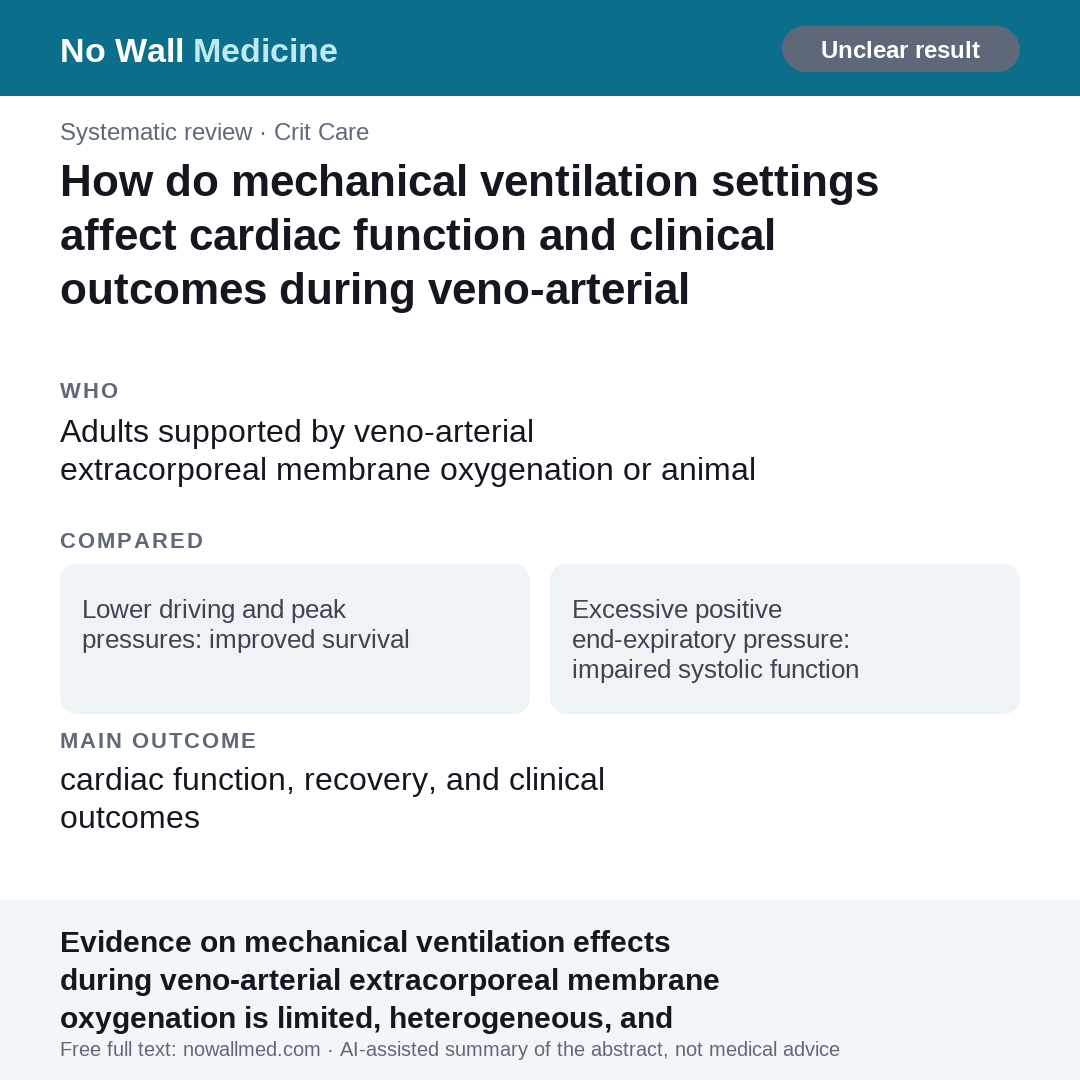
Clinical question: How do mechanical ventilation settings affect cardiac function and clinical outcomes during veno-arterial extracorporeal membrane oxygenation?
Why it matters: The role of mechanical ventilation settings in influencing hemodynamics and supporting cardiac recovery during veno-arterial extracorporeal membrane oxygenation remains poorly understood.
Key points
- Researchers reviewed 12 studies, including 10 clinical, 1 experimental, and 1 computational study, regarding ventilation during veno-arterial extracorporeal membrane oxygenation (a machine that pumps blood outside the body to provide oxygen and support the heart).
- Four human studies found that lower peak inspiratory pressures, lower driving pressures, and reduced respiratory rates were associated with improved survival.
- One study showed moderate positive end-expiratory pressure (pressure maintained in the lungs at the end of a breath) protected lungs without hurting heart function, but excessive pressure impaired systolic function.
Limitation the authors note: The evidence is limited, heterogeneous, and at considerable risk of bias.
Headline and key points written with AI from the paper’s abstract, with every number checked against it. Read the paper before relying on them.
Topics
Spotted a mistake? Suggest a correction