Metformin may reduce improvements in cardiorespiratory fitness and blood pressure during exercise training
The effects of metformin and exercise training on cardiorespiratory, blood pressure, and metabolic adaptations across the spectrum of glucose dysregulation: a systematic review and meta-analysis
Systematic review and meta-analysisKey finding
Does adding metformin to exercise affect cardiorespiratory, blood pressure, and metabolic adaptations?
Who
827
Adults with conditions across the spectrum of glucose dysregulation
Compared
Exercise plus metformin
Exercise alone
Main outcome
Peak oxygen uptake, body composition, blood pressure, glycaemic markers, and lipids
Result: mean difference -1.19 (95% CI -2.33 to -0.04) for VO2peak
Bottom line: Adding metformin to exercise may modestly attenuate improvements in cardiorespiratory fitness and blood pressure.
Limitation: Certainty of evidence was low to very low for most glycaemic and lipid markers.
eClinicalMedicine · 2026-04-25 · Save PNG
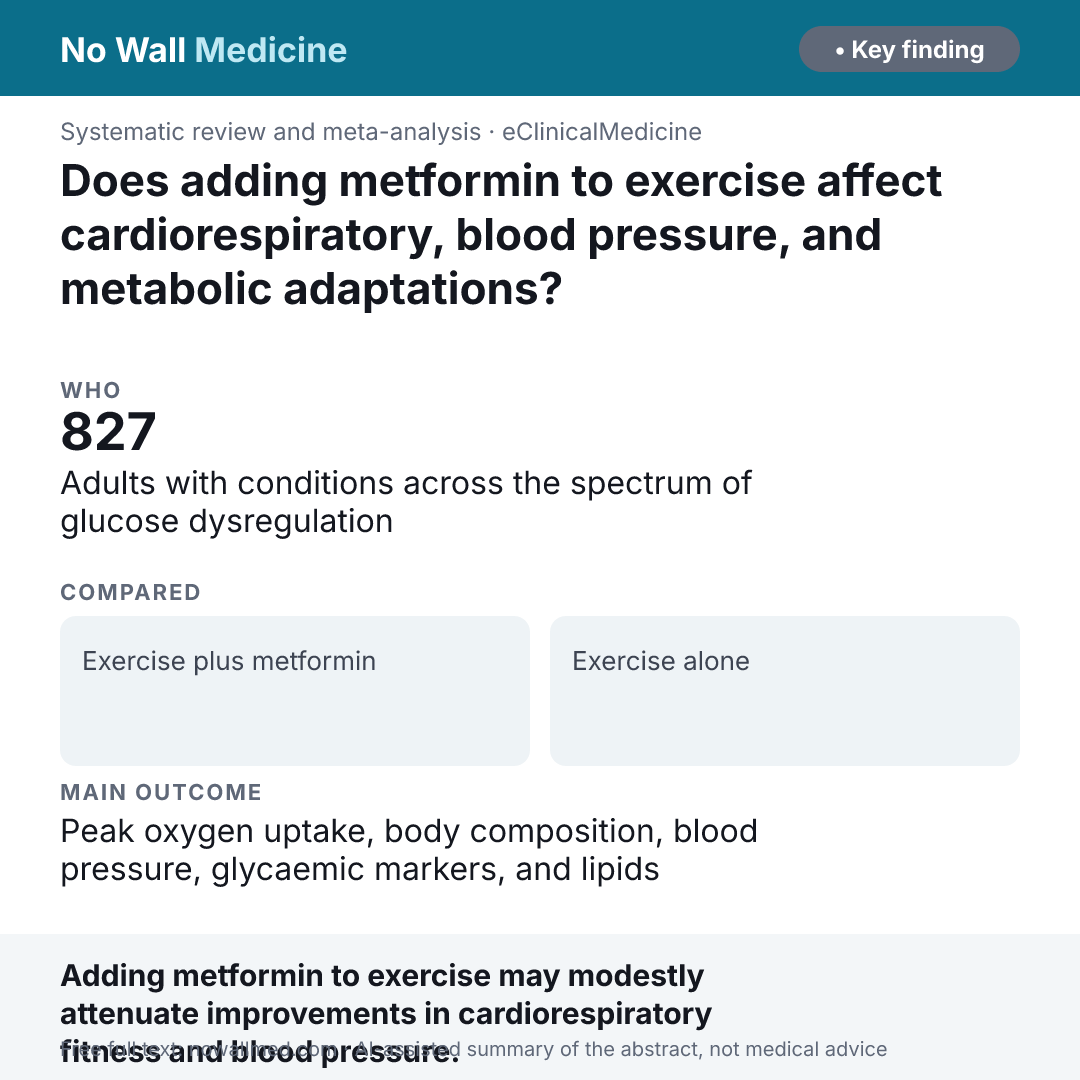
Clinical question: Does adding metformin to exercise affect cardiorespiratory, blood pressure, and metabolic adaptations?
Why it matters: It was not systematically quantified how metformin might blunt the physiological adaptations typically induced by structured exercise training.
Key points
- Researchers analyzed nine studies involving 827 adults to compare exercise plus metformin against exercise with a placebo or no metformin.
- Adding metformin was associated with smaller improvements in peak oxygen uptake, systolic blood pressure, and diastolic blood pressure compared to exercise alone.
- No significant differences were found between groups for body weight, body mass index, waist circumference, glucose, insulin, or lipid levels.
Limitation the authors note: The certainty of evidence was low to very low for most glycaemic and lipid markers.
Headline and key points written with AI from the paper’s abstract, with every number checked against it. Read the paper before relying on them.
Was this summary helpful?
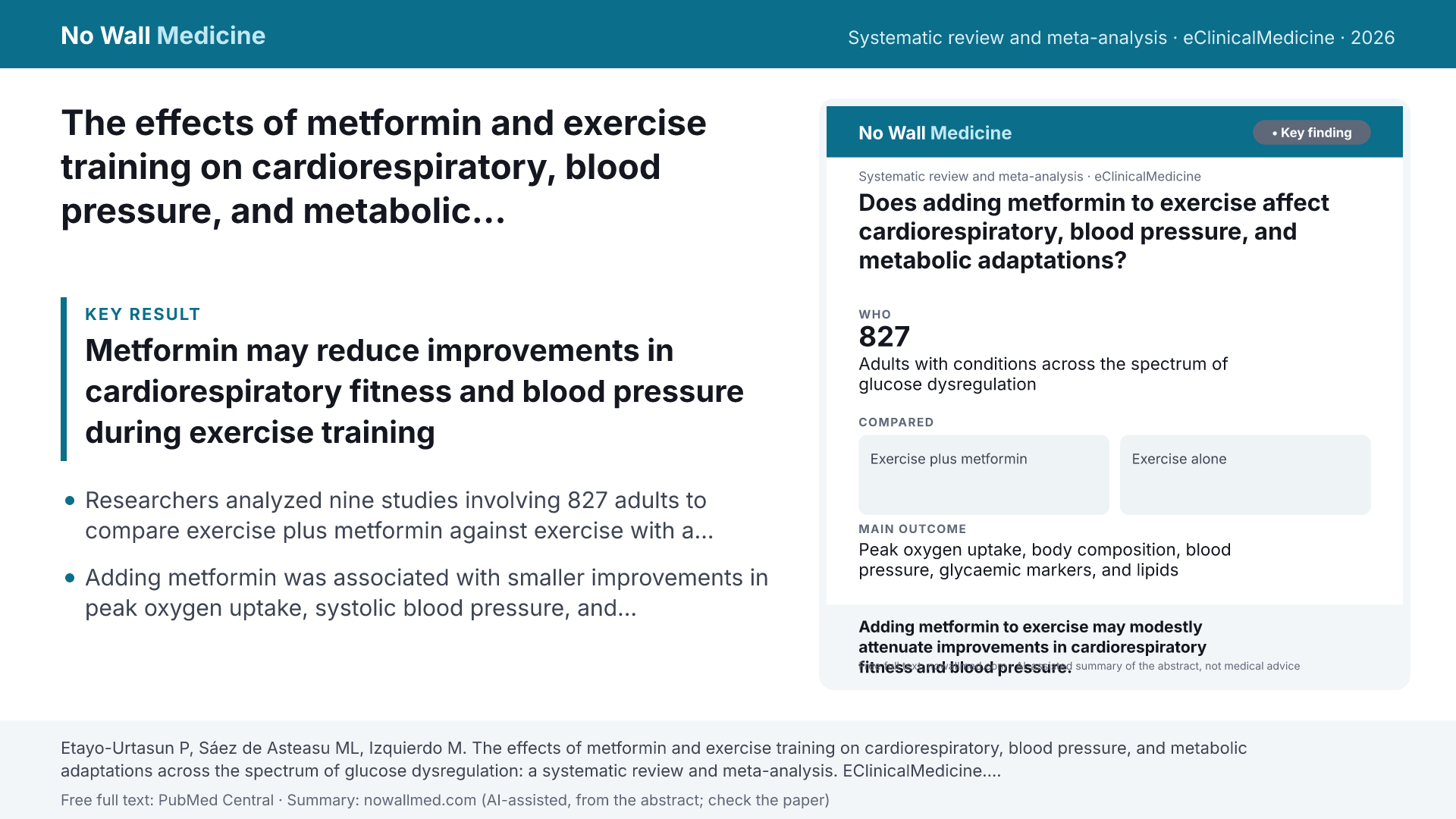
Headline, design, result, key points, caveat and citation as plain text.
Cite this article
Etayo-Urtasun P, Sáez de Asteasu ML, Izquierdo M. The effects of metformin and exercise training on cardiorespiratory, blood pressure, and metabolic adaptations across the spectrum of glucose dysregulation: a systematic review and meta-analysis. EClinicalMedicine. 2026;95:103915. doi:10.1016/j.eclinm.2026.103915
Spotted a mistake? Suggest a correction