Microprocessor prosthetic knees were associated with higher mobility and balance scores in early rehabilitation
The effects of microprocessor prosthetic knee use in early rehabilitation: A pilot randomized controlled trial
Pilot randomized controlled studyBenefit found
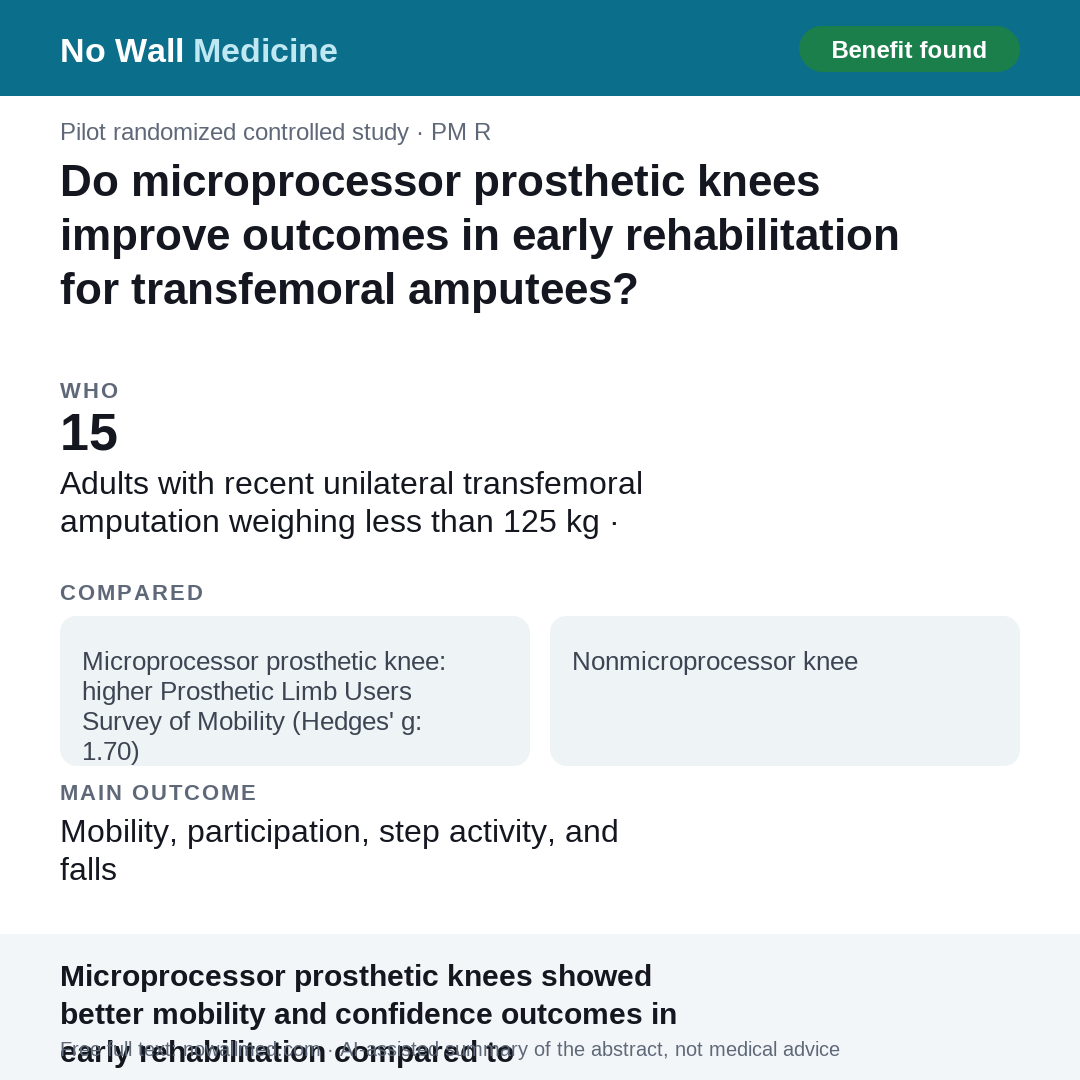
Do microprocessor prosthetic knees improve outcomes in early rehabilitation for transfemoral amputees?
Who
15
Adults with recent unilateral transfemoral amputation weighing less than 125 kg · Institutional laboratory
Compared
Microprocessor prosthetic knee: higher Prosthetic Limb Users Survey of Mobility (Hedges' g: 1.70)
Nonmicroprocessor knee
Main outcome
Mobility, participation, step activity, and falls
Bottom line: Microprocessor prosthetic knees showed better mobility and confidence outcomes in early rehabilitation compared to nonmicroprocessor knees.
Limitation: Small sample size and heterogeneity within groups
PM R · 2025-02-02Download image
Clinical question: Do microprocessor prosthetic knees improve outcomes in early rehabilitation for transfemoral amputees?
Why it matters: It is unknown if microprocessor-controlled prosthetic knees provide better health outcomes than non-microprocessor knees for people in early rehabilitation after a transfemoral amputation.
Key points
- Eighteen adults with recent single-leg above-knee amputations were randomized to use either a microprocessor-controlled prosthetic knee or a non-microprocessor knee.
- After 3 months, the microprocessor group had significantly higher scores for mobility, balance confidence, and return to normal living compared to the non-microprocessor group.
- Fifteen participants completed the trial, and effect sizes across mobility outcomes indicated better results for the microprocessor group.
Limitation the authors note: The small sample size and heterogeneity within groups resulted in few statistically significant differences.
Headline and key points written with AI from the paper’s abstract, with every number checked against it. Read the paper before relying on them.
Topics
Cite this article
Morgan SJ, Friedly JL, Nelson IK, Rosen RE, Humbert AT, Hafner BJ. The effects of microprocessor prosthetic knee use in early rehabilitation: A pilot randomized controlled trial. PM R. 2025. doi:10.1002/pmrj.13321
Spotted a mistake? Suggest a correction
Top studies every Monday
The week’s key trials and guidelines in your specialties, plus any topics you follow. By email, free.
Get the weekly digest