Web-based stress management intervention reduced perceived stress in employees with unbalanced work conditions
The Efficacy of a Web-Based Stress Management Intervention for Employees Experiencing Adverse Working Conditions and Occupational Self-efficacy as a Mediator: Randomized Controlled Trial
Randomized controlled trialBenefit found
Is a web-based stress management intervention effective for employees with high stress and effort-reward imbalance?
Who
262
Employees reporting effort-reward imbalance and elevated stress levels
Compared
Stress management intervention group: d=0.87 (95% CI 0.61-1.12) at 7 weeks
Waitlist control group
Main outcome
Perceived stress measured using the 10-item Perceived Stress Scale
Result: d=0.87 (95% CI 0.61-1.12) at 7 weeks; d=0.65 (95% CI 0.41-0.90) at 6 months
Bottom line: A web-based stress management intervention effectively reduces stress and improves occupational self-efficacy in employees facing adverse working conditions.
Limitation: Person-focused interventions might not be sufficient and need to be complemented by organizational-focused interventions.
J Med Internet Res · 2022-10-20Download image
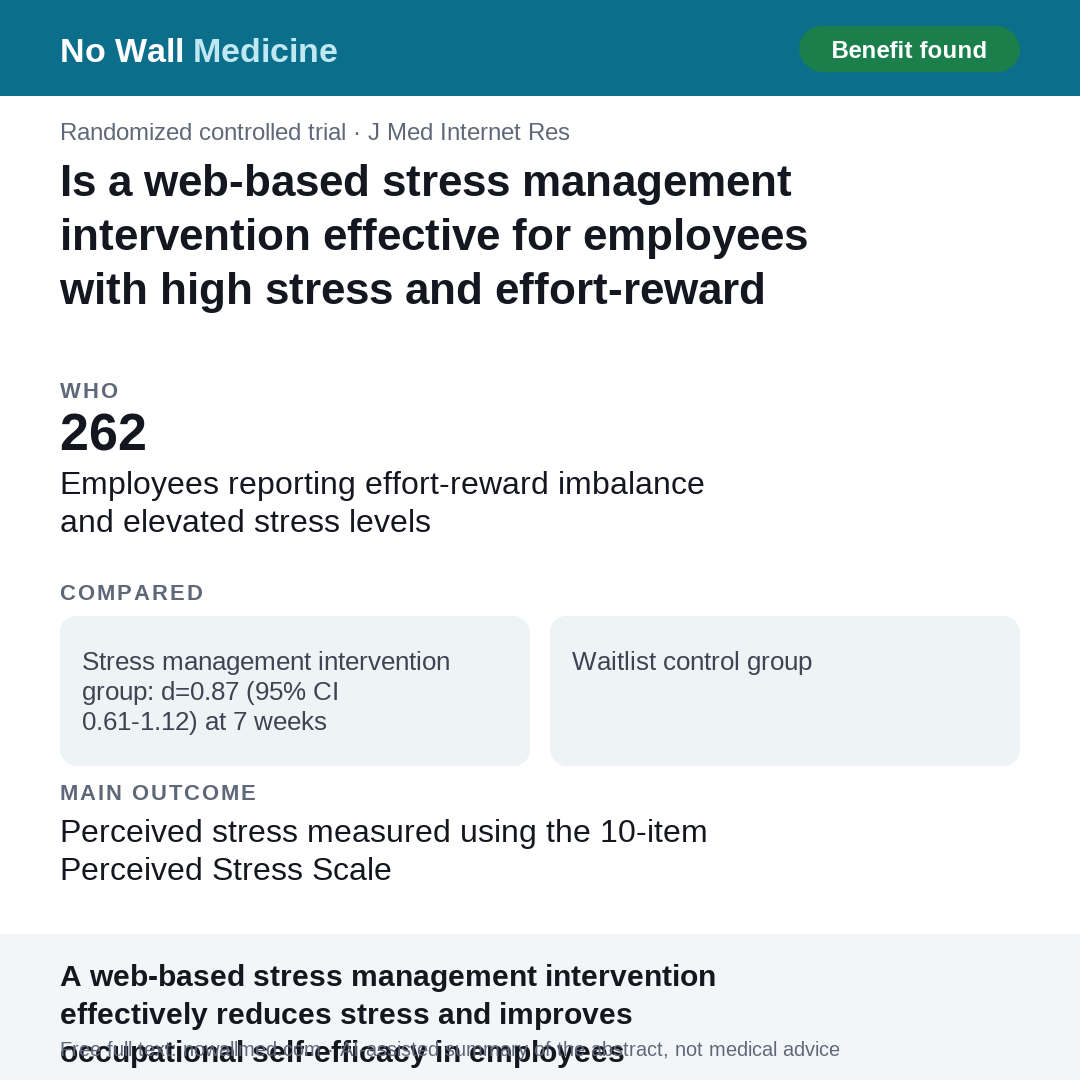
Clinical question: Is a web-based stress management intervention effective for employees with high stress and effort-reward imbalance?
Why it matters: It is unknown if web-based stress management interventions can effectively reduce stress and improve occupational self-efficacy for employees facing an imbalance between work effort and rewards.
Key points
- Researchers studied 262 employees with high stress and effort-reward imbalance, comparing a web-based stress management intervention to a waitlist control group.
- The intervention group showed significantly higher stress reduction at 7 weeks (d=0.87) and 6 months (d=0.65) compared to the control group.
- Increased occupational self-efficacy, or a person's belief in their ability to perform work tasks, mediated the stress reduction effect.
Headline and key points written with AI from the paper’s abstract, with every number checked against it. Read the paper before relying on them.
Was this summary helpful?
Subject terms
Cite this article
Nixon P, Ebert DD, Boß L, Angerer P, Dragano N, Lehr D. The Efficacy of a Web-Based Stress Management Intervention for Employees Experiencing Adverse Working Conditions and Occupational Self-efficacy as a Mediator: Randomized Controlled Trial. J Med Internet Res. 2022. doi:10.2196/40488
Spotted a mistake? Suggest a correction
Top studies every Monday
The week’s key trials and guidelines in your specialties, plus any topics you follow. By email, free.
Get the weekly digest