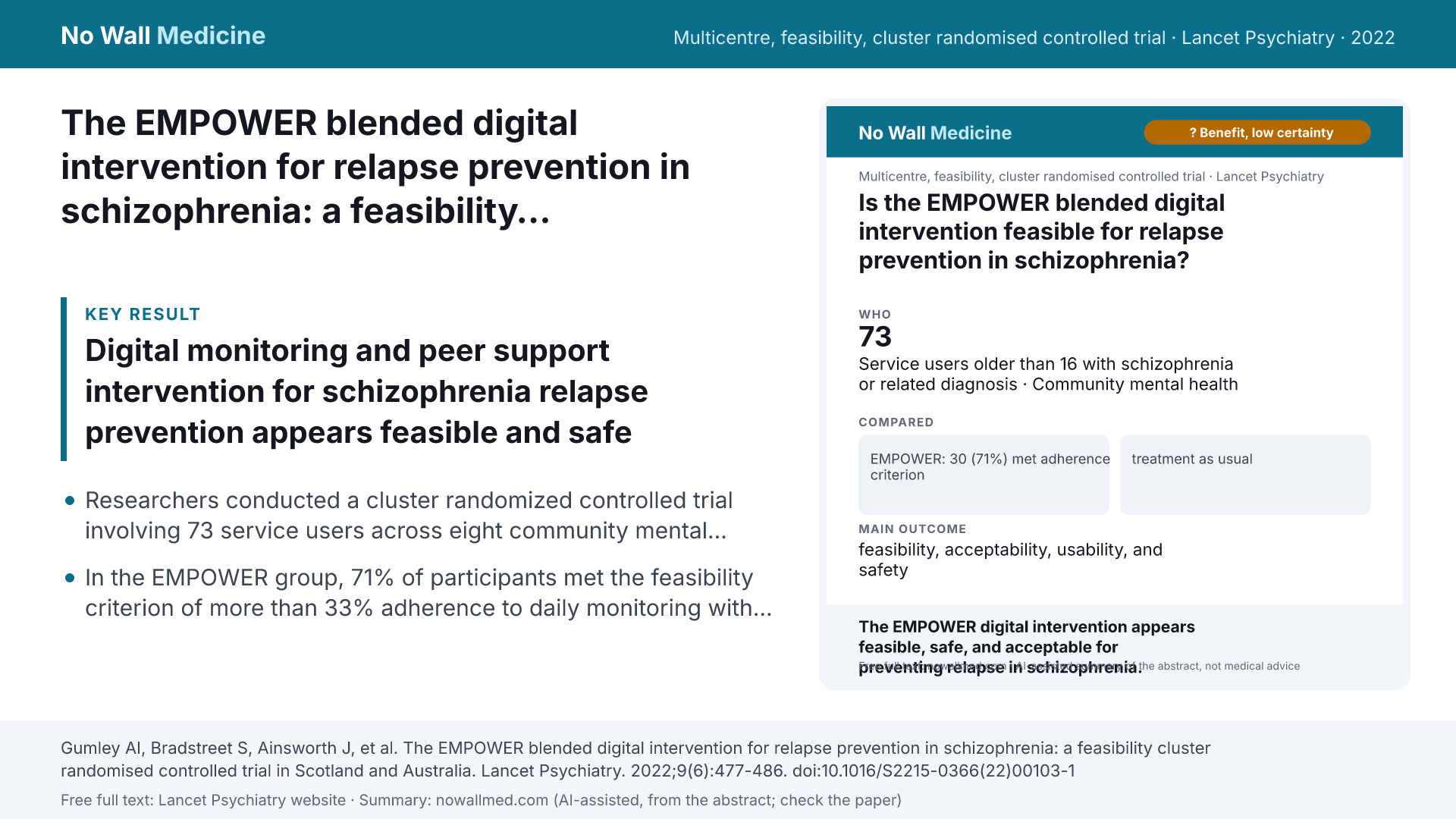
Digital monitoring and peer support intervention for schizophrenia relapse prevention appears feasible and safe
The EMPOWER blended digital intervention for relapse prevention in schizophrenia: a feasibility cluster randomised controlled trial in Scotland and Australia
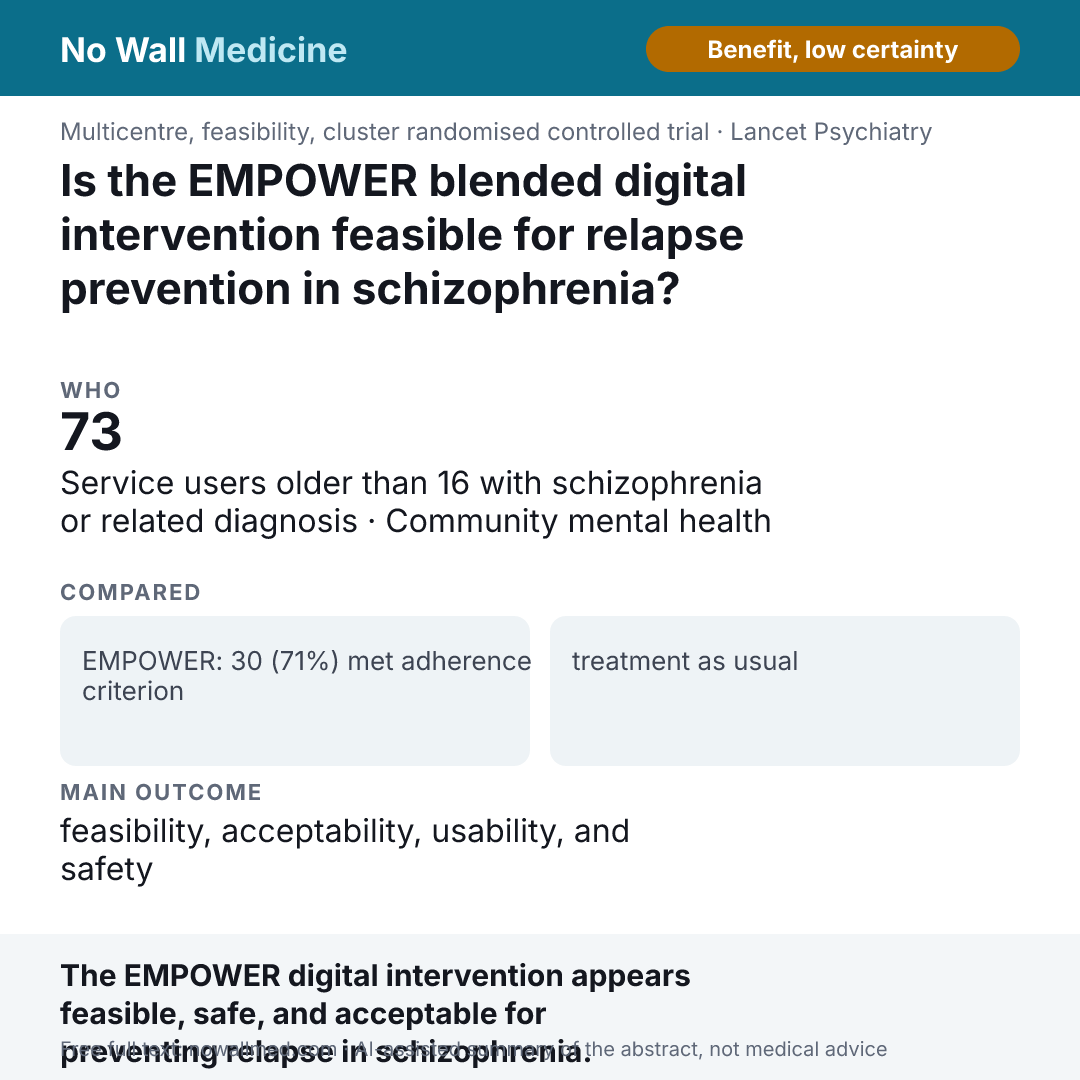
Multicentre, feasibility, cluster randomised controlled trialBenefit, low certainty
Is the EMPOWER blended digital intervention feasible for relapse prevention in schizophrenia?
Who
73
Service users older than 16 with schizophrenia or related diagnosis · Community mental health services in Glasgow and Melbourne
Compared
EMPOWER: 30 (71%) met adherence criterion
treatment as usual
Main outcome
feasibility, acceptability, usability, and safety
Result: mean difference -7·53 (95% CI -14·45 to 0·60) for fear of relapse
Bottom line: The EMPOWER digital intervention appears feasible, safe, and acceptable for preventing relapse in schizophrenia.
Funded by: UK NIHR and Australian National Health and Medical Research Council
Lancet Psychiatry · 2022-05-15 · Save PNG
Clinical question: Is the EMPOWER blended digital intervention feasible for relapse prevention in schizophrenia?
Why it matters: The quality of evidence regarding whether monitoring early warning signs can prevent relapse in people with schizophrenia is currently low.
Key points
- Researchers conducted a cluster randomized controlled trial involving 73 service users across eight community mental health services in Scotland and Australia.
- In the EMPOWER group, 71% of participants met the feasibility criterion of more than 33% adherence to daily monitoring with a median discontinuation time of 31.5 weeks.
- The EMPOWER group had 29 adverse events compared to 25 in the usual care group, including 13 app-related adverse events affecting 11 people.
Limitation the authors note: Participants, research assistants, and team members involved in delivering the intervention were not masked to treatment conditions.
Headline and key points written with AI from the paper’s abstract, with every number checked against it. Read the paper before relying on them.
Was this summary helpful?
Abstract
Background
Early warning signs monitoring by service users with schizophrenia has shown promise in preventing relapse but the quality of evidence is low. We aimed to establish the feasibility of undertaking a definitive randomised controlled trial to determine the effectiveness of a blended digital intervention for relapse prevention in schizophrenia. Methods
This multicentre, feasibility, cluster randomised controlled trial aimed to compare Early signs Monitoring to Prevent relapse in psychosis and prOmote Well-being, Engagement, and Recovery (EMPOWER) with treatment as usual in community mental health services (CMHS) in Glasgow and Melbourne. CMHS were the unit of randomisation, selected on the basis of those that probably had five or more care coordinators willing to participate. Participants were eligible if they were older than 16 years, had a schizophrenia or related diagnosis confirmed via case records, were able to provide informed consent, had contact with CMHS, and had had a relapse within the previous 2 years. Participants were randomised within stratified clusters to EMPOWER or to continue their usual approach to care. EMPOWER blended a smartphone for active monitoring of early warning signs with peer support to promote self-management and clinical triage to promote access to relapse prevention. Main outcomes were feasibility, acceptability, usability, and safety, which was assessed through face-to-face interviews. App usage was assessed via the smartphone and self-report. Primary end point was 12 months. Participants, research assistants and other team members involved in delivering the intervention were not masked to treatment conditions. Assessment of relapse was done by an independent adjudication panel masked to randomisation group. The study is registered at ISRCTN (99559262). Findings
We identified and randomised eight CMHS (six in Glasgow and two in Melbourne) comprising 47 care coordinators. We recruited 86 service users between Jan 19 and Aug 8, 2018; 73 were randomised (42 [58%] to EMPOWER and 31 [42%] to treatment as usual). There were 37 (51%) men and 36 (49%) women. At 12 months, main outcomes were collected for 32 (76%) of service users in the EMPOWER group and 30 (97%) of service users in the treatment as usual group. Of those randomised to EMPOWER, 30 (71%) met our a priori criterion of more than 33% adherence to daily monitoring that assumed feasibility. Median time to discontinuation of these participants was 31·5 weeks (SD 14·5). There were 29 adverse events in the EMPOWER group and 25 adverse events in the treatment as usual group. There were 13 app-related adverse events, affecting 11 people, one of which was serious. Fear of relapse was lower in the EMPOWER group than in the treatment as usual group at 12 months (mean difference -7·53 (95% CI -14·45 to 0·60; Cohen's d -0·53). Interpretation
A trial of digital technology to monitor early warning signs blended with peer support and clinical triage to detect and prevent relapse appears to be feasible, safe, and acceptable. A further main trial is merited. Funding
UK National Institute for Health Research Health Technology Assessment programme and the Australian National Health and Medical Research Council.
Abstract reproduced under the article’s CC BY NC ND licence.
Subject terms
Headline, design, result, key points, caveat and citation as plain text.
Cite this article
Gumley AI, Bradstreet S, Ainsworth J, et al. The EMPOWER blended digital intervention for relapse prevention in schizophrenia: a feasibility cluster randomised controlled trial in Scotland and Australia. Lancet Psychiatry. 2022. doi:10.1016/S2215-0366(22)00103-1
Spotted a mistake? Suggest a correction