Magrolimab added to venetoclax and azacitidine did not improve survival in untreated acute myeloid leukemia
The ENHANCE-3 study: venetoclax and azacitidine plus magrolimab or placebo for untreated AML unfit for intensive therapy
Phase 3 randomized trialNo clear difference
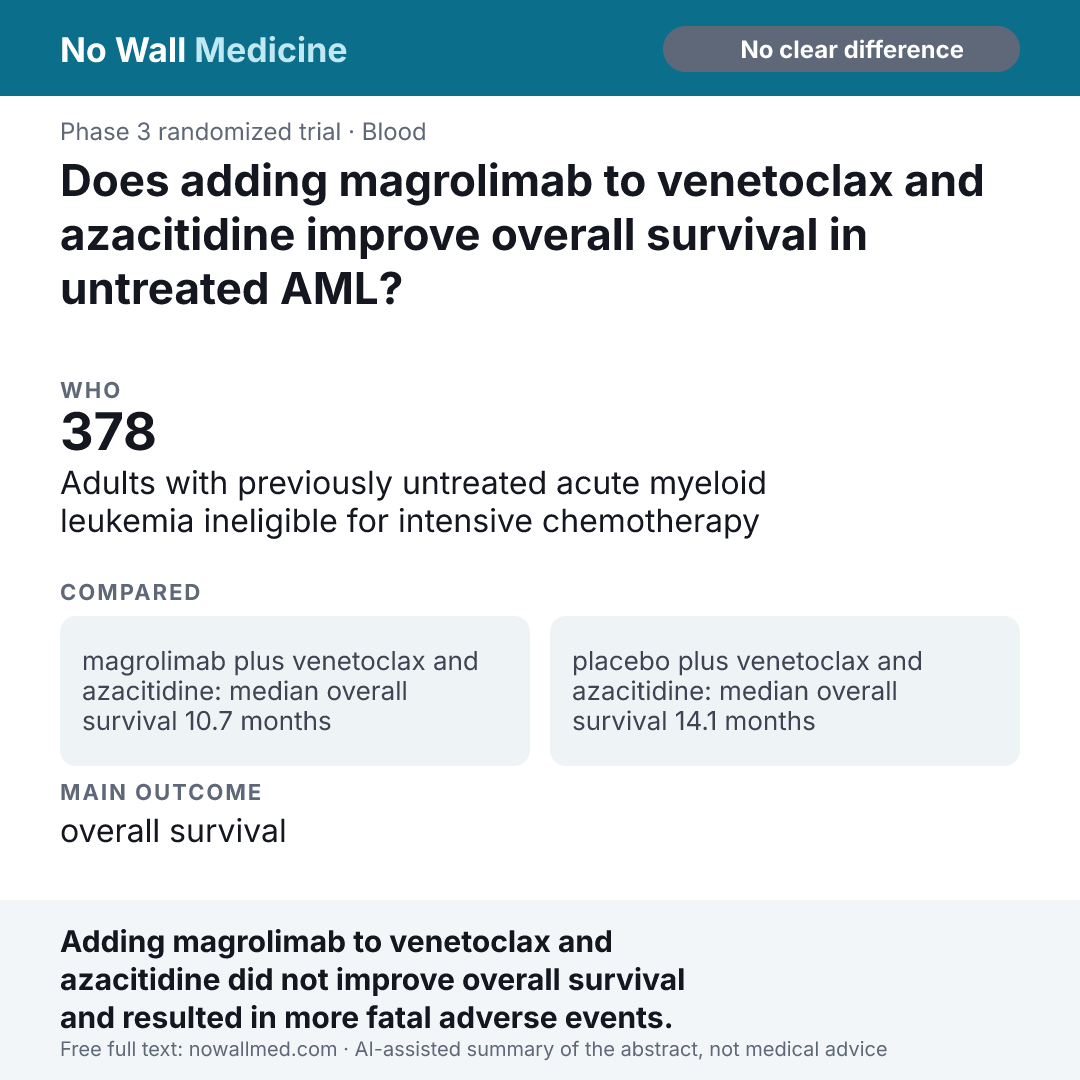
Does adding magrolimab to venetoclax and azacitidine improve overall survival in untreated AML?
Who
378
Adults with previously untreated acute myeloid leukemia ineligible for intensive chemotherapy
Compared
magrolimab plus venetoclax and azacitidine: median overall survival 10.7 months
placebo plus venetoclax and azacitidine: median overall survival 14.1 months
Main outcome
overall survival
Result: hazard ratio 1.178 (95% confidence interval 0.848-1.637)
Bottom line: Adding magrolimab to venetoclax and azacitidine did not improve overall survival and resulted in more fatal adverse events.
Limitation: The trial was stopped at a prespecified interim analysis owing to futility.
Blood · 2025-04-15 · Save PNG
Clinical question: Does adding magrolimab to venetoclax and azacitidine improve overall survival in untreated AML?
Why it matters: Patients with acute myeloid leukemia who are ineligible for intensive chemotherapy have limited treatment options.
Key points
- Researchers randomized 378 adults with untreated acute myeloid leukemia who could not receive intensive chemotherapy to receive magrolimab plus venetoclax and azacitidine or a placebo with the same drugs.
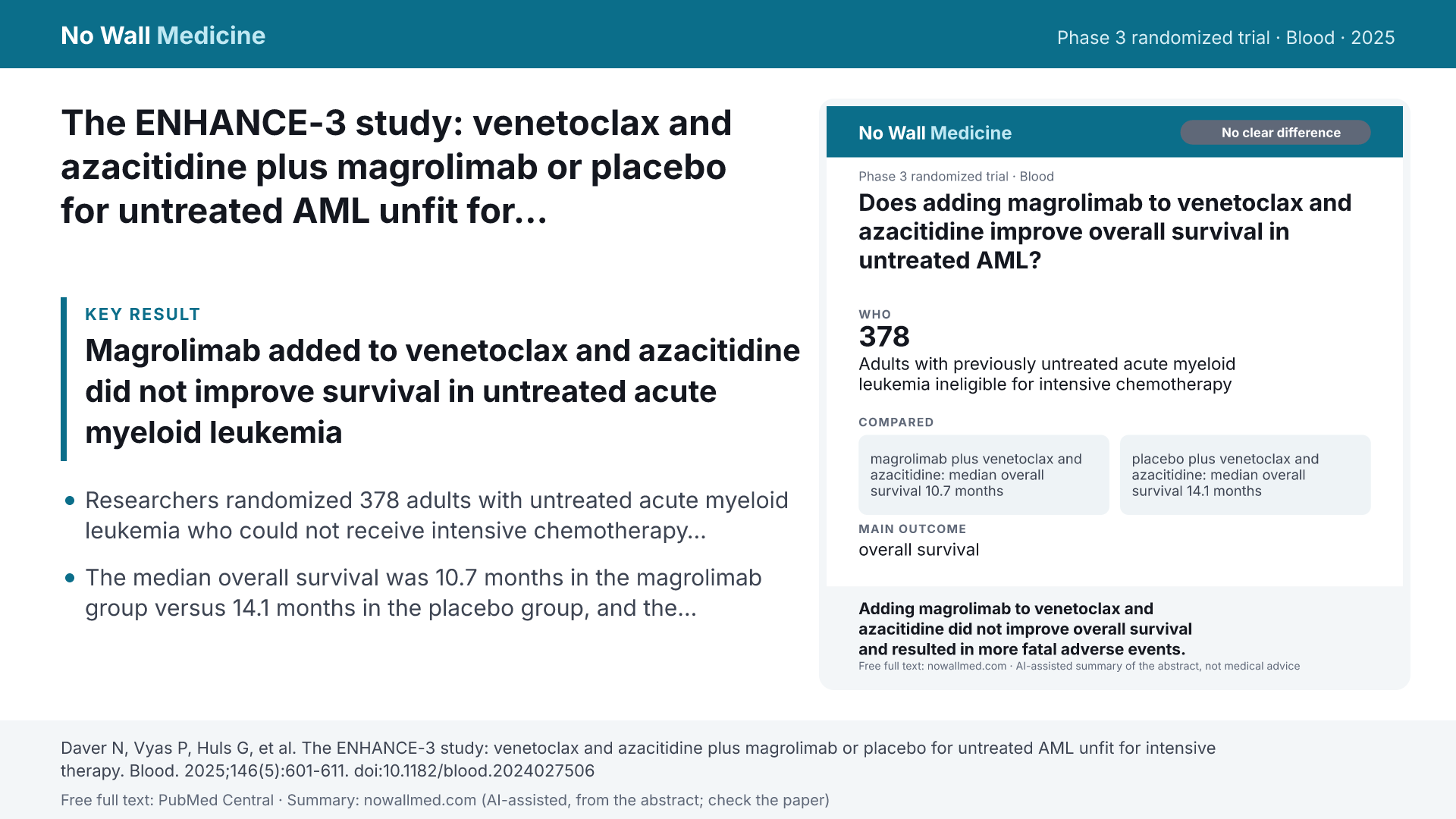
- The median overall survival was 10.7 months in the magrolimab group versus 14.1 months in the placebo group, and the trial was stopped early due to futility.
- The magrolimab group had more fatal adverse events at 19.0% compared to 11.4% in the placebo group, driven by grade 5 infections and respiratory events.
Limitation the authors note: The trial was stopped at a prespecified interim analysis owing to futility.
Headline and key points written with AI from the paper’s abstract, with every number checked against it. Read the paper before relying on them.
Was this summary helpful?
Abstract
Patients with acute myeloid leukemia (AML) ineligible for intensive chemotherapy (IC) have limited treatment options. The phase 3 ENHANCE-3 study aimed to determine whether magrolimab (magrolimab arm) was superior to placebo (control arm) when either was combined with venetoclax and azacitidine. Adults with previously untreated AML who were ineligible for IC were randomized to receive magrolimab (1 mg/kg on days 1 and 4, 15 mg/kg on day 8, 30 mg/kg on days 11 and 15, then weekly for 5 weeks, and then every 2 weeks) or placebo, venetoclax (100 mg on day 1, 200 mg on day 2, and 400 mg daily thereafter), and azacitidine (75 mg/m2 days 1-7) in 28-day cycles. The primary end point was overall survival (OS); key secondary end points included complete remission (CR) rate and safety. After randomization of 378 patients, the trial was stopped at a prespecified interim analysis owing to futility. At final analysis, with median follow-up of 7.6 months (magrolimab arm) vs 7.4 months (control arm), median OS was 10.7 vs 14.1 months (hazard ratio, 1.178; 95% confidence interval, 0.848-1.637). The CR rate within 6 cycles was 41.3% vs 46.0%. Addition of magrolimab to venetoclax and azacitidine resulted in more fatal adverse events (19.0% vs 11.4%), primarily driven by grade 5 infections (11.1% vs 6.5%) and respiratory events (2.6% vs 0%). There were similar incidences of any-grade infections, febrile neutropenia, and neutropenia between arms. These results highlight the difficulty in improving outcomes for patients with AML who were ineligible for IC. This trial was registered at www.clinicaltrials.gov as #NCT05079230.
Abstract reproduced under the article’s CC BY NC ND licence.
Subject terms
Headline, design, result, key points, caveat and citation as plain text.
Cite this article
Daver N, Vyas P, Huls G, et al. The ENHANCE-3 study: venetoclax and azacitidine plus magrolimab or placebo for untreated AML unfit for intensive therapy. Blood. 2025;146(5):601-611. doi:10.1182/blood.2024027506
Spotted a mistake? Suggest a correction