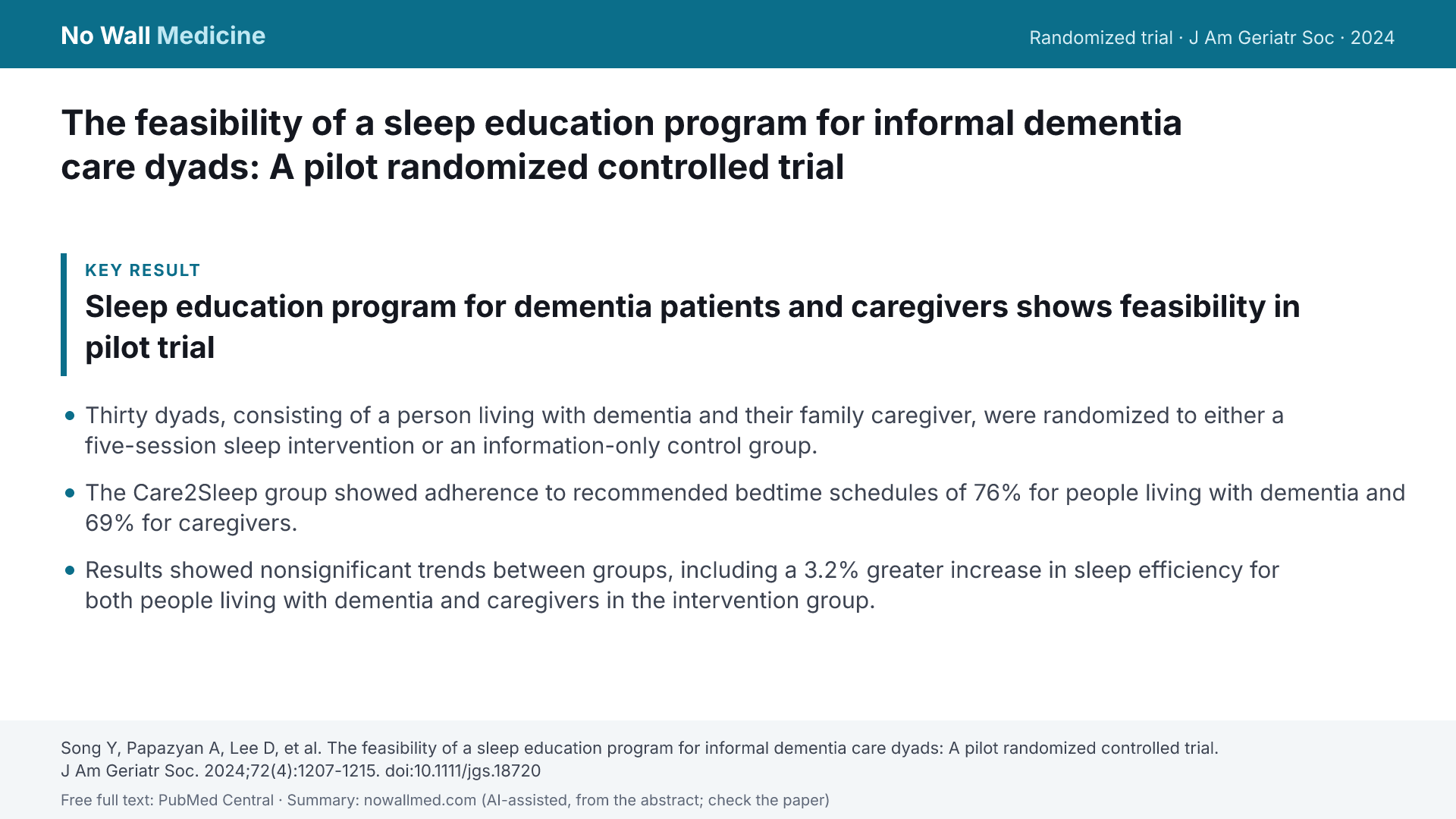
Sleep education program for dementia patients and caregivers shows feasibility in pilot trial
The feasibility of a sleep education program for informal dementia care dyads: A pilot randomized controlled trial
Key points
- Thirty dyads, consisting of a person living with dementia and their family caregiver, were randomized to either a five-session sleep intervention or an information-only control group.
- The Care2Sleep group showed adherence to recommended bedtime schedules of 76% for people living with dementia and 69% for caregivers.
- Results showed nonsignificant trends between groups, including a 3.2% greater increase in sleep efficiency for both people living with dementia and caregivers in the intervention group.
Headline and key points written with AI from the paper’s abstract, with every number checked against it. Read the paper before relying on them.
Was this summary helpful?
Subject terms
Headline, design, result, key points, caveat and citation as plain text.
Cite this article
Song Y, Papazyan A, Lee D, et al. The feasibility of a sleep education program for informal dementia care dyads: A pilot randomized controlled trial. J Am Geriatr Soc. 2024. doi:10.1111/jgs.18720
Spotted a mistake? Suggest a correction