The gap before real clinical application of imaging-based machine-learning and radiomic models for chemoradiation outcome prediction in esophageal cancer: a systematic review and meta-analysis
Systematic review and meta-analysisBenefit found
What is the clinical value of machine learning and radiomics for predicting esophageal cancer outcomes?
Who
Patients with esophageal cancer
Compared
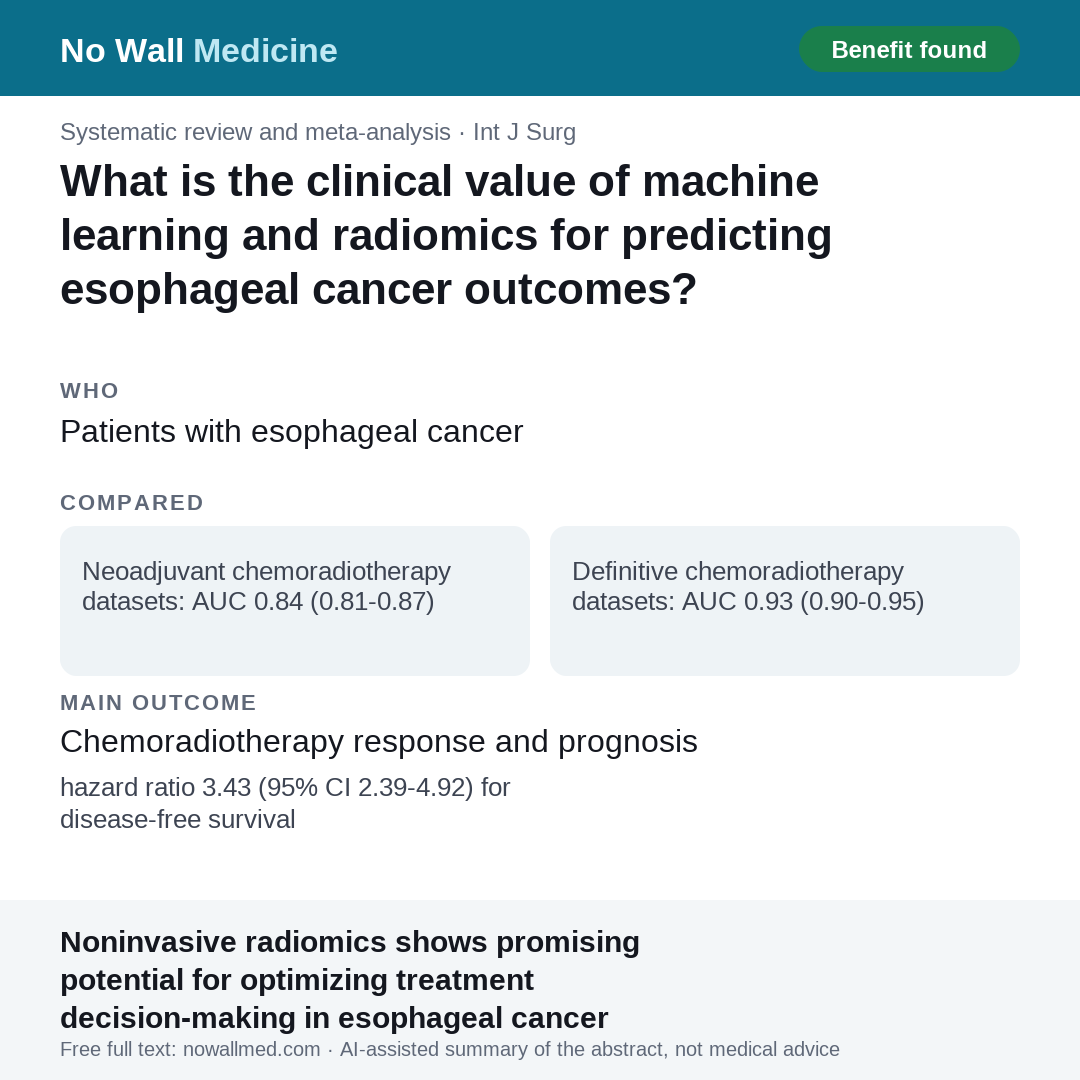
Neoadjuvant chemoradiotherapy datasets: AUC 0.84 (0.81-0.87)
Definitive chemoradiotherapy datasets: AUC 0.93 (0.90-0.95)
Main outcome
Chemoradiotherapy response and prognosis
Result: hazard ratio 3.43 (95% CI 2.39-4.92) for disease-free survival
Bottom line: Noninvasive radiomics shows promising potential for optimizing treatment decision-making in esophageal cancer patients.
Limitation: Need for improvements in reproducibility, clinical usefulness analysis, and model reporting.
Int J Surg · 2023-08-01Download image
Clinical question: What is the clinical value of machine learning and radiomics for predicting esophageal cancer outcomes?
Abstract
Background
Due to tumoral heterogeneity and the lack of robust biomarkers, the prediction of chemoradiotherapy response and prognosis in patients with esophageal cancer (EC) is challenging. The goal of this study was to assess the study quality and clinical value of machine learning and radiomic-based quantitative imaging studies for predicting the outcomes of EC patients after chemoradiotherapy. Materials and methods
PubMed, Embase, and Cochrane were searched for eligible articles. The methodological quality and risk of bias were evaluated using the Radiomics Quality Score (RQS), Image Biomarkers Standardization Initiative (IBSI) Guideline, and Transparent Reporting of a multivariable prediction model for Individual Prognosis or Diagnosis (TRIPOD) statement, as well as the modified Quality Assessment of Diagnostic Accuracy Studies (QUADAS-2) tool. A meta-analysis of the evidence focusing on predicting chemoradiotherapy response and outcome in EC patients was implemented. Results
Forty-six studies were eligible for qualitative synthesis. The mean RQS score was 9.07, with an adherence rate of 42.52%. The adherence rates of the TRIPOD and IBSI were 61.70 and 43.17%, respectively. Ultimately, 24 studies were included in the meta-analysis, of which 16 studies had a pooled sensitivity, specificity, and area under the curve (AUC) of 0.83 (0.76-0.89), 0.83 (0.79-0.86), and 0.84 (0.81-0.87) in neoadjuvant chemoradiotherapy datasets, as well as 0.84 (0.75-0.93), 0.89 (0.83-0.93), and 0.93 (0.90-0.95) in definitive chemoradiotherapy datasets, respectively. Moreover, radiomics could distinguish patients from the low-risk and high-risk groups with different disease-free survival (DFS) (pooled hazard ratio: 3.43, 95% CI 2.39-4.92) and overall survival (pooled hazard ratio: 2.49, 95% CI 1.91-3.25). The results of subgroup and regression analyses showed that some of the heterogeneity was explained by the combination with clinical factors, sample size, and usage of the deep learning (DL) signature. Conclusions
Noninvasive radiomics offers promising potential for optimizing treatment decision-making in EC patients. However, it is necessary to make scientific advancements in EC radiomics regarding reproducibility, clinical usefulness analysis, and open science categories. Improved model reporting of study objectives, blind assessment, and image processing steps are required to help promote real clinical applications of radiomics in EC research.
Topics
Cite this article
Yang Z, Gong J, Li J, Sun H, Pan Y, Zhao L. The gap before real clinical application of imaging-based machine-learning and radiomic models for chemoradiation outcome prediction in esophageal cancer: a systematic review and meta-analysis. Int J Surg. 2023. doi:10.1097/JS9.0000000000000441
Spotted a mistake? Suggest a correction
Top studies every Monday
The week’s key trials and guidelines in your specialties, plus any topics you follow. By email, free.
Get the weekly digest