Higher circulating 3-hydroxybutyrate levels were associated with lower risks of several cancer types
The genetically predicted causal associations between circulating 3-hydroxybutyrate levels and malignant neoplasms: A pan-cancer Mendelian randomization study
Mendelian randomization studyBenefit found
Do circulating 3-hydroxybutyrate levels have a causal effect on cancer risk?
Who
120 cancer phenotypes
Compared
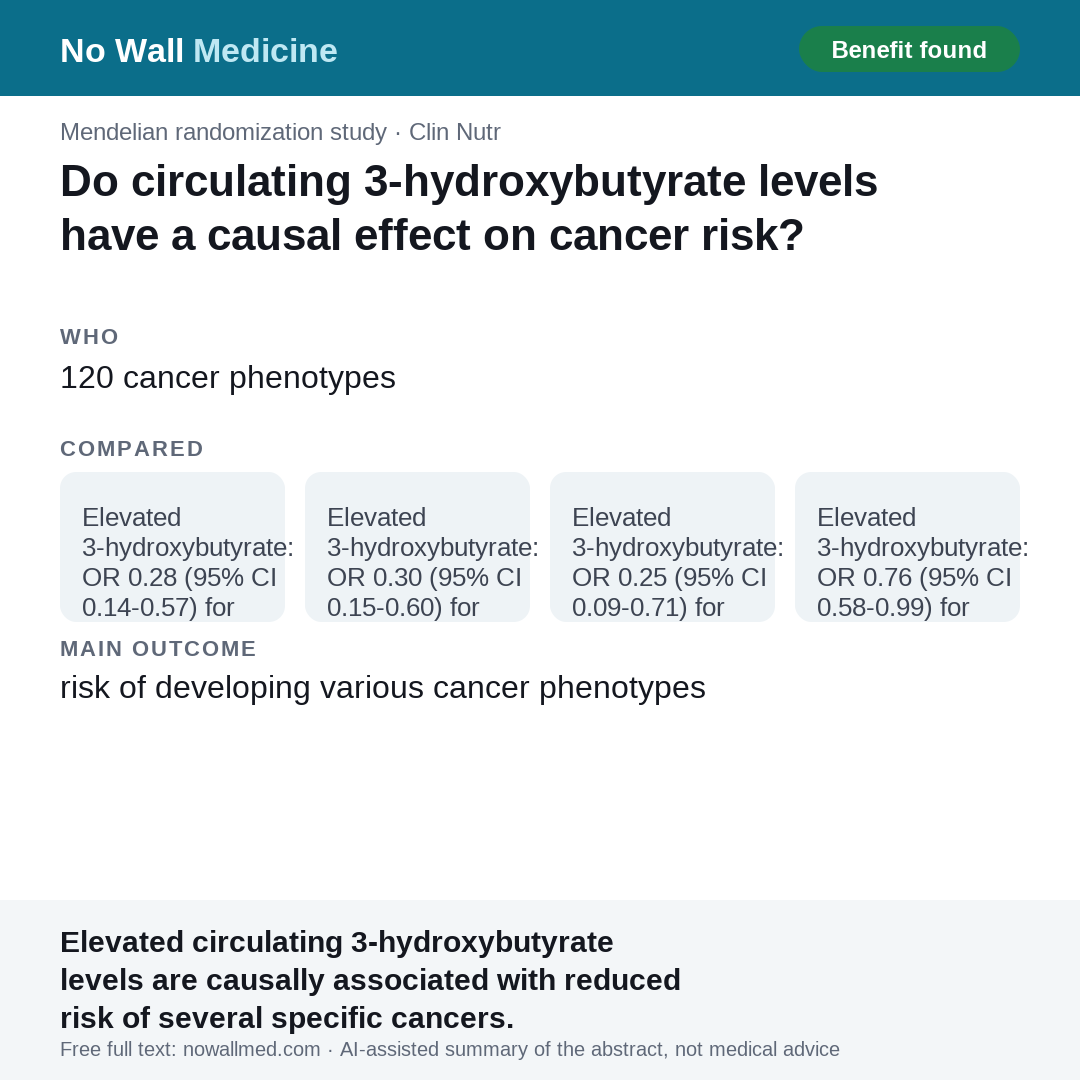
Elevated 3-hydroxybutyrate: OR 0.28 (95% CI 0.14-0.57) for diffuse large B-cell lymphoma
Elevated 3-hydroxybutyrate: OR 0.30 (95% CI 0.15-0.60) for biliary malignancies
Elevated 3-hydroxybutyrate: OR 0.25 (95% CI 0.09-0.71) for hepatocellular carcinoma
Elevated 3-hydroxybutyrate: OR 0.76 (95% CI 0.58-0.99) for primary lymphoid and hematopoietic malignancies
Main outcome
risk of developing various cancer phenotypes
Bottom line: Elevated circulating 3-hydroxybutyrate levels are causally associated with reduced risk of several specific cancers.
Clin Nutr · 2024-10-01Download image
Clinical question: Do circulating 3-hydroxybutyrate levels have a causal effect on cancer risk?
Why it matters: Previous studies have shown inconsistent results regarding how 3-hydroxybutyrate affects cancer risk.
Key points
- Researchers used Mendelian randomization to examine the link between 3-hydroxybutyrate, a ketone body, and 120 cancer phenotypes.
- Higher 3-hydroxybutyrate levels were associated with lower risks of diffuse large B-cell lymphoma (OR=0.28), biliary malignancies (OR=0.30), hepatocellular carcinoma (OR=0.25), and primary lymphoid and hematopoietic malignancies (OR=0.76).
- Increased liver fat was associated with lower 3-hydroxybutyrate levels and higher susceptibility to hepatocellular carcinoma (OR=13.9), biliary malignancies (OR=4.04), nasopharyngeal cancer (OR=3.26), and primary lymphoid and hematopoietic malignancies (OR=1.27).
Headline and key points written with AI from the paper’s abstract, with every number checked against it. Read the paper before relying on them.
Topics
Cite this article
Ye F, Huang Y, Zeng L, Li N, Hao L, Yue J. The genetically predicted causal associations between circulating 3-hydroxybutyrate levels and malignant neoplasms: A pan-cancer Mendelian randomization study. Clin Nutr. 2024. doi:10.1016/j.clnu.2024.09.044
Spotted a mistake? Suggest a correction
Top studies every Monday
The week’s key trials and guidelines in your specialties, plus any topics you follow. By email, free.
Get the weekly digest