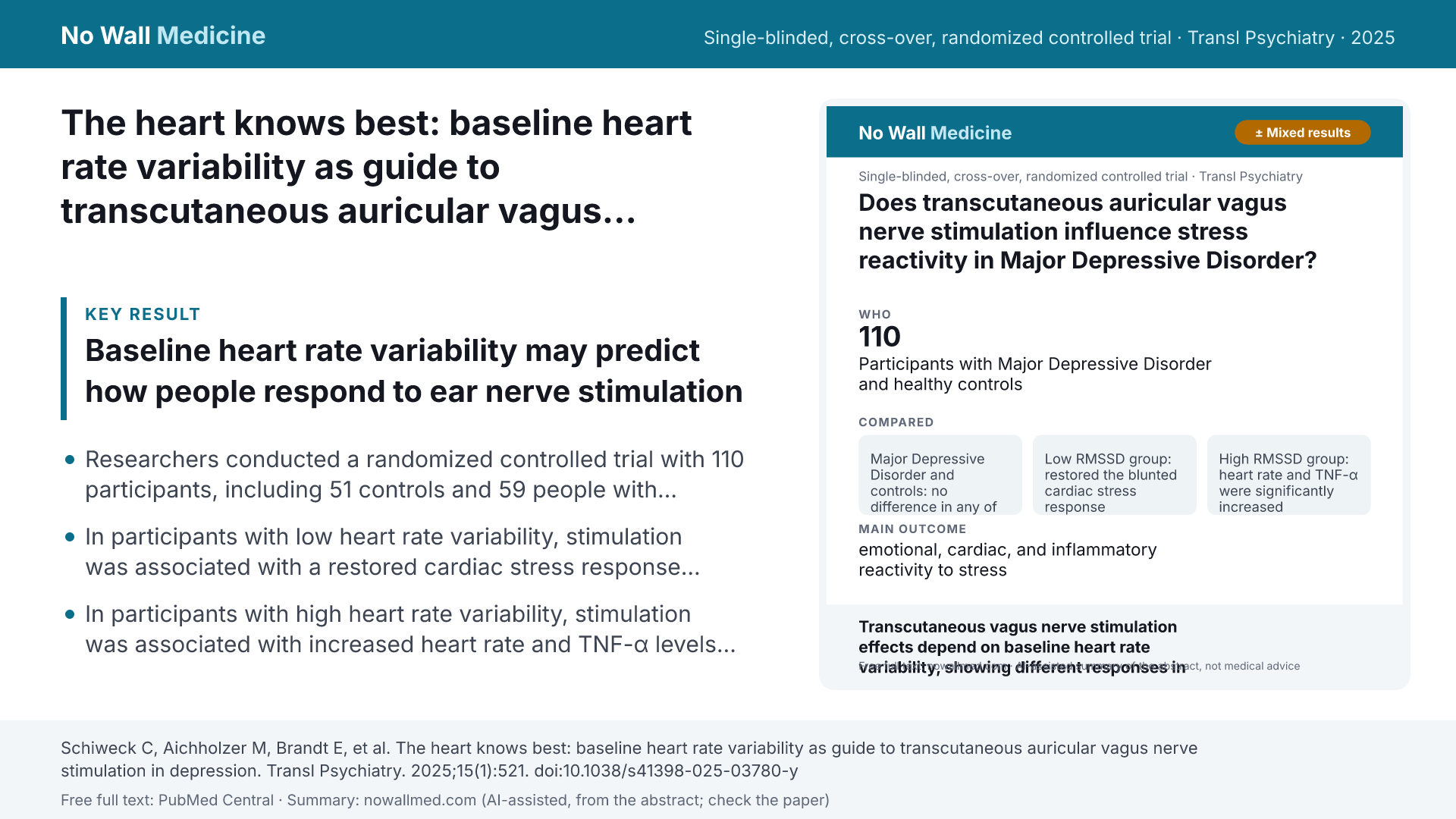
The heart knows best: baseline heart rate variability as guide to transcutaneous auricular vagus nerve stimulation in depression
Key result: Baseline heart rate variability may predict how people respond to ear nerve stimulation
Single-blinded, cross-over, randomized controlled trialMixed results
Does transcutaneous auricular vagus nerve stimulation influence stress reactivity in Major Depressive Disorder?
Who
110
Participants with Major Depressive Disorder and healthy controls
Compared
Major Depressive Disorder and controls: no difference in any of the outcomes
Low RMSSD group: restored the blunted cardiac stress response
High RMSSD group: heart rate and TNF-α were significantly increased
Main outcome
emotional, cardiac, and inflammatory reactivity to stress
Bottom line: Transcutaneous vagus nerve stimulation effects depend on baseline heart rate variability, showing different responses in low versus high RMSSD groups.
Transl Psychiatry · 2025-12-06
Key points
- Researchers conducted a randomized controlled trial with 110 participants, including 51 controls and 59 people with Major Depressive Disorder, to test ear nerve stimulation.
- In participants with low heart rate variability, stimulation was associated with a restored cardiac stress response and numerically decreased TNF-α levels.
- In participants with high heart rate variability, stimulation was associated with increased heart rate and TNF-α levels and decreased heart rate variability.
Discussion prompts
- Would these patients look like yours? Who was left out?
- Is the main outcome one that matters to patients?
- Is the difference large enough to change what you do?
Cite: Schiweck C, Aichholzer M, Brandt E, et al. The heart knows best: baseline heart rate variability as guide to transcutaneous auricular vagus nerve stimulation in depression. Transl Psychiatry. 2025;15(1):521. doi:10.1038/s41398-025-03780-y
Free full text: PubMed Central · Summary and visual abstract: nowallmed.com/a/the-heart-knows-best-baseline-heart-rate-variability-as-guide-to-47xov6/ (AI-assisted from the abstract; check the paper before relying on it).