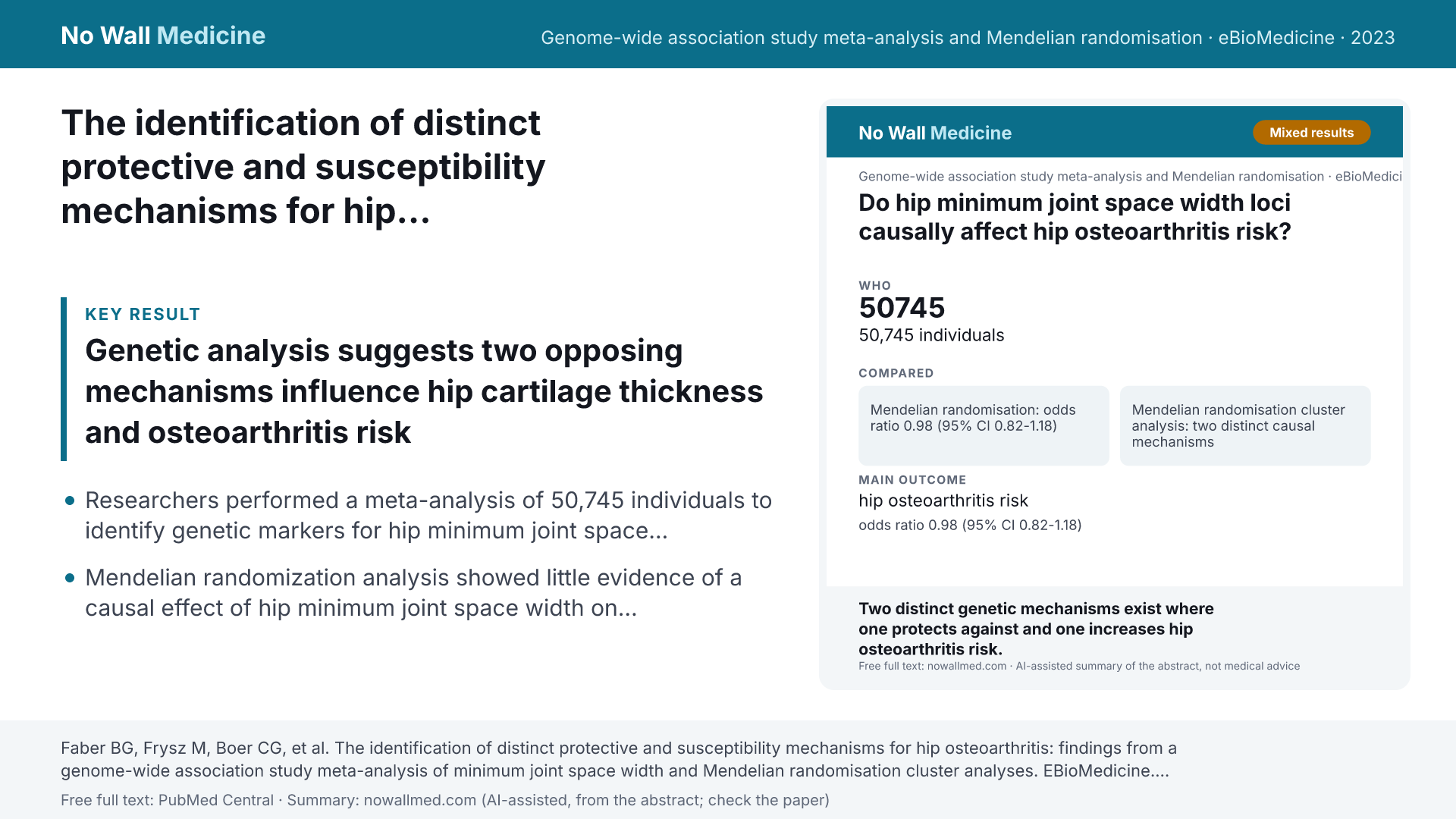
Genetic analysis suggests two opposing mechanisms influence hip cartilage thickness and osteoarthritis risk
The identification of distinct protective and susceptibility mechanisms for hip osteoarthritis: findings from a genome-wide association study meta-analysis of minimum joint space width and Mendelian randomisation cluster analyses
Genome-wide association study meta-analysis and Mendelian randomisationMixed results
Do hip minimum joint space width loci causally affect hip osteoarthritis risk?
Who
50745
50,745 individuals
Compared
Mendelian randomisation: odds ratio 0.98 (95% CI 0.82-1.18)
Mendelian randomisation cluster analysis: two distinct causal mechanisms
Main outcome
hip osteoarthritis risk
Result: odds ratio 0.98 (95% CI 0.82-1.18)
Bottom line: Two distinct genetic mechanisms exist where one protects against and one increases hip osteoarthritis risk.
Funded by: Medical Research Council and Wellcome Trust
eBioMedicine · 2023-08-22Download image
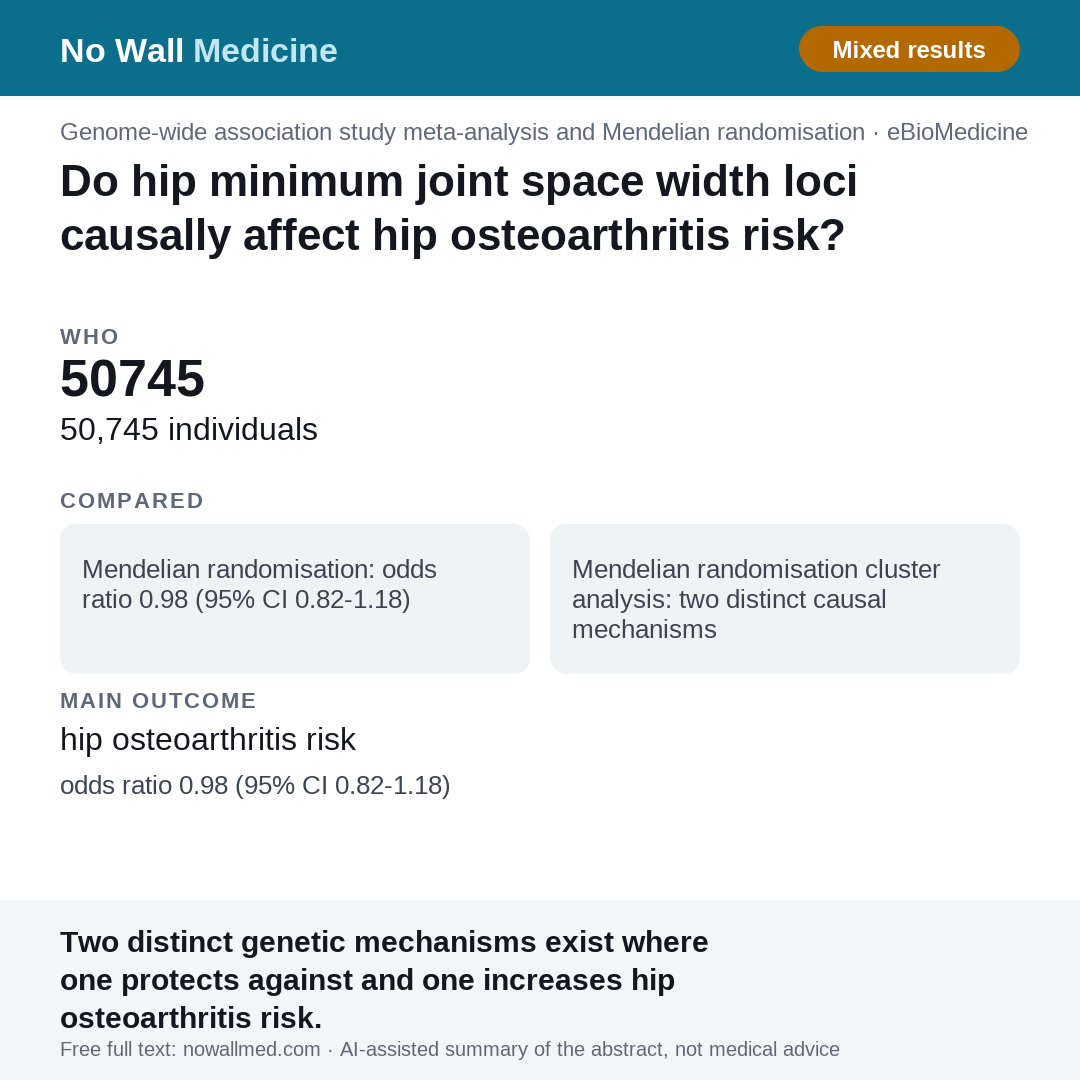
Clinical question: Do hip minimum joint space width loci causally affect hip osteoarthritis risk?
Why it matters: It is unknown which genetic factors determine hip cartilage thickness and whether these factors increase or decrease the risk of developing hip osteoarthritis.
Key points
- Researchers performed a meta-analysis of 50,745 individuals to identify genetic markers for hip minimum joint space width, which serves as a proxy for cartilage thickness.
- Mendelian randomization analysis showed little evidence of a causal effect of hip minimum joint space width on hip osteoarthritis, with an odds ratio of 0.98 (95% CI 0.82-1.18).
- Cluster analysis suggested one group of genetic markers is protective, while another group increases hip osteoarthritis risk and is positively associated with height.
Headline and key points written with AI from the paper’s abstract, with every number checked against it. Read the paper before relying on them.
Was this summary helpful?
Subject terms
Cite this article
Faber BG, Frysz M, Boer CG, Evans DS, Ebsim R, Flynn KA. The identification of distinct protective and susceptibility mechanisms for hip osteoarthritis: findings from a genome-wide association study meta-analysis of minimum joint space width and Mendelian randomisation cluster analyses. eBioMedicine. 2023. doi:10.1016/j.ebiom.2023.104759
Spotted a mistake? Suggest a correction
Top studies every Monday
The week’s key trials and guidelines in your specialties, plus any topics you follow. By email, free.
Get the weekly digest