Multi-component hospital avoidance programme showed no statistically significant effects in residential aged care homes
The impact of a multi-component hospital avoidance programme in residential aged care homes: a stepped-wedge cluster randomised trial
Prospective stepped-wedge cluster randomised trialNo clear difference
Does a multi-component hospital avoidance programme reduce hospital bed days in residential aged care homes?
Who
Nursing staff, personal care workers, and residents in residential aged care homes · Eleven residential aged care homes in Queensland, Australia
Compared
Usual care
Intervention: 27% relative increase in hospital bed days
Main outcome
Number of hospital bed days per 100 resident days
Result: Estimate, 95% CI: 1.13, 0.93-1.74
Bottom line: The multi-component intervention did not significantly reduce hospital bed days in residential aged care homes.
Age Ageing · 2025-10-06Download image
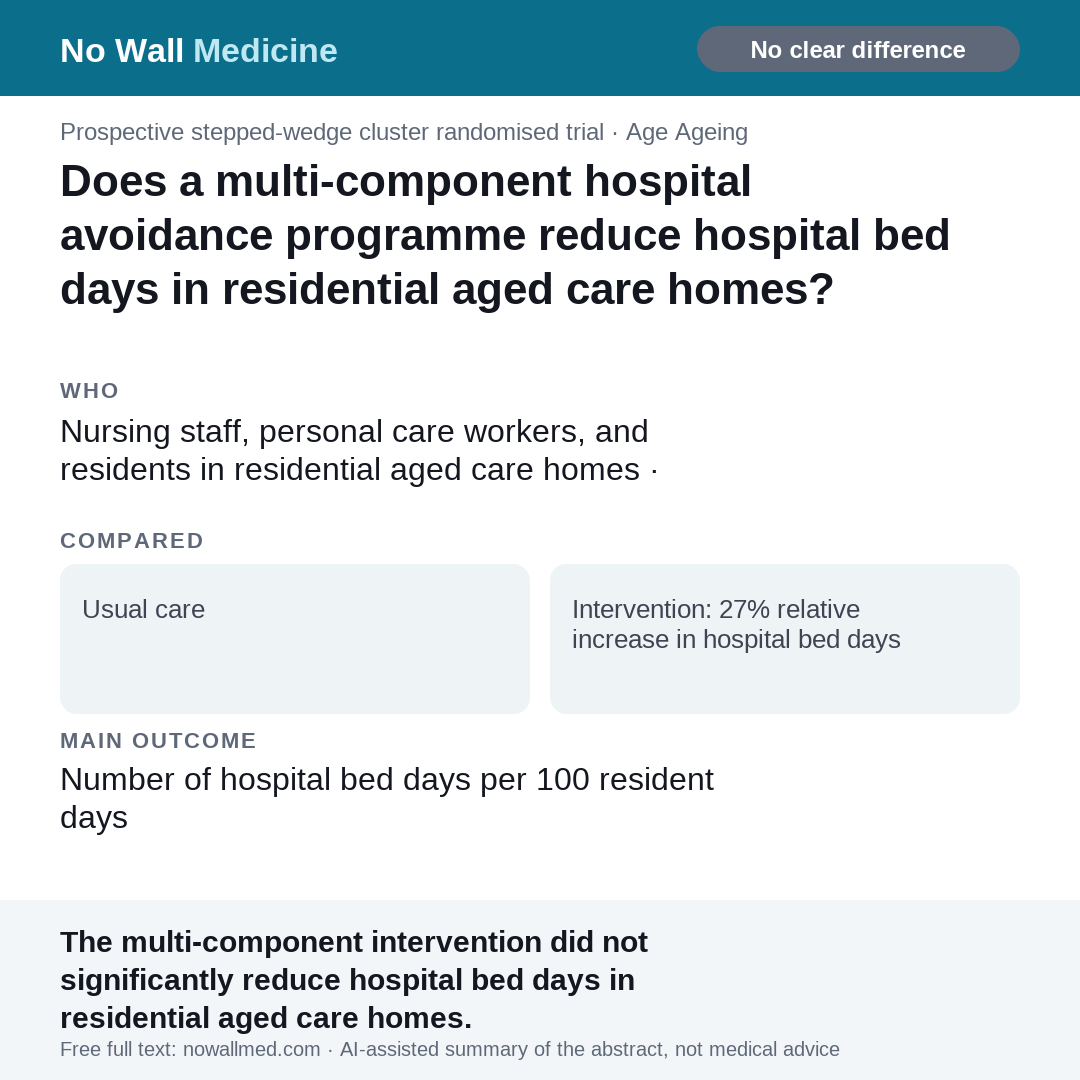
Clinical question: Does a multi-component hospital avoidance programme reduce hospital bed days in residential aged care homes?
Why it matters: It is unclear if a multi-component intervention involving training, equipment, and decision support tools can reduce hospital bed days for residents in aged care homes.
Key points
- Researchers conducted a stepped-wedge cluster randomized trial involving eleven residential aged care homes in Queensland, Australia, targeting nursing and personal care staff.
- The intervention was not linked to statistically significant changes in hospital bed days, emergency department transfers, or hospital admissions.
- Exposure to the intervention was associated with a 27% relative increase in hospital bed days per 100 resident days and a 10% increase in hospital admissions.
Headline and key points written with AI from the paper’s abstract, with every number checked against it. Read the paper before relying on them.
Topics
Cite this article
White NM, Lee XJ, Allen MJ, Graves N, Harvey G, Shield C. The impact of a multi-component hospital avoidance programme in residential aged care homes: a stepped-wedge cluster randomised trial. Age Ageing. 2025. doi:10.1093/ageing/afaf275
Spotted a mistake? Suggest a correction