Structured feedback with a wearable tracker increased daily step counts in hemodialysis patients
The Impact of a Wearable Activity Tracker and Structured Feedback Program on Physical Activity in Hemodialysis Patients: The Step4Life Pilot Randomized Controlled Trial
Randomized controlled trialBenefit found
Does structured feedback with a wearable tracker increase physical activity in hemodialysis patients?
Who
55
Hemodialysis patients with end-stage kidney disease · Single academic hemodialysis unit
Compared
Wearable activity tracker plus structured feedback: Δ 920 [±580 SD] steps
Wearable activity tracker alone: Δ 281 [±186 SD] steps
Main outcome
Absolute change in daily step count averaged per week
Result: between-group difference Δ 639 [±538 SD] steps; P<0.05
Bottom line: Structured feedback with a wearable tracker led to a greater daily step count in hemodialysis patients over 12 weeks.
Limitation: Single-center study and small sample size.
Funded by: Satellite Healthcare and National Institute for Diabetes and Digestive and Kidney Diseases
Am J Kidney Dis · 2023-02-17Download image
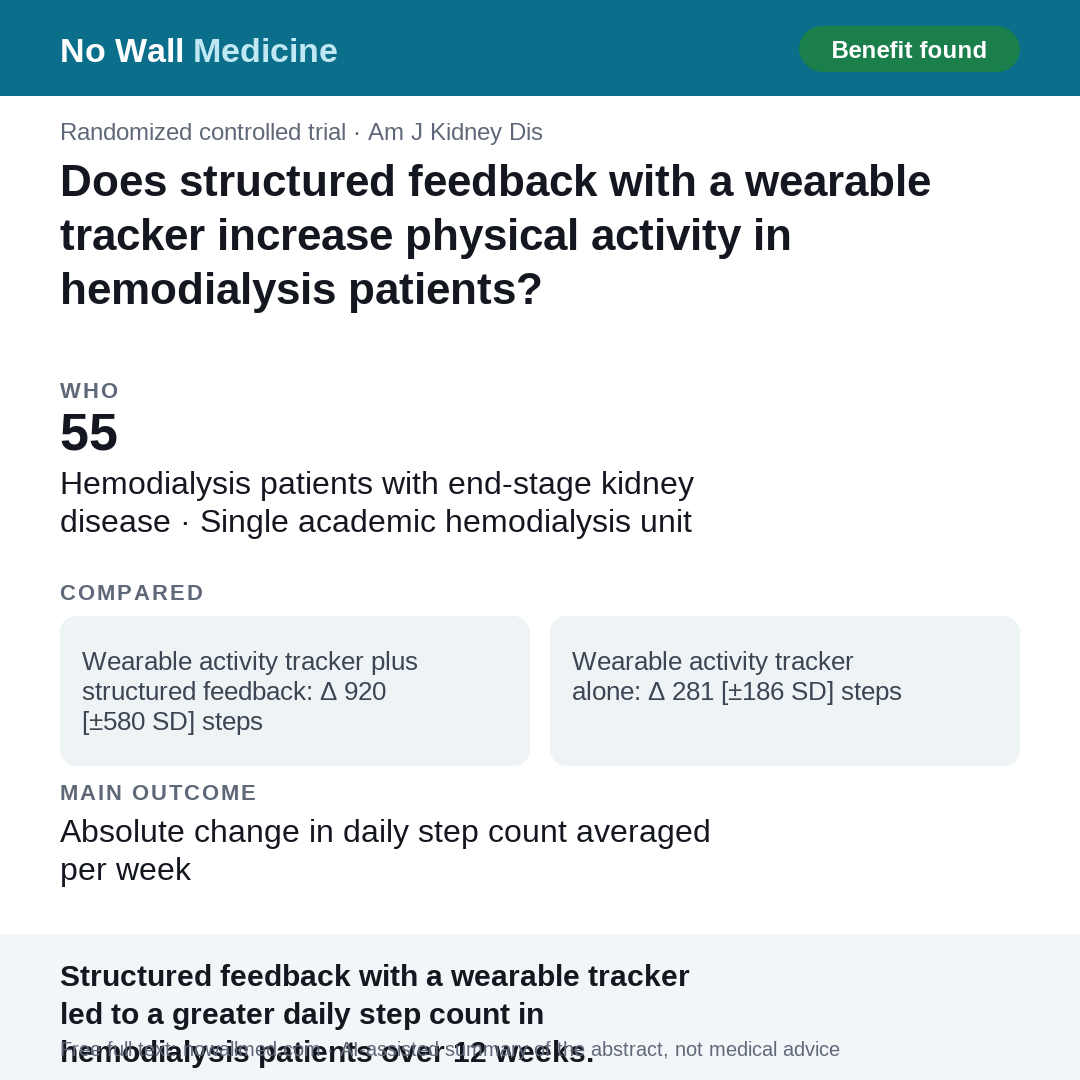
Clinical question: Does structured feedback with a wearable tracker increase physical activity in hemodialysis patients?
Why it matters: It is unknown if adding structured feedback coaching to a wearable activity tracker can effectively increase physical activity in people with end-stage kidney disease.
Key points
- Researchers studied 55 participants with end-stage kidney disease receiving hemodialysis, comparing a wearable tracker with weekly coaching to a wearable tracker alone.
- The structured feedback group had a larger change in daily step count at 12 weeks compared to the tracker-only group (Δ 920 [±580 SD] versus Δ 281 [±186 SD] steps).
- The difference between the two groups was Δ 639 [±538 SD] steps with a P<0.05.
Limitation the authors note: The authors state this was a single-center study with a small sample size.
Headline and key points written with AI from the paper’s abstract, with every number checked against it. Read the paper before relying on them.
Was this summary helpful?
Subject terms
Cite this article
Malhotra R, Rahimi S, Agarwal U, Katz R, Kumar U, Garimella PS. The Impact of a Wearable Activity Tracker and Structured Feedback Program on Physical Activity in Hemodialysis Patients: The Step4Life Pilot Randomized Controlled Trial. Am J Kidney Dis. 2023. doi:10.1053/j.ajkd.2022.12.011
Spotted a mistake? Suggest a correction
Top studies every Monday
The week’s key trials and guidelines in your specialties, plus any topics you follow. By email, free.
Get the weekly digest