The impact of bimanual reach training with augmented position sense feedback on post-stroke upper limb somatosensory and motor impairment
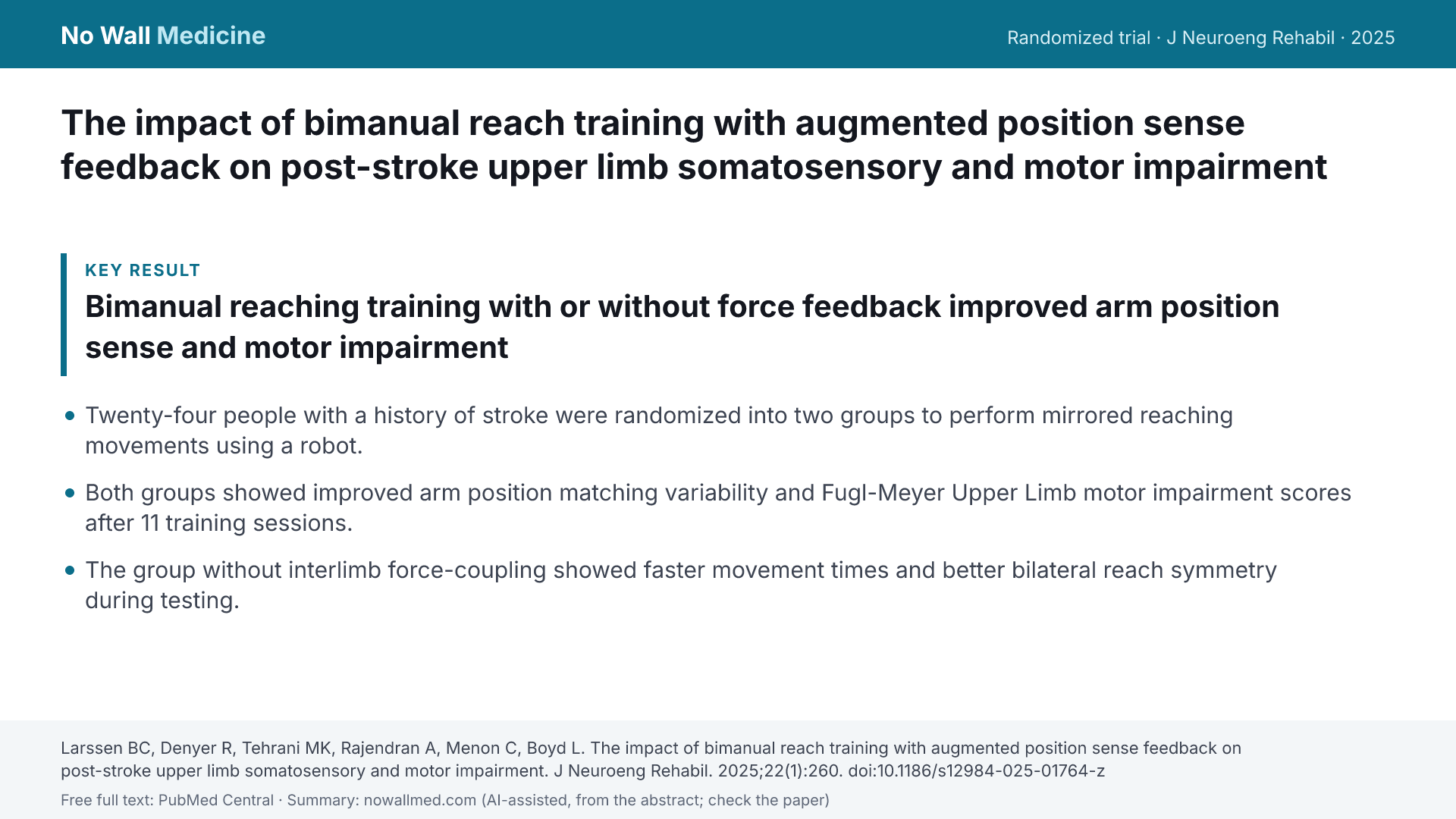
Key result: Bimanual reaching training with or without force feedback improved arm position sense and motor impairment
Key points
- Twenty-four people with a history of stroke were randomized into two groups to perform mirrored reaching movements using a robot.
- Both groups showed improved arm position matching variability and Fugl-Meyer Upper Limb motor impairment scores after 11 training sessions.
- The group without interlimb force-coupling showed faster movement times and better bilateral reach symmetry during testing.
Why it matters: Few clinical interventions specifically target the loss of arm position sense, which is a common sensory impairment after a stroke.
Discussion prompts
- Would these patients look like yours? Who was left out?
- Is the main outcome one that matters to patients?
- Is the difference large enough to change what you do?
Cite: Larssen BC, Denyer R, Tehrani MK, Rajendran A, Menon C, Boyd L. The impact of bimanual reach training with augmented position sense feedback on post-stroke upper limb somatosensory and motor impairment. J Neuroeng Rehabil. 2025;22(1):260. doi:10.1186/s12984-025-01764-z
Free full text: PubMed Central · Summary and visual abstract: nowallmed.com/a/the-impact-of-bimanual-reach-training-with-augmented-position-sense-siut5m/ (AI-assisted from the abstract; check the paper before relying on it).