Peer and family messages and AI-powered chatbots increased intention to use health chatbots
The Impact of Chatbot Type and Normative Messaging on Chatbot Usage Intention Based on the Health Technology Acceptance Model: Randomized Controlled Trial
Randomized controlled trialBenefit found
Does chatbot type affect usage intention?
Who
1000
US adults · US
Compared
AI-powered: higher usage intention
rule-based: lower usage intention
Main outcome
usage intention
Bottom line: AI-powered chatbots increase usage intention
J Med Internet Res · 2026-09-15Download image
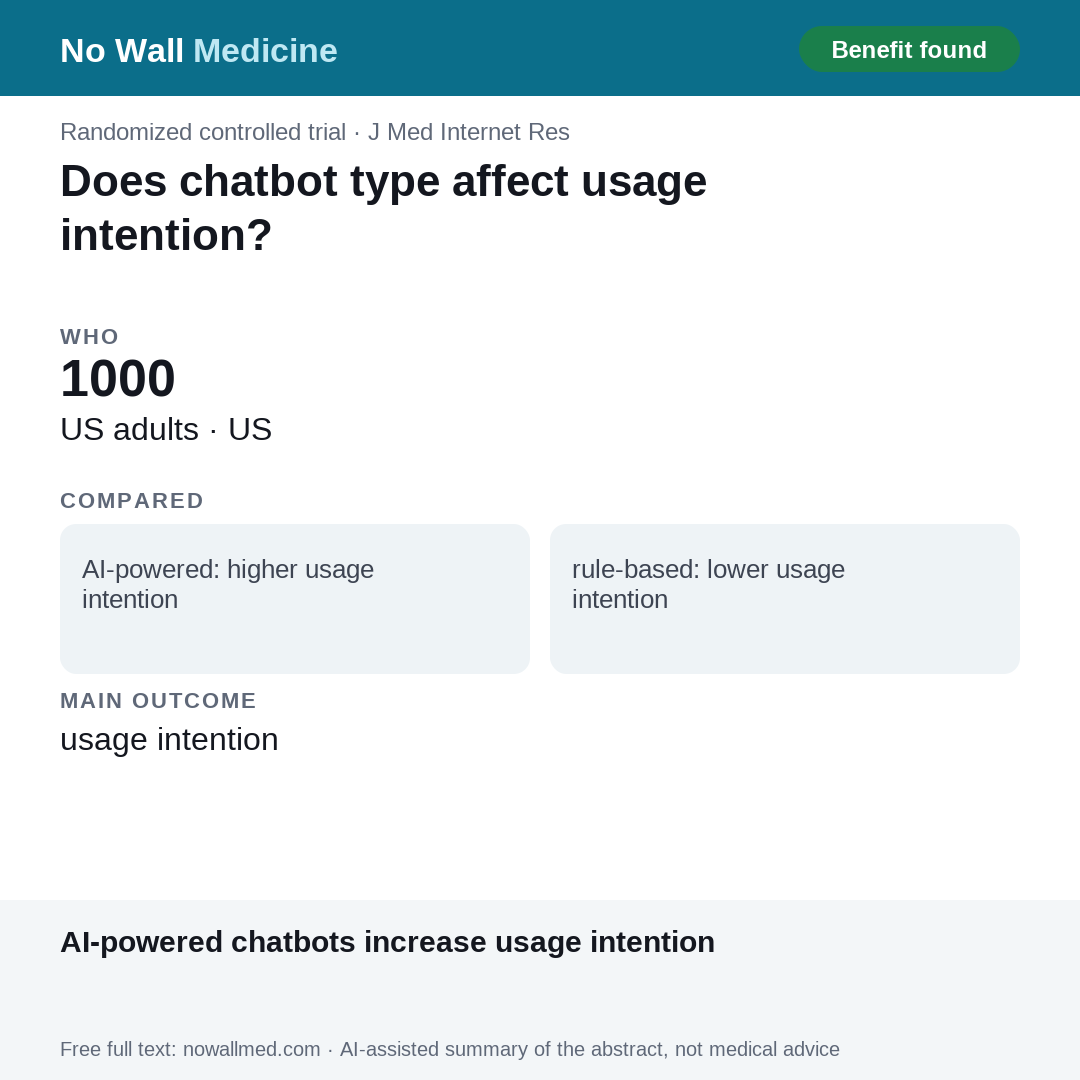
Clinical question: Does chatbot type affect usage intention?
Why it matters: Existing models do not fully integrate technology acceptance factors with health motivation factors relevant to digital health use.
Key points
- Researchers conducted an online experiment with 1000 US adults to compare different message types and chatbot types in a cancer prevention scenario.
- Peer-oriented and family-oriented messages led to higher usage intention than expert-oriented messages, and AI-powered chatbots showed higher usage intention than rule-based chatbots.
- The model explained 50.8% of the variance in usage intention, with trust and perceived benefits being positive predictors and privacy concerns being a negative predictor.
Headline and key points written with AI from the paper’s abstract, with every number checked against it. Read the paper before relying on them.
Topics
Cite this article
Liao Y, Madeo A, Allen CG, Frey MK, Maxwell W, Schlechter C. The Impact of Chatbot Type and Normative Messaging on Chatbot Usage Intention Based on the Health Technology Acceptance Model: Randomized Controlled Trial. J Med Internet Res. 2026. doi:10.2196/97773
Spotted a mistake? Suggest a correction